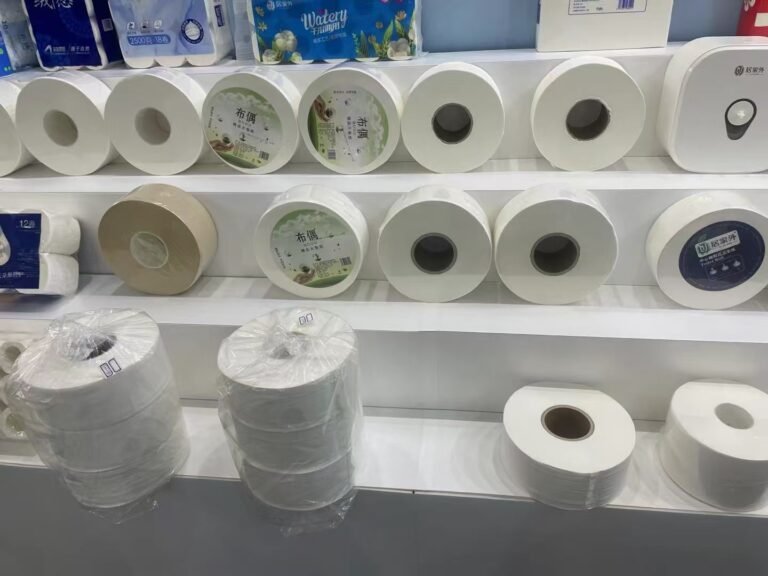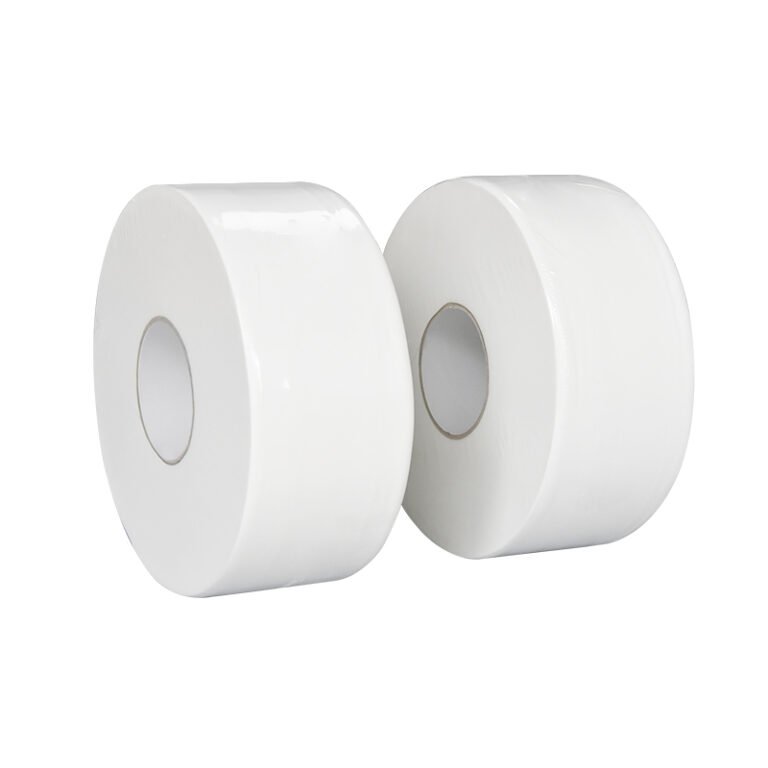
Jumbo roll tissue is bought by facilities that cannot afford to run out. An office building, an airport concourse, a hospital wing or a factory floor generates washroom traffic at a volume where a retail-format roll has to be replaced constantly, and where every dispenser change is paid for in labour rather than in paper. Jumbo roll tissue addresses that with high-capacity, long-meterage rolls loaded into a wall-mounted dispenser that maintenance staff open on a schedule.
It is also one of the easiest products in the tissue category to buy badly, for a specific structural reason: jumbo rolls are quoted by the roll, while the quantity that determines value is the length of paper on the core. That length is the figure least likely to appear prominently on a quotation and the easiest to vary after the order is signed. This guide covers the size range, the meterage question, how dispenser fit is actually resolved, and what to verify when the container arrives.
What Jumbo Roll Tissue Actually Is
Jumbo roll tissue, usually abbreviated JRT and sometimes called jumbo tissue or large-format bathroom tissue, is a high-capacity toilet tissue roll wound on a wide core for use in a commercial wall dispenser rather than on a domestic spindle. It serves high-frequency washrooms, and the format exists to lengthen the interval between dispenser changes.
How the web is presented to the user depends on the dispenser and on the order specification. Some commercial dispensers cut the web at a blade; others dispense a perforated length that the user tears off. Perforation is therefore a specification field, not an assumption — whether the roll is perforated, and at what pitch, has to be agreed with the factory and matched to the hardware already on your wall. Buyers who leave it out of the brief frequently discover at installation that the roll they ordered does not present the way their dispenser expects.
The service conditions are what drive the rest of the construction. A jumbo web is pulled at speed, at an angle, by users who are not being careful with it, and it has to unwind cleanly from a large diameter across a long service interval without telescoping off the core. This is why the JRT line is built on high-tensile long-fibre webs rather than on the softer, lower-strength construction that suits a premium retail bathroom roll.
Top Source Paper produces jumbo toilet paper at its virgin wood pulp tissue factory in Mancheng District, Baoding, in northern China’s tissue manufacturing cluster. The JRT line runs 2-ply and 3-ply in roll diameters from 18 cm to 28 cm, built for high-capacity long-meterage service in commercial washrooms, with long-fibre reinforcement for tensile strength. The rolls are supplied into office buildings, airports, hospitals and factories — the facility types where washroom traffic is continuous rather than intermittent.
JRT Size Range and Construction
Roll Diameter: 18 cm to 28 cm
Diameter is the headline dimension on a jumbo roll and the one that decides whether the roll physically closes inside your dispenser cabinet. The production range covers 18 cm through to 28 cm.
Where inside that range you should order is not a question the factory can answer for you, because it depends on two things only you know: the maximum roll diameter your installed cabinets will accept, and your washroom service interval. Measure the cabinet limit from the hardware itself or from a roll that currently fits, decide the longest service interval your cleaning contract allows, and then confirm the specific diameter with the factory against those two constraints. Ordering at the top of the range because it looks like better value is how buyers end up with rolls that will not fit the wall.
Ply: 2-Ply and 3-Ply
Jumbo rolls are produced in 2-ply and 3-ply. The choice between them is a positioning and consumption decision rather than a quality decision. Two-ply is the standard commercial construction: strong enough for a firm pull, opaque enough that users do not take extra length to compensate, and lighter per metre, which matters when you are filling containers. Three-ply is specified where the washroom is part of a guest or visitor experience and the softer hand feel is worth the additional fibre.
Whichever ply you choose, the wider ply logic applies — basis weight and embossing interact with ply count, and a ply number on its own does not define the sheet. That interaction is set out in the 1-ply versus 2-ply versus 3-ply comparison.
Basis Weight and Fibre Furnish
All Top Source Paper products are built on 100% virgin wood pulp with a balanced long and short fibre ratio, and no recycled or reprocessed pulp is added at any point. Across the whole range, basis weight capability spans 13 to 45 GSM; the figure for a specific JRT construction is agreed per order and confirmed on the certificate of analysis, together with a statement of whether it is quoted per ply or for the finished sheet.
Fibre furnish matters more in jumbo than in most other tissue formats because of the load the web carries. Long fibre is what delivers the tensile strength that stops the web snapping mid-pull, and it is what keeps the sheet intact when it gets wet. Short-fibre and recycled furnish is cheaper per tonne and is widely used in jumbo rolls sold purely on price, but it produces a web that loses strength when wet and sheds fibre during wiping. Those are the two complaints we hear most often from facility buyers, because both leave residue on the floor, on the dispenser and on the user’s hands.

Meterage: Buy Metres, Not Rolls
The central buying rule for jumbo roll tissue is to specify and contract the meterage per roll, then verify it on arrival. Roll count tells you how many units are in the container. Meterage tells you how much paper you bought.
A quotation listing only ply, diameter and rolls per carton leaves the length of paper on each core unstated. Diameter cannot substitute for it, because diameter is a function of both how much paper is wound and how tightly it was wound. Rewinding tension is the variable that separates two rolls of identical outside dimension carrying different lengths of paper, and both look correct on a pallet.
What High-Yield Meterage Control Actually Governs
High-Yield Meterage Control is the production discipline that addresses this directly. It governs two things: rewinding tightness, and slit meterage. Its stated objective is to eliminate basis-weight misstatement and short-meterage shrinkage.
Translated into what a buyer can use, that means three things are worth asking for by name. First, the contracted meterage per roll, written on the proforma invoice rather than confirmed verbally. Second, the rewinding tension standard that meterage figure assumes, since the same length wound at a different tension produces a different roll diameter and a different feel in the dispenser. Third, the in-process records for your order. The second stage of the three-stage QC process is an in-process inspection during converting that covers basis weight, tension and the perforation line — that is the stage where a meterage or tension drift first becomes visible, and it is the record set a buyer is entitled to request rather than the finished-goods summary alone.
A batch that is short on meterage is caught here or it is caught by you at goods-received. There is no third place.
Converting Quotations to a Comparable Basis
Meterage is also what makes supplier comparison possible. Convert every quotation to cost per thousand metres before comparing them. Two quotations that look close per roll routinely separate by a wide margin per metre, and the cheaper-looking roll is often the shorter one.
The same conversion applies on the consumption side. A facility’s washroom paper spend is a function of metres consumed per day, so the replenishment schedule should be built from metres and from your own measured daily consumption — not from cartons, and not from another site’s rule of thumb. Measure consumption at one representative washroom over a full week, scale it across the estate, and that figure, not the unit price, is what decides which quotation is actually cheaper.
Dispenser Fit: How It Is Actually Resolved
Jumbo rolls only work if they load into the hardware already fixed to the wall. Dispenser compatibility sits alongside wet tensile strength and tiered bulk pricing among the criteria facility suppliers and janitorial distributors actually buy on — and it is the criterion that is hardest to fix once the container has landed.
Three dimensions have to match, and all three are measured from your own installed hardware rather than copied from a supplier’s data sheet.
- Roll diameter against the cabinet. The dispenser has a maximum diameter it will close around. Measure that limit, or measure a roll that currently fits, and specify inside it. The 18 cm to 28 cm production range spans both compact and high-capacity cabinets, but the range does not help you if you order the wrong end of it.
- Core inner diameter against the spindle. Jumbo dispensers hold the roll on a spindle or centre post, and the core has to clear it. Core inner diameter varies by dispenser brand and by order, so measure your own spindle and write the value into the specification. Top Source Paper customises core inner diameter to the buyer’s dimension, which makes this a solved problem provided the measurement reaches the factory in the brief. If you are switching supplier while leaving dispensers in place, this is the first dimension to check when a roll will not mount.
- Roll width against the dispensing path. The web width has to align with the dispenser throat and, where the unit cuts, with the cutting edge. A roll too wide jams; a roll too narrow dispenses off-centre and tears unevenly. Confirm width together with core diameter rather than treating it as an afterthought.
Perforation belongs in this list as a fourth item, for the reason given earlier: whether the web is perforated and at what pitch has to suit the dispenser’s presentation method, and it is checked in-process during converting alongside basis weight and tension.
The fastest way to close all four is a physical sample. Sampling and dispatch of small samples takes 1 to 3 working days, so a dispenser-fit check on the actual hardware is a matter of days, not a bottleneck in the order schedule.
What to Settle Before Ordering, by Facility Type
The four facility types this line serves each put a different question at the top of the brief. None of them comes with a standard diameter or a standard ply — those are decisions you make from your own service contract and cabinet hardware, then confirm with the factory.
| Facility type | Why it appears in the JRT brief | What to settle before ordering |
|---|---|---|
| Office buildings | Concentrated daily peaks with routine cleaning access | Your cabinet’s maximum diameter, your service interval, and the meterage per roll that interval requires |
| Airports and transport | Continuous high volume with restricted service windows | Tensile strength under fast pulling, lint shedding, and core inner diameter against installed spindles |
| Hospitals and clinics | Continuous use with strict hygiene and cleaning routines | Virgin fibre verification on the COA, the additive position, and perforation suited to the dispenser |
| Factories and industrial sites | Shift-based use, heavy soiling, wet hands and gloves | Wet tensile figure for the specific construction, and roll integrity under rough handling |
Whatever the facility type, the jumbo toilet paper range is the reference point for available constructions. Washroom paper beyond JRT — folded hand towels in particular — is covered in the multifold paper towel guide and the wider paper hand towel range, since most janitorial programmes buy both together.

Placing a JRT Order
The fields below are the minimum to fix in writing. Each one is a decision that will otherwise be made for you on the production floor.
Related: jumbo vs standard roll comparison.
- Ply — 2-ply or 3-ply.
- Roll diameter — inside the 18 cm to 28 cm range, and inside your dispenser cabinet limit.
- Core inner diameter — measured from your installed dispensers.
- Roll width — matched to the dispenser throat and cutting edge.
- Perforation — perforated with a stated pitch, or unperforated, matched to how your dispenser presents the web.
- Meterage per roll — contracted as a figure, with the rewinding tension standard it assumes.
- Basis weight and its definition — the GSM figure plus whether it is per ply or for the finished sheet.
- Fibre furnish — 100% virgin wood pulp, no recycled content, with virgin fibre verification on the COA.
- Embossing — micro, edge, or Deco and point-to-point, named rather than described generically.
- Wet performance — the wet tensile figure for your specific construction, taken from the COA rather than assumed from another product line.
- Pack and carton — rolls per carton, carton specification, plain or custom printed.
- Documentation to request — the virgin pulp COA, the wet tensile and dust-rate test video pack, and the container reinforcement and moisture-proof packing photographs and video.
- Trade and payment frame — FOB, CIF, CFR or EXW from Tianjin Xingang Port, 30% T/T deposit and 70% balance before shipment.
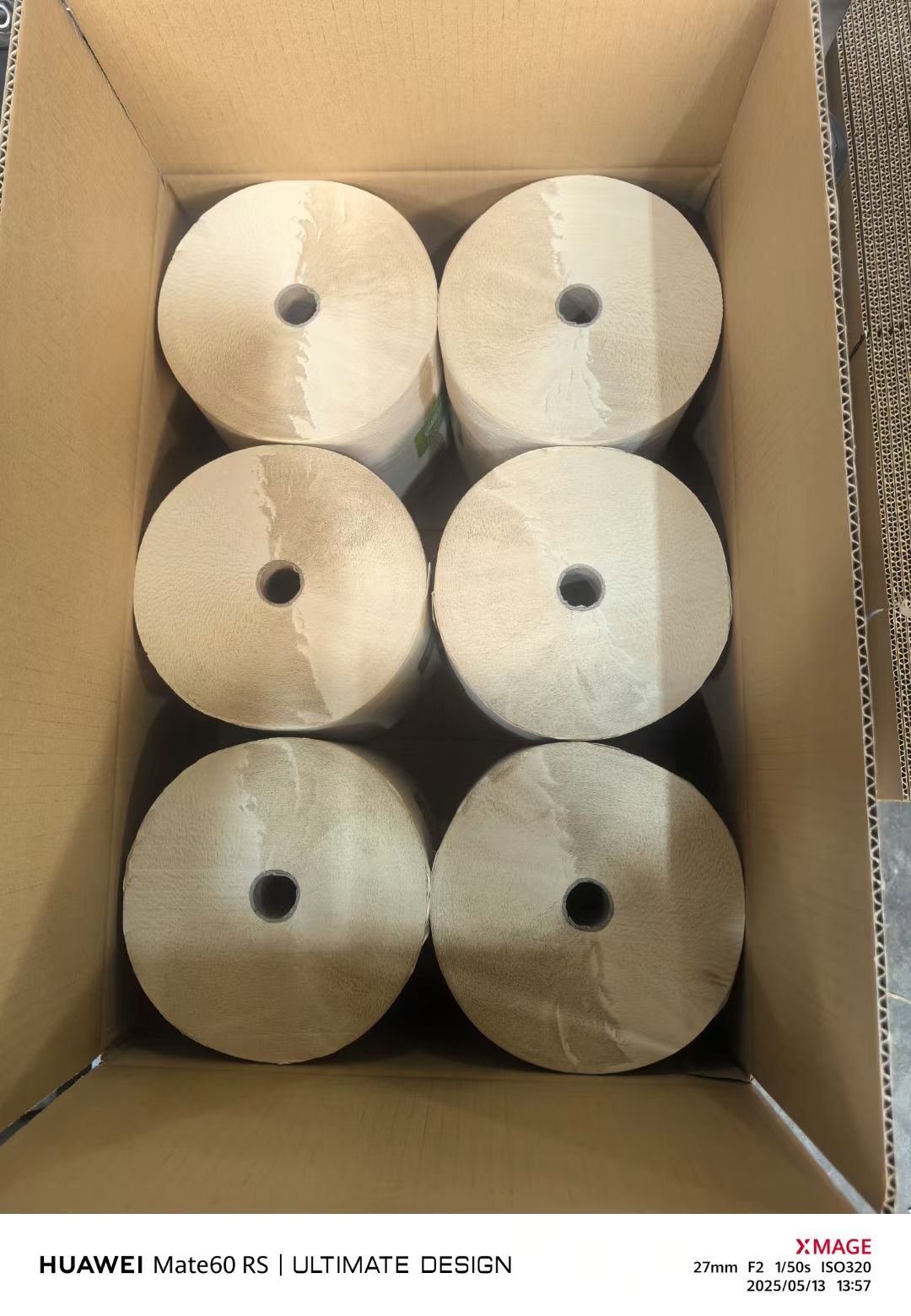
Order minimums follow the packaging decision. White-label and plain stock jumbo rolls can start from one 20GP container. Custom printed cartons or outer packaging move the minimum to one 40HQ, because plate-making and print setup are amortised across the container. First bulk production runs 25 to 30 working days including packaging plate-making, sampling and outer carton printing; repeat orders run 20 to 25 working days. If you are assembling a mixed washroom paper programme rather than a single JRT line, the bulk toilet paper sourcing guide covers how container loads are planned across product lines.
The Payment and Inspection Timeline
The order sequence matters for jumbo rolls specifically, because it determines where your inspection checkpoint falls relative to your money. The terms are 30% T/T deposit with the 70% balance before shipment, and the documentation is released at that point rather than after dispatch. Read as a timeline:
- Specification and sampling. Samples produced and dispatched in 1 to 3 working days. Run the dispenser-fit check on real hardware at this stage.
- Deposit. 30% T/T against the proforma invoice, which carries the contracted specification including meterage per roll.
- Production with in-process inspection. Basis weight, tension and perforation line are checked during converting. This is the stage to request records from if meterage is your main exposure.
- Pre-shipment final inspection. Carton specification and drop test.
- Documentation, then balance. The virgin wood pulp COA, the wet tensile and dust-rate test video pack, and the container reinforcement and moisture-proof packing photographs and video are provided before the 70% balance falls due. The container seal video is part of that release.
- Dispatch. The container departs direct from Tianjin Xingang Port on FOB, CIF, CFR or EXW terms.
That ordering is the buyer’s protection. The inspection evidence arrives while 70% of the payment is still yours, which is what makes a specification breach a conversation rather than a loss. It is also why the documentation list belongs in the purchase order as a deliverable, and not left as an expectation.
Verifying a JRT Delivery on Arrival
Documents first, then physical checks. Read the COA against your specification line by line — tensile strength against the figure you contracted, brightness against the whiteness position you specified with no fluorescent brightening agents, and the virgin fibre verification that confirms the furnish behind the ply.
Then run four physical checks on rolls pulled at random from different cartons across the pallet, not from the top layer.
Meterage. Unwind and measure. Consistency across the sample matters as much as the absolute figure: a batch that varies roll to roll tells you rewinding tension was not held, even if the average lands close to the contracted number.
Fit. Load a sample roll into an actual dispenser on site and run it down to the core. It should mount on the spindle without force, unwind without telescoping, and present or tear the way your dispenser expects.
Wet behaviour. Wet a length of web and pull it. A long-fibre virgin web holds. Ask for the wet tensile figure for your construction on the COA and compare what you feel against what was documented — the wet tensile and dust-rate test video pack exists for exactly this comparison.
Dust and lint. Wipe a dark surface with a dry length of web and look at the surface in raking light. Fibre residue on the surface is a lint problem, and in a hospital or a food-adjacent area it is a rejection-level finding rather than a negotiation.
Two notes on wet performance, because this is where JRT specifications are most often written carelessly. Wet tensile strength is one of the criteria facility suppliers buy on, and the wet tensile test video pack ships with the order, so the figure is verifiable. But the wet-strength resin formulation used on this side of the factory is the kitchen paper and hand towel process; jumbo roll wet performance rests on long-fibre tensile construction and must be confirmed on the COA figure for your specific construction rather than assumed from a hand towel data sheet. Do not let a supplier quote you one product line’s wet chemistry against another’s.
Transit protection is the other practical item. Ocean shipments use thickened waterproof corrugated outer cartons, fumigation-free pallets with high-tensile strapping, and a pre-loading container seal and watertightness check. Once the stock is on site, keep it in a dry store: tissue that absorbs moisture in storage loses strength before it is ever loaded into a dispenser.
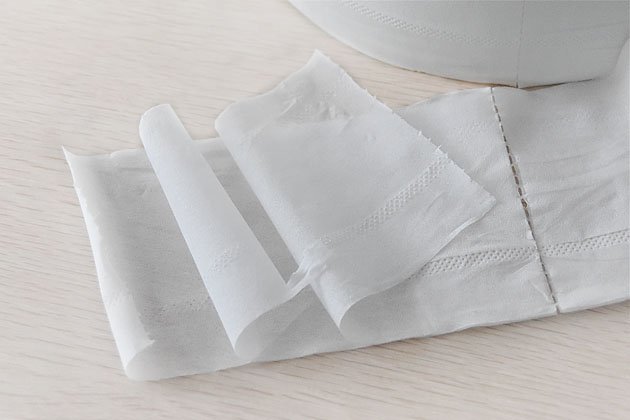
Once the format is set, settle the ply question: 2-ply versus 3-ply jumbo roll tissue compares strength, meterage per diameter, and cost per dry hand.
The same measurement logic across household and commercial formats is laid out in the toilet paper roll dimensions guide.
Frequently Asked Questions
What size is a jumbo roll tissue?
Top Source Paper produces jumbo toilet paper in roll diameters from 18 cm to 28 cm, in 2-ply and 3-ply construction. Which diameter to order depends on the maximum your installed dispenser cabinet will close around and on your washroom service interval; confirm the specific figure with the factory against both constraints.
How do I know how much paper is on a jumbo roll?
Meterage per roll is the figure that tells you, and it has to be requested explicitly and written onto the proforma invoice. Diameter is not a reliable substitute, because rewinding tension determines how much paper fits inside a given diameter. Verify on arrival by unwinding random samples from different cartons across the pallet.
Are jumbo rolls perforated?
It depends on the dispenser and on the order specification. Some commercial dispensers cut the web at a blade, others present a perforated length the user tears off. Perforation and pitch are therefore specification fields to agree with the factory and match to your installed hardware — and perforation line is one of the items checked during in-process inspection while converting.
What is the difference between jumbo roll tissue and standard toilet rolls?
Standard rolls are a retail and household format, wound on a narrow core for a domestic spindle, and are consumed quickly in a commercial setting. Jumbo rolls are high-capacity, long-meterage rolls on a wide core, loaded into a commercial wall dispenser, built on high-tensile long-fibre webs, and specified in diameters from 18 cm to 28 cm. Standard rolls serve retail shelves, household use and hotel guest rooms; JRT serves high-frequency commercial washrooms.
Is 2-ply or 3-ply better for jumbo roll tissue?
Two-ply is the standard commercial construction, because it is strong enough for a firm pull, opaque enough to stop users taking extra length, and lighter per metre in container terms. Three-ply is specified where the washroom forms part of a guest or visitor experience and the softer hand feel justifies the additional fibre.
Will jumbo rolls fit my existing dispensers?
Only if the dimensions match: roll diameter against the cabinet maximum, core inner diameter against the spindle, roll width against the dispensing path, and perforation suited to how the dispenser presents the web. Measure your own hardware and write all four into the specification. Core inner diameter is customisable to your measurement. A physical sample, prepared and dispatched in 1 to 3 working days, is the fastest way to confirm fit before a container order.
What is the minimum order for jumbo roll tissue?
White-label and plain stock jumbo rolls start from one 20GP container. Orders with custom printed cartons or outer packaging start from one 40HQ container. First bulk production takes 25 to 30 working days including packaging plate-making and carton printing; repeat orders take 20 to 25 working days.
Specify Meterage, Verify on Arrival
Jumbo roll tissue rewards buyers who specify in metres and verify with a tape measure. Fix ply, diameter, core inner diameter, width, perforation and meterage against your installed dispensers and your own service interval; insist on 100% virgin wood pulp with a long-fibre web; ask for the in-process tension records rather than only the finished-goods summary; and check the COA plus a random physical sample before the balance is released. Handled that way, a JRT programme delivers fewer dispenser changes, less lint on the floor, and a washroom paper cost you can forecast from measured consumption instead of estimating from carton counts.
Further jumbo roll specifications, facility sizing guidance and dispenser compatibility material is collected in the jumbo toilet paper library. To request JRT samples for a dispenser-fit check, or to have an existing jumbo specification reviewed before your next container, contact the Top Source Paper team — samples ship within 1 to 3 working days, and inquiries can also go to info@chinatoiletpaper.com or +86-13180210660 on WhatsApp.
The jumbo commercial toilet paper sizing guide adds the high-traffic change-out math to these specs.
The buying guide sets the meterage rule; the jumbo rolls wholesale audit guide adds the caliper-and-geometry cross-check that tests whether a quote is physically possible.