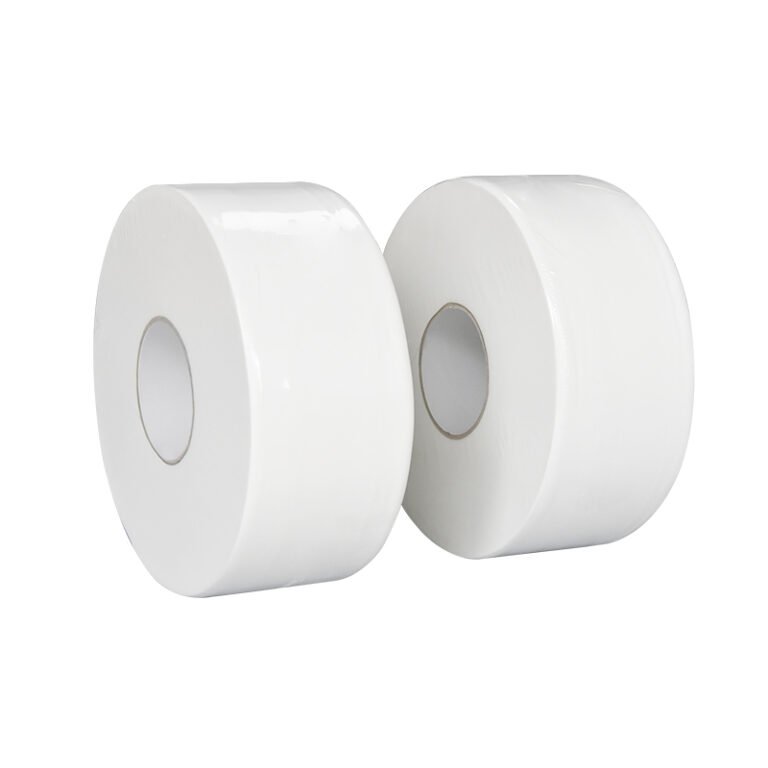
A wholesale quote for jumbo toilet paper rolls usually arrives with four numbers: diameter, ply, metres per roll, rolls per carton. Three of them are easy to print and hard to audit, and the one that decides whether you reorder or quietly disappear from the category is the metreage nobody re-measures after the first container. The buying discipline itself – contract the metreage, convert every quote to a cost per thousand metres, verify on arrival – is set out on this site in the JRT buying guide, and this article does not re-teach it.
What the buying guide does not give you is an independent way to catch the specific fraud of its own best rule: a roll that states a big metreage and shows a matching diameter, yet physically cannot hold that length. This is that missing layer – the geometric cross-check that turns four quoted numbers into a yes-or-no on a forklift, and the core-weight test that catches the other way a jumbo roll is quietly shortened. Read the buying guide for how to order; read this for how to distrust the quote before you order.
Key Takeaways
- The buy-on-metreage rule, the cost-per-thousand-metres conversion and the on-arrival verification sequence belong to this site’s JRT buying guide; this article supplies the audit that checks whether a quote’s numbers are even physically consistent.
- A heavier or deeper core eats usable windings without changing the outside diameter; measure the core and weigh the roll net before comparing any two quotes, because diameter alone cannot show what is paper and what is tube.
- Roll length can be cross-checked by geometry: L = pi x (OD^2 – ID^2) / (4 x sheet thickness). On placeholder inputs, 280 mm outside against a 76 mm core at 0.25 mm thick computes to roughly 228 m; the same roll wound to 240 mm computes to roughly 163 m.
- The geometry check is a flag, not the contracted figure: because sheet thickness varies with embossing, a computed length only tells you which lots deserve the buying guide’s unwind-and-measure test, not what you should accept on paper.
- This mill publishes JRT diameters from 18 to 28 cm in 2-ply and 3-ply, and its written meterage policy refuses grammage overstatement and short-metre shrinkage.
- Per-line GSM beyond the standard toilet-paper band (13-18 GSM) is not a number any honest jumbo supplier publishes blind; the full portfolio runs 13-45 GSM.
- The Four Numbers, Read As An Audit Target
- The Core: Where the Cheap Weight Hides
- Cross-Checking Metreage With Calipers
- Why The Computed Length Is Not The Contracted One
- What Each Quoting Style Can Hide
- Where This Audit Meets The Buying Guide’s Checks
- From Shared 20GP Without Re-Running The Maths
- FAQ
- Audit The Quote Before You Trust The Metres
The Four Numbers, Read As An Audit Target
Print the quote and mark what is missing. Outside diameter and ply appear on almost every listing; sheet width appears on some; core diameter and metres per roll appear where the supplier is confident and vanish where the answer is elastic. The buying guide tells you to insist on the metreage and contract it per roll – that is the ordering rule. The audit question this article adds is different: given the diameter and a core size, can that roll physically carry the metreage it claims?
The Core Standard Already On This Site
The 76 mm (3-inch) jumbo core standard, and which dispensers accept it, are already established on this site in the high-capacity jumbo guide; this article does not re-teach that number. What the machine side adds for audit purposes is a datum from equipment tables – rewinding data sheets list parent-jumbo inlets at 76.2 mm while finished consumer-roll cores run 38-48 mm, and one such table is public. Those describe equipment inlets, not any wholesaler’s delivery spec. The audit never asks “is the core 76 mm” in the abstract; it asks whether the core inside your delivered carton matches the figure printed on your quote – measured, not assumed.
What the Mill Controls Versus What the Quote Claims
The internal policy behind honest metreage – the High-Yield Meterage Control that holds rewind tightness and slit length against short-metre shrinkage – is documented in the JRT buying guide and not re-derived here. The audit uses it as a baseline: a mill that controls tension to a standard produces rolls whose stated diameter and stated metreage agree, which is exactly the property the geometry check in the third section tests on an unfamiliar supplier.
The Core: Where the Cheap Weight Hides
A heavier core does two expensive things at once. It raises net weight, which flatters a kilo-priced offer, and it eats windings, which silently lowers metres on a roll whose diameter looks identical on the loading dock.
The reason buyers rarely catch this is that nobody re-cores a sample. The check costs one minute: slide a bore gauge or a caliper inside the tube and compare against the stated core. Then weigh one roll with and one without its wrapper, and keep the record. A supplier who quotes total carton weight but not net roll weight is describing freight, not tissue, and the difference between those two weights is where shrinkage lives.
Warning: the “same diameter, same price” trap
Two 24 cm, 2-ply jumbo rolls from two mills can differ by dozens of metres of usable paper without either number on the carton being false. The difference is core size, sheet thickness at the embosser, and rewind tension – none of which the outside diameter reports.
A diameter-only quote is not a comparison. Before you choose between two offers, get all four numbers or wind neither.
Cross-Checking Metreage With Calipers
Geometry gives you the audit the buying guide’s ordering rules presuppose but do not perform: a way to ask whether a stated length fits a stated diameter. The formula the trade’s own calculators use is L = pi x (OD^2 – ID^2) / (4 x t), where OD is outside diameter, ID the core diameter and t the sheet thickness.
A Worked Placeholder
Take inputs as an example, not as anyone’s spec: a 280 mm outside diameter, a 76 mm core, and 0.25 mm effective sheet thickness after embossing. The annulus of paper is 280^2 – 76^2 = 72,624 mm^2 of cross-section; divide by four times the thickness and the roll computes to roughly 228,000 mm, about 228 metres. Now wind the same sheet to 240 mm instead: 51,824 mm^2 of annulus, roughly 163 metres. Forty millimetres of diameter is sixty-plus metres per roll, invisible from the forklift seat. Every input here is a placeholder, but the arithmetic holds for whatever numbers your calipers actually read.
How To Use The Output
Feed the formula your quoted diameter, a measured core, and the metreage the quote claims. If the numbers cannot coexist – if a 240 mm roll is being sold as 300 metres at any honest thickness – the quote is internally impossible and you have an opening line for the supplier before a single pallet is opened. When the numbers do coexist, you have learned nothing except that the claim is physically possible; the length itself is still settled by the buying guide’s unwind-and-measure verification, not by this division.

Why The Computed Length Is Not The Contracted One
The one failure mode that would make this tool dangerous is treating its output as the metreage you accept on paper. It cannot be, because the thickness term is doing all the work and thickness is the one number a caliper cannot pin down on a soft, embossed web.
Run the arithmetic on the same market data two cluster guides cite, and the tension is instructive. The high-capacity guide notes a 25 cm roll can carry very long metreage, and the roll-dimensions standard lists a wide observed span; feed those into the geometry and only a thin effective thickness reconciles a big diameter with a big length. That is not an error in either guide – it is the lesson. Embossed, loosely wound paper hides metres behind air, so a diameter that could hold 400 metres at one thickness holds far fewer at another. The computed length is therefore a filter that flags which lots deserve the buying guide’s physical unwind check; the contracted metreage always outranks the arithmetic.
What Each Quoting Style Can Hide
Converting two quotes onto one comparable unit is the buying guide’s rule – reduce every offer to cost per thousand metres before you compare. What that conversion cannot do is tell you which raw unit a supplier chose to quote and why. The quoting dialect itself leaks information.
| Quoting style | What it makes comparable | What it can hide |
|---|---|---|
| Price per kilogram | Fibre cost across grades and mills | Heavier core, looser wind, more air per metre |
| Price per roll | Line items on a reorder sheet | Diameter or metreage quietly reduced |
| Price per metre | What the washroom consumes | Nothing – but most suppliers resist quoting it |
The per-kilo unit flatters a mill that embosses thicker and winds softer, because core and air both weigh; the per-roll unit flatters whoever shrank the diameter after you stopped measuring. Suppliers who resist moving to the per-metre basis of the buying guide’s conversion are telling you their least-favourable unit is per-metre, and that resistance arrives free.
On the grammage side, keep the claim ladder honest: this portfolio runs 13-45 GSM overall, with the standard toilet-paper line specified at 13-18 GSM. A supplier quoting a jumbo-specific grammage they cannot show on a COA is inventing a number, which is why per-line grammage beyond the bands above is not published here either – the parent reel’s physical indices, tensile and brightness first, are verified at sampling instead, and that verification chain is described in the converting-plant guide to mother rolls.
Where This Audit Meets The Buying Guide’s Checks
The on-arrival verification routine – match the COA to the batch, unwind and measure metreage, weigh net, load a sample into a real dispenser, check wet behaviour and dust – is owned and ordered by the buying guide, and this article will not re-list it as if it were new. The audit adds exactly two lines to that routine, both born from the sections above.
The Two Audit Lines
Take one caliper outside-diameter reading per pallet and log it beside the quoted metreage, then run the geometry division on the spot. Photograph the core and the wrapper alongside the reading, so a later shrinkage claim has an exhibit that predates the argument.
Those two lines are cheap insurance against the specific failure the buying guide’s rule cannot self-detect: a supplier who contracts the metreage correctly, invoices it correctly, and still ships a roll whose diameter is mostly tube. The core-weight check and the geometry flag are how you catch that supplier in the first pallet instead of the sixth.
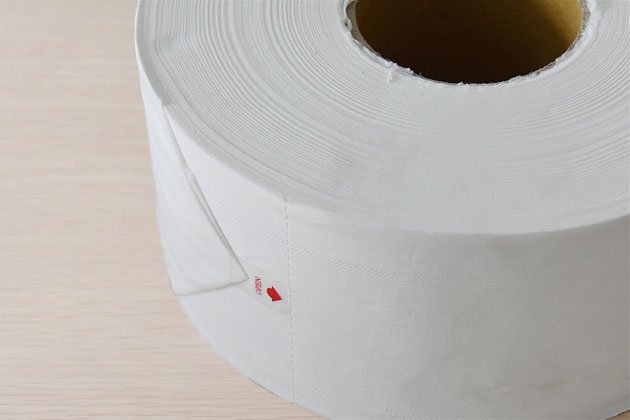
Video: “Jumbo Roll Tissue manufacturing process”, Top Source Paper own channel. Mill footage of the jumbo-roll production line; it is not a metreage-audit demonstration.
From Shared 20GP Without Re-Running The Maths
Entry commitment for plain or white-label jumbo stock is a shared 20GP consolidation; custom colour-printed packaging steps up to one 40’HQ. That single line is the whole MOQ posture, and the carton-vs-container arithmetic – what each cube actually holds of jumbo formats – already lives in the 20GP against 40HQ MOQ guide, which this article does not re-run.
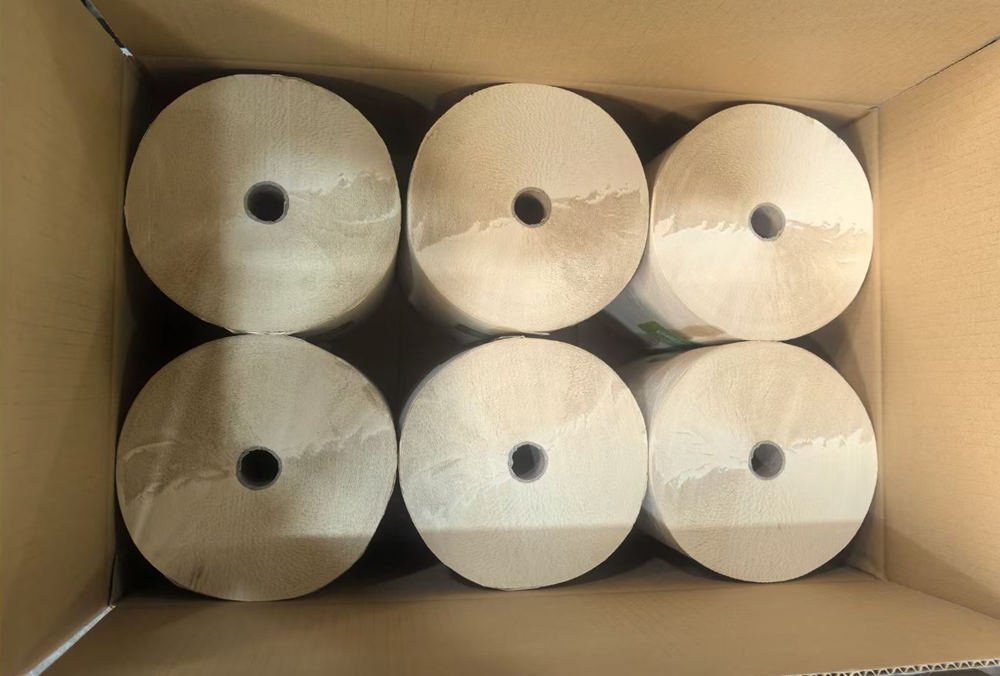
Two ordering realities sit beside it and rarely appear in listings. First, every wholesale jumbo decision carries sea-freight physics: tissue is light, bulky and allergic to moisture, which is why packing here is thick, high-strength moisture-proof corrugated with fumigation-free pallets, tension straps, and a seal-and-moisture check before loading, documented in the packing photo set. Second, terms decide who owns the risk window: FOB, CIF, CFR or EXW ex Tianjin Xingang with 30% T/T down and 70% released against the QC report and seal video means the deposit buys you the paperwork chain, not just the paper.
For distributors weighing jumbo rolls against retail-ready bath tissue in the same planogram conversation, the jumbo toilet paper pillar page indexes the format itself, and the container numbers above come straight from the mill’s published MOQ position.
Audit The Quote Before You Trust The Metres
The buying guide tells you to buy metres; this article is the scepticism that tells you whether the metres on the quote can physically be there. Four numbers on the PO, one caliper reading and one geometry division per lot, and a core weighed net – that is the whole countermeasure, and it exists to catch the supplier who does everything the ordering rule asks and still ships you air.
Lead times make the audit cheap: samples of the actual reels dispatch in 1-3 working days, so the caliper check and the division happen on a reference roll long before the 30% deposit converts into a container. If your current jumbo supplier will not quote metres per roll and core diameter in writing, send the quote to this mill and get the audited numbers back beside a COA that carries its own batch line.
Frequently Asked Questions On Jumbo Toilet Paper Rolls Wholesale
Can I check a jumbo roll’s metreage without unwinding it?
Only as a flag, not a verdict. The geometry division L = pi x (OD^2 – ID^2) / (4 x t) tells you whether a stated diameter can physically hold the quoted metreage for a plausible thickness. It cannot confirm the length, because embossed thickness varies – the contracted metreage is still verified by unwinding, per the JRT buying guide.
How do I audit the core on a delivered jumbo roll?
Measure it. Slide a bore gauge or caliper into the tube and compare against the core diameter printed on your quote and the holder on your floor – the 76 mm site standard is established on the high-capacity jumbo guide, but a delivered carton should never be trusted to a standard. Then weigh the roll net; a heavy tube flatters per-kilo pricing while eating windings.
Why does the same diameter hide different lengths?
Because outside diameter reports paper plus core plus air, not paper alone. A heavier core, a looser rewind or a thinner sheet each takes metres off the roll while the forklift-visible diameter stays the same, which is why a diameter-only quote is never a comparison.
Should I buy jumbo rolls by weight or by the roll?
Neither as your decision unit. Convert offers to cost per metre as the JRT buying guide directs; the audit here adds only that per-kilo pricing hides core weight and per-roll pricing hides shrinkage, so weigh the unit choice itself as a signal.
What is the minimum order for wholesale jumbo toilet paper?
Plain and white-label jumbo stock ships from a shared 20GP container. Custom colour-printed cartons and packaging carry a one 40’HQ minimum, with first production at 25-30 working days and reorders at 20-25.