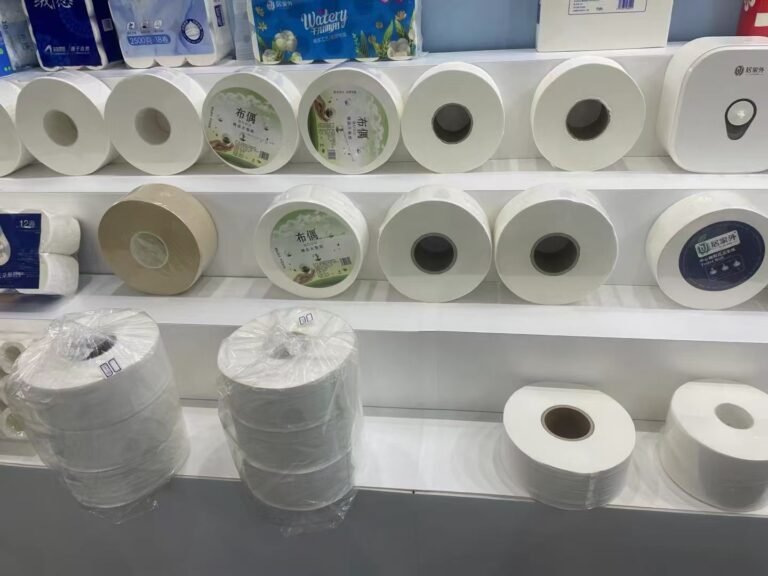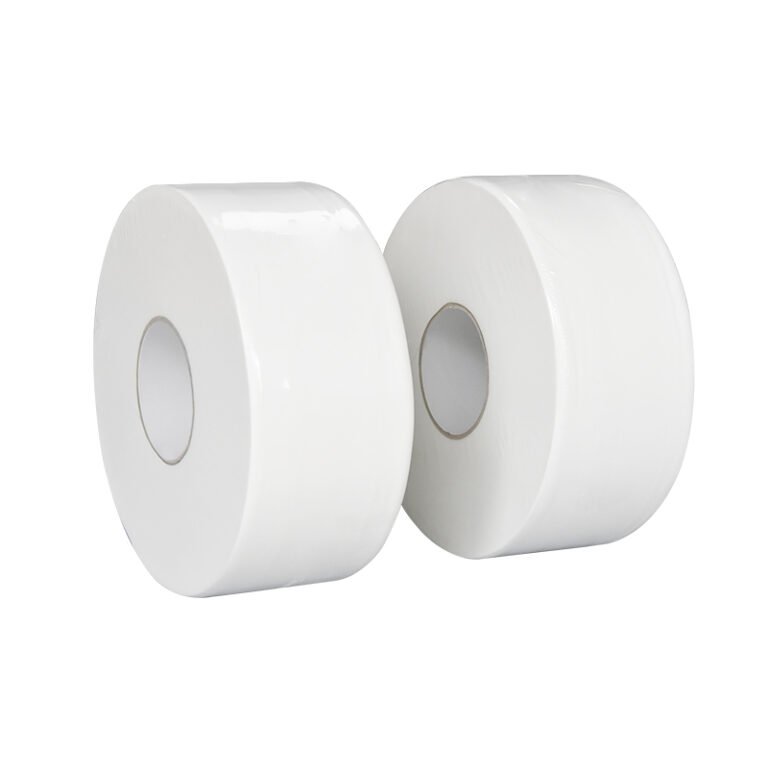
Our rewinder decides what a jumbo roll is made of; the cabinet on your wall decides whether it works. Short answer: jumbo toilet paper dispenser fit rests on four measured fields, outer diameter against cabinet clearance, core inside diameter against the hold mechanism, width against arm spacing, and the mechanism itself, and only the first carries a published number from this mill. The line is specified as diameter from 18 cm to 28 cm, 2-ply or 3-ply, on high-tensile long fibre.
The centre-feed pairing protocol already measures your axle, pairs core diameter with maximum wound diameter under a compression tolerance, runs a shift on the real unit and assigns responsibility by brand. Only the jumbo-scale consequences are missing.
What Decides Jumbo Toilet Paper Dispenser Fit Before Any Size Chart Does
Outer diameter is the published field, and it is published as a band, which describes our winder rather than your housing. Core inside diameter is measured on the finished roll at rest, not on the bare tube; we carry it as a customisation item with no published value, because no universal jumbo core size exists to recite. Width is judged against the spacing of the arms or cheeks that locate the roll: too wide it rubs the side plate, too narrow it floats and walks.
The fourth field, how the roll is held, is the one buyers leave blank, and it reorders the other three: an arm grips a range, a shoulder absorbs nothing, a brake cares about radius, a cartridge turns the refill into a shape match rather than a dimension pair, settled by the cored versus coreless decision.
Four readings, taken with a tape before you email anyone, decide whether a roll you have never held fits the cabinet you own, and none is a number this mill publishes. Door path: with the housing open, find the largest circle that clears the closure on every axis, subtract a margin you choose, and that is your true maximum outer diameter. Incumbent: measure the outer diameter of a roll that runs today, because that one reading answers what the specification sheet cannot see. Arms: on a spring unit, record the spread at rest and under load with the tube seated, since the gap is the clamp force left to grip. Cheeks: subtract the roll width you will buy from the internal holder width, and the remainder is the axial float the roll walks in. Each is a buyer-measured field on a purchase-order line, not a size chart.
The Capacity-versus-Clearance Trade Inside the Published Band
The published range is a range you buy inside, and the ceiling is your housing’s: measure the door path at full fill, subtract a margin you choose, and that becomes your maximum. The meterage side belongs to the jumbo roll buying guide, and the pallet-weight consequences of the top end to the extra-large JRT capacity page. A clearance ceiling is a service-interval ceiling.
Arithmetic explains why the two ends behave differently. Paper in a wound roll fills an annulus, so cross-section is roughly outer diameter squared minus core diameter squared. To make the maths visible I use a placeholder core of 10 cm, an arbitrary value for the example, not a recommendation and not a published size. At that placeholder an 18 cm roll leaves about 224 units of paper area and a 28 cm roll about 684. One added centimetre gains roughly 16 percent at the small end and 8 percent at the large one, while the cabinet pays an identical centimetre both times. Diameter is a diminishing return priced in millimetres of clearance.
The same annulus maths becomes a service interval without inventing a metre of paper, so treat this as arithmetic on variables. Let D be the largest outer diameter your cabinet clears, d the core inside diameter, t one wound layer thickness, and L the length unrolled, a figure from your own usage log rather than ours. L scales with D squared minus d squared, divided by t, so each extra centimetre of D adds the change in D squared, an increment that shrinks as D grows. Read the ceiling backwards: if today’s roll already reaches the diameter your door clears, the largest roll in the band lengthens nothing, because the housing binds, not the winder.
Why a Jumbo Toilet Roll Fails Differently from a Centre-Feed Towel Roll
A centre-feed towel roll is light and swapped several times a shift, so its problems surface late, when a loose bore creeps along a worn axle. A jumbo roll goes in once, takes thousands of pulls, each rotating most of the remaining mass, and stays large for weeks. Diameter fails at installation, the bore at the end of the refill, so a fit test on a new roll alone is half a test.
Telescoping is a bracing problem more than a paper problem. The stack is held axially by the tube and whatever the arms press against it; when that slackens, layers migrate sideways a pull at a time and the next user draws a rope through a throat sized for a clean sheet. Published construction is the resistance: 2-ply or 3-ply on high-tensile long fibre. Ask what your lot ran at, because the in-process rewind check records grammage, tension and perforation line, and tension decides how hard a roll holds its diameter under a pallet. Ply versus yield: the 2-ply versus 3-ply jumbo comparison.
Name each failure by the dimension that causes it and the fix stops being guesswork. Door fouling is outer diameter against clearance, seen on day one with a full roll, and no ply count rescues it. Core crush is the tube wall against the clamp load the arms or shoulder impose; overshoot that preload and the bore goes oval and the roll walks. Spindle slip is an undersized core inside diameter on a fixed shaft, and brake drag is a mismatch between the radius the hub is tuned to and the radius presented at full fill. Mid-shift unwinding, a tail pulled as a rope rather than a sheet, is telescoping set off by axial slack. The published band and the 2-ply or 3-ply high-tensile long fibre say the web resists breaking under tension and the roll holds its wound diameter under stack load; they say nothing about clearing your door or surviving your arm preload, and that is geometry on your side of the wall.

Spring Arms, Fixed Spindles and Braked Hubs
Spring-loaded arms squeeze the tube, and the tube has to sit inside the spring’s working range. An oversized core pre-compresses the arm before the roll is in place, so the clamp force left when it matters is smaller than intended; the roll rides loose, turns with the pull and drifts. An undersized core leaves the arm nearly extended, gripping at the bottom of its range, and cardboard tube ends soften as they cycle between humid and dry, so a roll that held on installation day can slip by week four.
A fixed spindle with a machined shoulder absorbs nothing: the bore slides on or it does not, and forcing it is not a fix, because a tight tube deforms its end on the shoulder and a deformed end cannot brace the stack. There the core tolerance you specify does the whole job. A braked hub turns on the radius the web leaves the roll at, so a setting that presents one clean turn at full fill can over-run when the bundle is small. Each behaviour is a property of hardware, which is why the mechanism belongs on the order line beside the numbers.
Humidity and Stack Load, and the Numbers Behind Jumbo Toilet Paper Dispenser Fit
Paper takes up and gives off moisture, and a jumbo roll is mostly paper: a long web wound thick plus a laminated card tube. The diameter and bore measured in a dry plant are not the values that meet your spindle in a humid building months later. So state the condition: outer diameter after relaxation and after a pallet stack, core inside diameter on the same basis, acceptance read at destination.
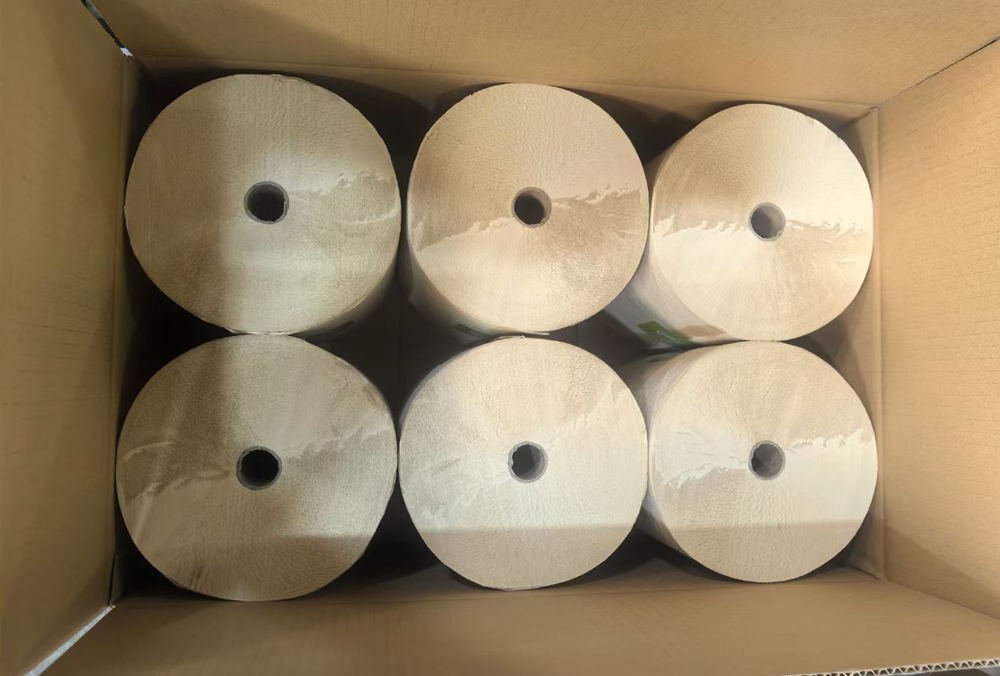
Shipping is the part we control, and it is published: heavy-duty moisture-proof corrugated master cartons, fumigation-free pallets, high-tensile strapping, a container checked for sealing and water-tightness before loading, and packing photographs and video as an order deliverable. That is protection and mechanical load at once: strap pressure and stack weight deform tube ends in transit. Inspect on arrival, pull two rolls, look squarely down the bore. Months of dwell sit on the warehouse stock-aging read.

What to Write in the PO, and What This Mill Will Not Sign For
A fit block reads as conditions with named measurement bases, not adjectives. Fill every blank from your own building: maximum finished outer diameter with tolerance, measured at rest after relaxation and under stack; core inside diameter nominal with tolerance, on the finished roll; finished width and the axial float your holder allows; the mechanism by type; the cabinet’s measured clearance at full fill. Then the acceptance test: sample rolls from this order’s lot, run on that named unit for a full shift. A line reading standard jumbo roll is how a return story starts next quarter.
Samples are the cheap half: one to three working days to make and dispatch, against 25 to 30 working days for a first production run and 20 to 25 for reorders. Payment sets the order too: 30 percent T/T deposit, 70 percent before shipment against the quality report and container-seal video, and once that balance moves the remedy window narrows. On quantities, plain and unprinted white-label jumbo rolls ship from a 20GP consolidated load, while the custom-printed carton and the custom-printed outer PE sleeve each start at one 40’HQ.
Split the signatures by what each party can measure. The fit fields above, maximum outer diameter with tolerance, core inside diameter nominal with tolerance on the finished roll, finished width with its axial float, and the hold mechanism by type, are yours to supply and sign: you take them from the tape, and your signature says they describe your cabinet. This mill signs only that the rolls land inside the diameter band it publishes and that your named width and core nominal are made to your number. Artwork is its own order line, and the print decision, not the fit decision, is what moves the quantity threshold above. The pairing sequence that binds those signatures lives in the centre-feed pairing protocol; aim it at a jumbo cabinet rather than reopening a core-standard question this site has closed.
The boundary. We publish diameter from 18 cm to 28 cm, 2-ply or 3-ply on high-tensile long fibre, 100% virgin wood pulp, from eighteen-plus years of papermaking and export at Daceying, Mancheng, Baoding in Hebei, shipped from Tianjin Xingang; formats sit on the jumbo toilet paper line page. Core inner diameter is a customisation item inside that. We will not sign a fit guarantee against a cabinet we never measured, or a universal core size that does not exist. The buyer resources index pairs with this.
Symptom at the Cabinet, the Dimension Behind It, the Field to Change
A triage sheet. The middle two columns are yours to fill from your building; the last names the page that carries the deeper argument.
| Symptom at the cabinet | Dimension behind it | Field to change | Deeper explanation |
|---|---|---|---|
| Door will not close on a fresh roll | Outer diameter versus clearance | Lower maximum diameter in the band; state clearance | Extra-large JRT capacity page |
| Roll drifts before the refill is gone | Core inside diameter, tube length | Core nominal plus tolerance on the finished roll; holder spacing | Centre-feed pairing protocol |
| Tail tears, users pull a fistful | Bore grip and tension at a shrinking radius | Name the mechanism and the drag accepted at full and near-empty fill | 2-ply versus 3-ply jumbo comparison |
| Passed at the sample table, fails on the floor | Measurement condition between readings | State the basis; run acceptance at destination | Warehouse stock-aging read |
Every row turns on a number only the buyer can produce, not on a supplier quoting a size from memory.

Frequently Asked Questions
How much clearance does a cabinet need around a 28 cm jumbo roll?
Nobody publishes it, because it is a property of your housing. Measure the door path with a roll at its fullest diameter, set your maximum wound outer diameter below that reading by a margin you choose, and write both into the order.
Does jumbo toilet paper come on a standard core size?
No standard value exists for us to recite, and catalogue figures describe one brand’s own roll and dispenser pairing. Our sheet publishes diameter from 18 cm to 28 cm and 2-ply or 3-ply construction, and treats core inner diameter as a customisation item you specify. Measure the spindle or arms you run, state the nominal with a tolerance on the finished roll at rest, and verify a packed sample before the balance is released.
What does the hold mechanism change that a size chart cannot?
How a tolerance band behaves. Spring arms grip a range and lose clamp force when a core sits at the wrong end of it. A fixed shoulder absorbs nothing, and forcing a tight bore damages the tube end. A braked hub is tuned to a radius that one refill sweeps across, so identical published numbers can run well in one building and jam in another.
A roll fitted in one season, will the next container still fit?
Test it rather than assume it. Paper and tube stock move with humidity, so a roll measured in a dry plant does not necessarily arrive at the same diameter or bore condition after ocean transit and a pallet stack. Take acceptance at destination rather than at the sample table, and look down the tube ends when the container lands.