Ask how long a distribution center can hold a container of toilet paper and the honest answer is not a number stamped on the pallet. Paper does not expire the way food does; it degrades along a curve set by the conditions it sits in and the months it stays there: the load on the bottom tier, moisture rising through the floor, the heat of a summer roof, and the length of the dwell. A sealed carton in a cool, dry, uncrowded bay stays sound for a long time; the same carton at the base of an overstacked bay under a hot roof does not.
The operating question is not when this goes off but what my warehouse does to these rolls every month they stay. This page names four degradation factors and the check that catches each, then the batch-label and FIFO practice that makes dwell time visible. It invents no shelf life.
Conditions and Dwell, Not a Printed Date
The first move is to stop looking for an expiry figure and start reading the environment. There is no fixed lifespan that a mill certifies for a pallet of finished rolls sitting in your building, because lifespan in that context is a property of the storage, not of the product. A conservation note on storing works on paper, published by the Canadian Conservation Institute, puts the relationship in measurable terms: relative humidity over 60 percent accelerates chemical and biological deterioration, the recommended level for general paper collections is below 50 percent, and lower humidity can in turn make paper more fragile. The same source states plainly that a low temperature in the storage area slows the rate of deterioration and increases the lifespan. Read together, those two facts say that a warehouse is a variable you set, and that a hot, humid, crowded bay ages stock faster than a cool, dry, uncrowded one holding identical goods.
That is the whole difference between a family storing spare rolls in a linen closet and a distributor holding a container bay for a quarter. The imported roll arrives in a moisture-controlled, packing-protected state; what happens next is entirely up to your floor. Everything below is organized around that: what physically degrades a stored roll, how you detect it before it costs you a shipment to the customer, and how you rotate stock so nothing sits long enough for the conditions to catch up with it.
Factor One: Stacking Height and Column Crush
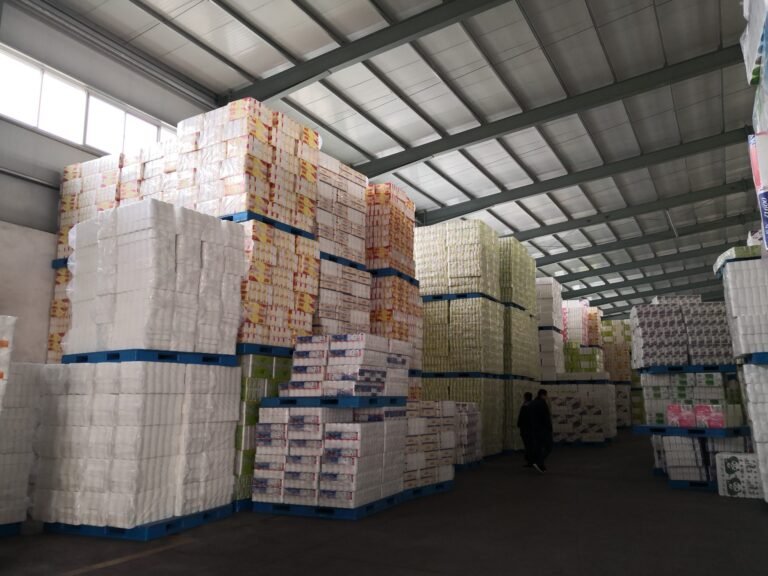
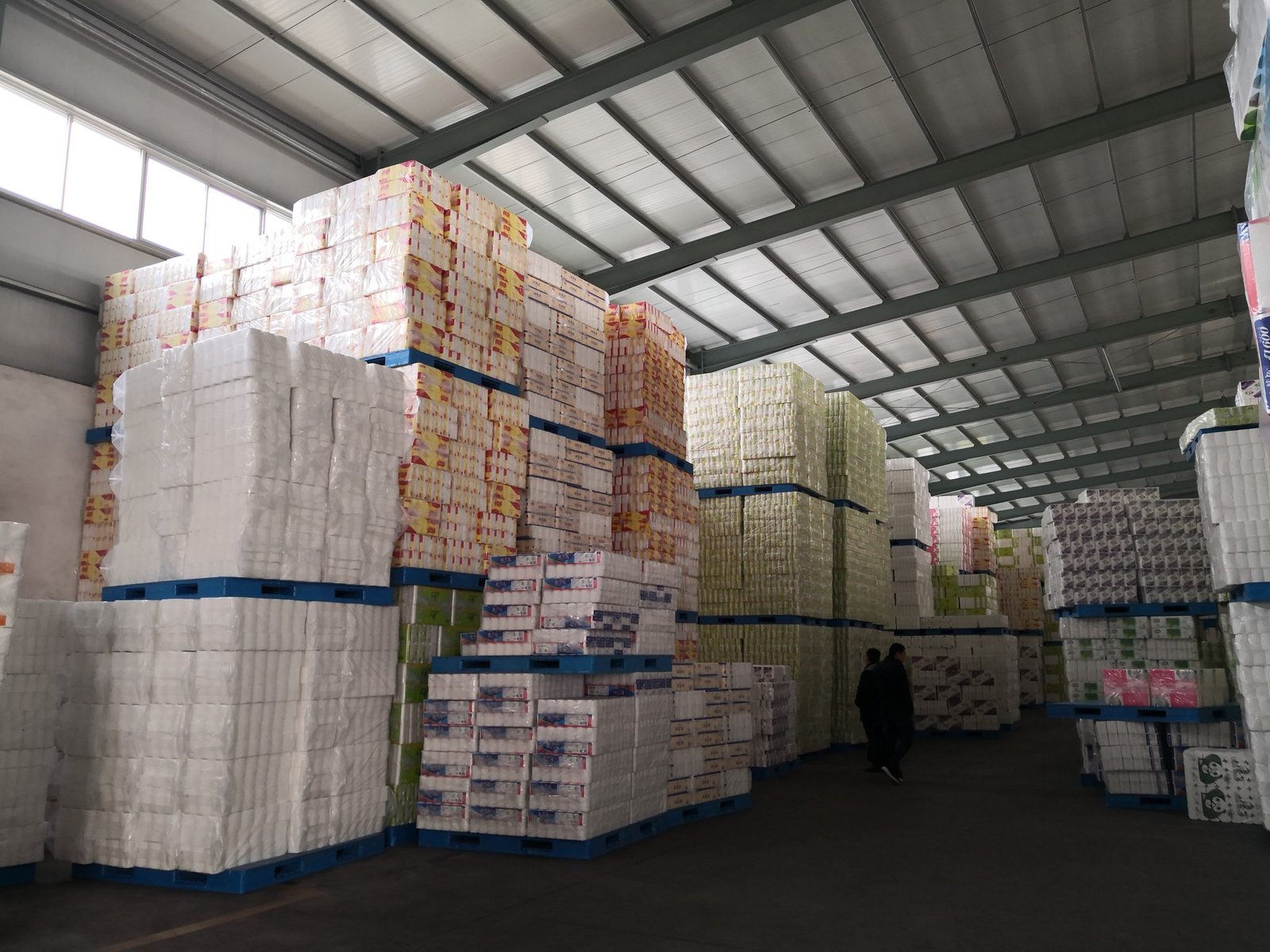
Tissue is soft by design, and the corrugated cartons around it are compressible. Put one pallet on the floor and the bottom layer carries its own load plus everything above it. Put a second pallet on top, or stack a tall column of cartons, and the rolls at the base of the column are under continuous pressure for as long as the stack stands. Nothing has to be dropped on them, nothing has to touch them. The deformation is cumulative and it is invisible from outside the wrap. What you find when you finally open a bottom carton at a long dwell is a roll that has lost roundness, a sheet pack that has bulged sideways, a log that has telescoped on its core, or a carton whose corner has been crushed enough to jam a dispenser on the customer’s wall.
The check is cheap and it belongs at goods-in and at any long-dwell review: sample a pallet near the bottom of a tall column and inspect the lowest cartons and the lowest rolls in them, not just the top of the stack where everything looks fine. Compare that against a pallet from a single-tier row and the difference tells you what your stacking is doing. Beyond that, stack height is your trade-off to make, not a number the mill certifies for your warehouse. Keep goods on rated pallets and single-stack unless the outer packaging is explicitly built to bear a second tier; a packing spec designed for one-high stowage does not become a two-high packing just because the bay got crowded in a slow month. If you must go tall to fit a quarter’s stock, treat the bottom layer as at-risk, shorten its dwell, and send it out first.
Factor Two: The Floor Under the Pallet and Rewicking
Paper and board are hygroscopic; they trade moisture with whatever is touching them and whatever the air around them holds. In a distribution building the two quiet sources of that moisture are the slab and the exterior wall. Concrete wicks groundwater upward by capillary action, and a carton sitting directly on a bare slab will pull that moisture into its flutes over weeks. A softened flute is a carton that has lost the stacking strength it was supposed to give you, which is exactly the layer that was protecting the rolls underneath it. On the wall side, cold exterior surfaces in winter and warm humid air in summer drive condensation onto the goods nearest them. Neither failure came from the product; both came from where you put it.
The corrections are physical, not chemical. Never store cartons on a bare slab; keep every bay on pallets with a moisture barrier between pallet and floor, and leave an air gap between the goods and the exterior wall so the surface can be monitored and the load is not the first thing to meet condensation. Bound the relative humidity of the bay and measure it rather than reacting to the pallet that happens to feel damp, because the conservation thresholds above are a warning that both directions hurt: high humidity drives mould and distortion, and very dry storage makes paper fragile. This is the stationary-side companion to a question this site answers elsewhere. What protects tissue on the water, inside a sealed metal container that crosses dew point every day of a voyage, is the subject of the container loading and moisture-proof packing guide, which deals with before the ship leaves; this section is about the months after it arrives.
Factor Three: Summer Heat, Fragrance and Hue
Temperature is an accelerator. Every chemical process in a stored sheet runs faster as the bay gets hotter, and a distribution center under a metal roof in July is not the same environment as the same bay in January, holding the same lot. Two categories of SKU feel that first. A product carrying an added fragrance is only holding scent in a volatile carrier, and heat drives that carrier off, so the top note thins out even inside a sealed wrap before anyone opens it. And the visual side drifts: inks, adhesives and any brightening dose age unevenly as temperature rises, so a hue that matched at receipt can read a shade warmer after a hot quarter. None of this needs a thermometer figure to act on; the point is directional and it comes straight from the conservation guidance, which says lower temperature slows deterioration and higher temperature does the opposite.
One honest clarification about whitening, because buyers ask it and the answer changes what you store. This mill specifies no added fluorescent brightening agents and runs on 100 percent virgin wood pulp, so the whiteness on these reels comes from the pulp and the bleaching rather than from a brightener dose that could yellow as a stored artefact. Whether or not a product carries a brightener dose, and how a brightness number is measured and read, is a separate subject with its own method and standards, and it is worked through in the toilet paper brightness guide; this page will not restate that whole system. What belongs here is only the storage consequence: heat ages whatever is most chemically active or volatile in the roll, so keep fragrance-bearing and colour-critical stock out of the hot roofline and judge those SKUs by how fast you turn them, not by how they looked at arrival.
Factor Four: Dwell Time and the FIFO Batch Clock
The first three factors all scale with time, which makes dwell the master variable and the one you can actually see if you instrument it. The instrument is a batch label applied at arrival. As each pallet clears receiving, mark it with the production batch it came from and the date it landed, and record both in the inventory system, so that age on the floor is a stored field rather than a memory. The rule you build on top is the ordinary one: first in, first out. The oldest batch of a given SKU that is sitting on the rack ships before a younger one of the same SKU, always, unless something specific overrides it.
A FIFO ledger only earns its keep if someone reads it, so run a periodic aging report that lists, by lot, how long each batch has sat and how fast it is selling. The lot that is both old and slow is the one that will meet you as a customer complaint three months from now, and it should be dealt with while it is still an inventory decision, not after it is a quality dispute. If your receiving process already ties each lot to the origin documentation, the buyer resources page collects the trade-side artefacts that make a batch traceable back to its shipment, from the with-shipment evidence package through the packing and quality records, so the batch on the pallet and the batch on the paperwork are the same batch.
The Turnover Decision Line: Moving Stock Toward What Sells
Before you let a bay overstock, there is a moment to decide what to do with the slow lot rather than waiting for the environment to decide for you. That moment is a business judgment and it is yours to set; there is no factory figure that tells you the right number of weeks, because the right number depends on your own demand rate for that SKU and on how fast the conditions in your specific bay are working against the stock. What you can define is a line. When a lot crosses an aging threshold you choose, you act on it before ordering more of the same SKU: move it toward a SKU that is actually selling, redirect it to a channel that will clear it, repack it into a configuration that turns faster, or discount it while it is still sound and still traceable to its batch. The purpose of the line is not to punish slow stock; it is to stop dwell from quietly converting a full-margin pallet into a damaged-returns cost.
Set the line deliberately and write it into the same FIFO process that produced the aging report, so the trigger is procedural rather than a panic at year-end. A distributor who rotates on batch, watches the aged-and-slow list weekly, and pulls stock toward sell-through before it degrades is managing the exact three variables this whole page keeps returning to: load, moisture, and heat, each of them a function of how long the pallet sits. Dwell is the lever that connects the warehouse physics to the commercial result.
What This Changes on the Next Order
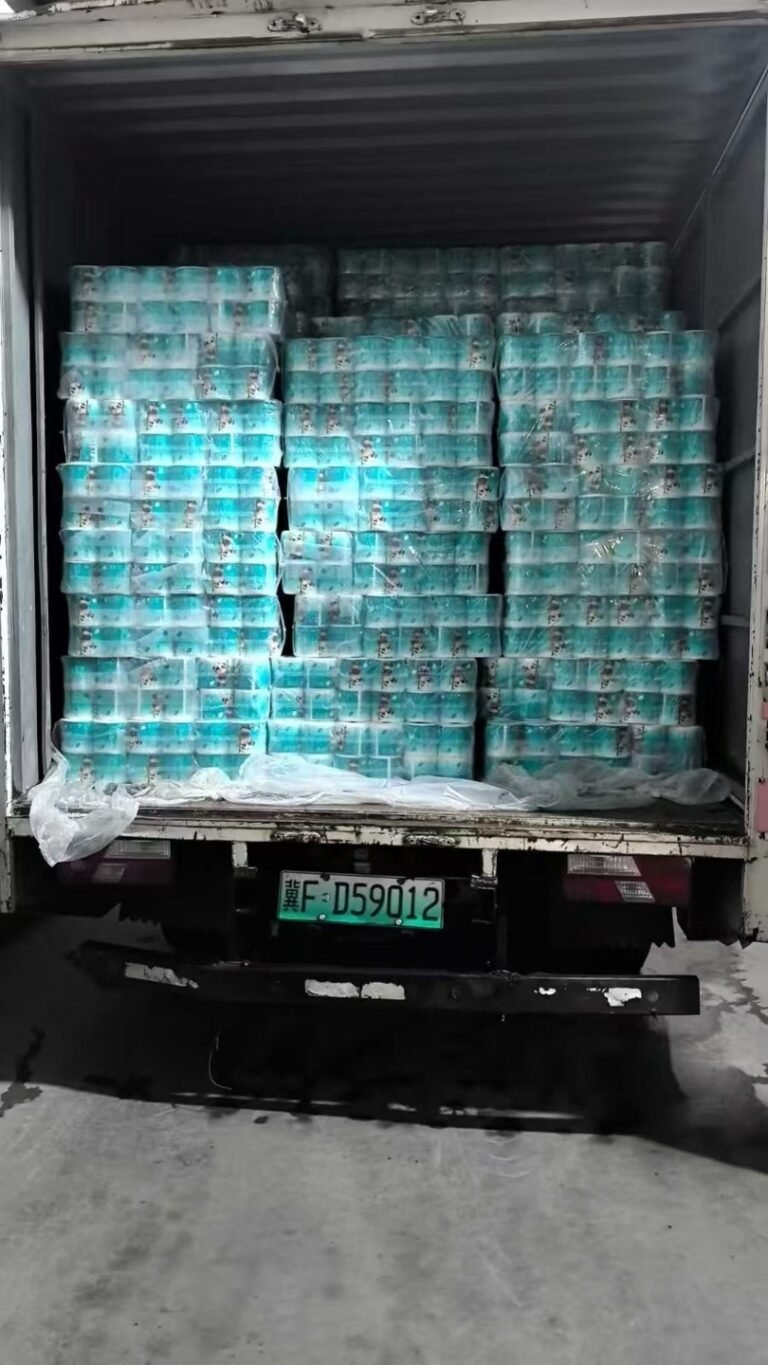
Storage is downstream of the order, but a few origin-side choices make the months in your bay easier to survive. Buy rolls wound and packed to a moisture-controlled standard: the mother-roll and finished-goods controls here track moisture balance at the converting stage, and the export build runs on thickened moisture-proof corrugated outer cartons, fumigation-free pallets and high-tensile strapping, with container airtightness and water-tightness checked before loading, shipped out of Tianjin Xingang under whichever of FOB, CIF, CFR or EXW you trade on. Ask for the with-shipment package as a contract deliverable rather than a courtesy: the 100 percent virgin pulp COA covering tensile strength, brightness and virgin-fibre verification, and the loading and moisture-proof packing photo-and-video record, so your goods-in team is receiving against a known batch condition, not a guess. White-label product ships from a shared 20GP container and custom-printed packaging from one 40’HQ, which is also the practical unit of your dwell: a container you have to hold for two quarters is a container whose bottom tier and exterior-wall bays deserve the extra inspection, not less.
Where This Page Ends and the Rest Begins
This article owns one claim and one job: the aging of a distributor’s warehouse stock is a function of conditions and dwell, and the buyer’s countermeasures are the four checks above plus a batch-labelled FIFO rule. The adjacent questions live on their own pages and should not be confused with this one. The moisture that attacks a sealed container crossing dew point at sea is a before-shipment problem, answered in the container loading and moisture-proof packing guide; the after-arrival months are here. What makes a roll white and how a brightness figure is measured is a different subject again, carried by the brightness guide, which this page deliberately does not repeat. And the decision of how much to stock against a customer’s facility usage, before it ever becomes a dwell problem, belongs to the bulk hand towel facility stocking guide. Read those four together and you have the arc from mill to bay to end user; this one is the bay.
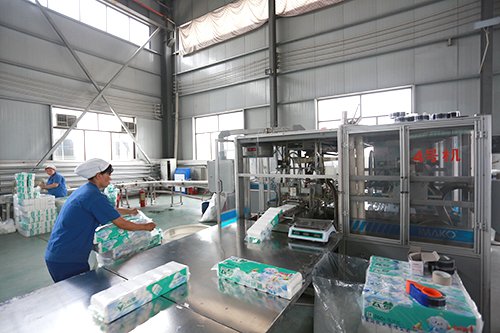
Video: “Precision Manufacturing for Unmatched Quality Toilet paper” on the Top Source Paper channel (@topsourcepaper4025). It shows tissue production where reels and cartons are formed and handled; it is not a warehouse-aging demonstration. Use it as context for the origin-side controls named above: moisture at converting, packing, and the with-shipment evidence you receive against.
Frequently Asked Questions
Does toilet paper in a warehouse have an expiry date?
Not a printed one that governs you. Paper does not carry a food-style expiry; how fast a stored roll degrades is set by the conditions around it and the months it sits, not by a date stamped at the mill. Published paper-storage guidance frames it the same way: relative humidity above 60 percent accelerates chemical and biological deterioration, the recommended level for general paper collections is below 50 percent, and cooler, drier, uncrowded storage lengthens the useful life. Manage the environment and the turnover clock, and treat any shelf-life figure a supplier quotes as a claim to test in your own warehouse, not a guarantee.
Does stacking pallets high crush the rolls on the bottom?
It can, and the damage is cumulative and invisible until you unwrap. Tissue and the corrugated cartons holding it are compressible, so every tier in a pallet column loads the one below it, and over months the bottom rolls can lose roundness, bulge, telescope, or flatten enough to jam a dispenser. Nothing has to touch them directly for this to happen. Inspect the lowest layer of a sampled pallet on receipt and again at a long dwell, keep goods on rated pallets and single-stack unless the packaging is built to double, and treat any stack height that trades warehouse space for product risk as your decision to make, not the mill's to certify.
How do I stop warehouse-floor moisture from wrecking stock?
Get it off the slab and keep it there. Paper and corrugated are hygroscopic, so moisture wicking up through a concrete floor or driven onto an exterior wall softens carton flutes and can move into the product. Store on pallets with a barrier between pallet and slab, leave an air gap off outside walls, and control the relative humidity of the bay rather than reacting to a damp pallet. This is the stationary-side companion to the packing that protects goods during the voyage; that is covered separately on the container loading and moisture-proof packing guide, which deals with before the ship leaves, while this is about months after it arrives.
Does summer heat affect scented or whitened rolls?
Heat is an accelerator, so it shows up first in whatever is most chemically active or volatile in the SKU. Added fragrance carriers volatilise faster in a hot bay, so a scented product loses its top note; inks, adhesives and any brightening dose age and can shift hue as temperature rises. Conservation guidance makes the same point in general form: lower temperature slows the rate of deterioration and raises the useful life, and the converse is what a summer warehouse does to stock parked near a hot roofline. For the record, this mill specifies no added fluorescent brightening agents and runs on 100 percent virgin wood pulp, so its whiteness comes from the pulp and the bleaching rather than a brightener dose; the measurement itself is explained in the brightness guide.
What FIFO practice should a distributor use at arrival?
Label at the dock and rotate oldest first. As each pallet clears receiving, mark it with its production batch and the date it landed, log both to the inventory system, and build the pick rule so the oldest batch on the floor ships before a younger one of the same SKU. Run a periodic aging report that lists how long each lot has sat, and set the point where slow-moving aged stock gets moved toward a selling SKU, repacked, or redirected as a business call you make against your own demand rate. That is not a shelf-life number; it is a turnover rule, and it is what converts dwell time from something happening to you into something you are steering.