Mixed Container Orders for Tissue: Packing Several SKUs into One 40HQ and Still Getting Clean Pricing
Short answer: a mixed container is how growing tissue distributors actually buy, and the factories know it, but it only works when you plan it as three separate problems. First the physics: tissue is low density, so a 40HQ mixed with jumbo rolls, facial tissue and towels hits its volume limit long before its weight limit, and every carton type you add eats floor space through stacking interfaces. Second the packing standard: each product family wants different pallet heights, strapping and protection, and dock trouble almost always traces back to mixed pallet dimensions, not to the goods themselves. Third the pricing: a mixed container is not a campaign, so expect the mixed-SKU rate on the small lines and push the factory to give campaign pricing only on the SKU that fills a meaningful share of the cube. Quote it as a loading plan with per-SKU cubic allocation, not as a product list.
One-SKU containers are for startups and stock runs. The moment your customers want more than one thing, your purchasing becomes Tetris: jumbo rolls for the janitorial accounts, facial tissue for the grocery shelf, towel rolls for the foodservice accounts, and one container that has to carry all of it. Done badly, the mixed container is the most expensive unit a tissue importer ever buys. Done deliberately, it is the instrument that lets a mid-size distributor grow without a warehouse full of dead stock.
Why the Mixed Container Is Where Growing Importers Live
The first order is almost always one SKU at its minimum, which is exactly the logic the 20GP versus 40HQ MOQ guide walks through: a white-label single product fills a smaller box, a custom-printed program wants the big one. Growth breaks that symmetry. Your second customer needs a format the first does not buy; the janitorial line wants cores and the retail line does not; one buyer asks for printed film this quarter. You do not want to run each new SKU in its own container, because freight is a per-container event and you would be paying four bookings, four inspections and four customs entries to deliver what could have been one arrival. So you mix. The failure mode is treating mixing as a convenience rather than as a logistics design problem, and the three sections below are the design.
The Physics: Volume Dies First, and Interfaces Cost You the Cube
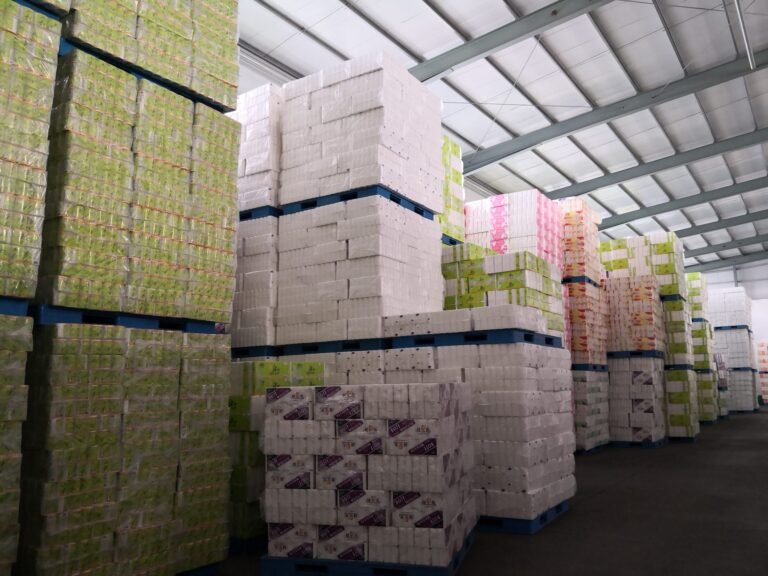
Toilet paper, facial tissue and towel are all roughly the same weight per square meter of fiber, but wildly different densities of finished product: a jumbo roll stack is near-solid, a retail bag of twelve pills is mostly air, and boxed facial tissue lands in between. A tissue 40HQ therefore exhausts its cubic capacity before its payload limit, which means the real currency in a mixed container is floor area, and every time you change product family you pay it twice: once for the pallet footprint that cannot nest with the pallet beside it, and once for the aisle space the loading sequence needs. Two pallet heights that cannot interlock waste more cube than a single bad carton spec does. The practical rule importers converge on: plan the mix around two or three pallet footprints, not two or three SKUs. Ask the factory what pallet sizes each line actually ships on, because the answer is usually bigger than you expect and rarely matches across lines.

Packing Standards: The Dock Problem Starts at the Packer
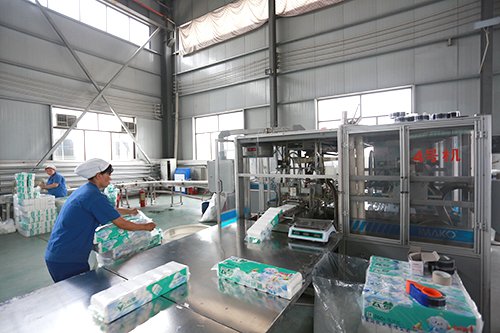
Tissue protects differently per line. Jumbo rolls want compression resistance, because a crushed core means a rejected roll even when the paper is perfect. Retail packs want moisture and abrasion protection, because the film and carton are the product and printed film scuffs the moment pallets shift. Towels want strapping discipline, because towel bales are heavy for their face area and they travel low in the stack where a loose strap becomes a topple at the first tilt. Mixing the three means the packing standard has to be written line by line and confirmed as an exhibit to the order, because a factory that packs your jumbo campaign to retail-pack standards has just bought you freight inefficiency, and the reverse has bought you damage. The moisture layer is the one variable people forget until it costs a container: the same ocean transit that carries your dry goods carries the condensation cycle that kills cartons, which is what the moisture-proof packing guide breaks down, and it applies per product family, not per container.
The Pricing Question: Mixed Load Versus Campaign Rate
Here is where the mixed container quietly loses its argument if you do not negotiate it consciously. Campaign pricing, the first real volume tier described in the volume discounts and call-off guide, is earned by like-with-like runs: the mill saves money because one setup and one artwork cylinder carry across containers. A mixed container gives none of that away, so the honest answer to “what is my campaign rate?” inside a mixed load is: you have a campaign rate for nothing, unless a single SKU occupies a large enough share of the cube that it still gets a dedicated run. The move that works is structural: decide which line is your anchor SKU, ask for that line’s campaign rate on its share of the container, and expect the secondary lines to price at their individual MOQ rates. You will also want the anchor line’s unit economics defended against mixed-loading surcharges: some converters add a per-pallet changeover charge, which is a legitimate cost the first time and a margin leak the fifth time; both should be a named line in the quote, not invisible. The wholesale pricing logic per product line is what the jumbo roll quote audit guide teaches you to read, and the same decomposition applies to every line item the mix creates.
What the Factory Needs in a Mixed-Load RFQ
A factory quoting a mixed container blind quotes worst case, and worst case is your margin. The quote request that gets a real number carries a loading plan: per-SKU quantities in cartons, the carton dimensions per line, target pallet footprints, which lines are printed versus plain, and the loading order preference heavy-low light-high. With that, the mill can price the packing difference honestly instead of padding for ambiguity, and you can compare two factories’ mixed quotes on the same physical plan, which is the only comparison worth making; the quote-level reasoning continues in the low-quote audit guide. One contractual note: who physically does the loading, and under which delivery term, changes who owns the mixed-load risk between warehouse and ship side. Whether you are buying FOB or CIF, the named Incoterms rule assigns that boundary, published officially by the International Chamber of Commerce at iccwbo.org Incoterms rules; quote the exact rule, then argue only about what the rule leaves to you.
Receiving the Mixed Load: Where the Design Gets Graded
The mixed container’s report card arrives on the day, and it is read per line, not per container. The reconciliation discipline in the invoice, packing list and ASN article works the same way, but mixing raises the stakes: one packing list, three products, three counting methods, and short quantities now hide behind carton types that look similar at the dock. Photograph the stacking pattern before unloading, because the interlocked-versus-blocked pattern is your evidence for both shortage claims and damage attribution later. Then grade the cube: what fraction of the container actually carried goods. If you paid for a mixed container and received a container full of dead air between incompatible pallets, the fix goes into the next RFQ’s loading plan, not into a complaint, because the geometry was yours to specify.
FAQ
How many SKUs should one tissue container mix?
Two or three is the practical ceiling, because the constraint is pallet footprints and protection standards rather than SKU count. Beyond three, the stacking interfaces and the per-line reconciliation work start eating the freight saving that motivated the mix.
Do Chinese tissue factories charge more for mixed containers?
They should, slightly and visibly: mixed packing, split artwork and changeover time are real costs. A clean quote line itemizes them; a padded quote folds them invisibly into every unit price, which is how the mix quietly becomes the most expensive way to buy paper.
Can I still get volume pricing on one line in a mixed load?
Yes, if that line occupies enough of the container to justify its own production run. Negotiate the anchor SKU on campaign terms and expect the secondary lines at their own MOQ rates; the split is what a real mixed-load quote looks like.
What causes most damage in mixed tissue containers?
Pallet incompatibility and loose strapping on the heavy low lines, almost never the products themselves. Interlock the footprints, strap to the heaviest standard in the load, and keep the moisture protection per product family rather than per container.
Should mixed loads ship FOB or CIF?
The same per-container logic you would use anywhere, with one twist: a mixed load is one arrival for several buying cycles, so predictable scheduling matters more than usual. Whichever Incoterm you choose, name the 2020 rule in the contract so the loading-risk boundary is written, not assumed.