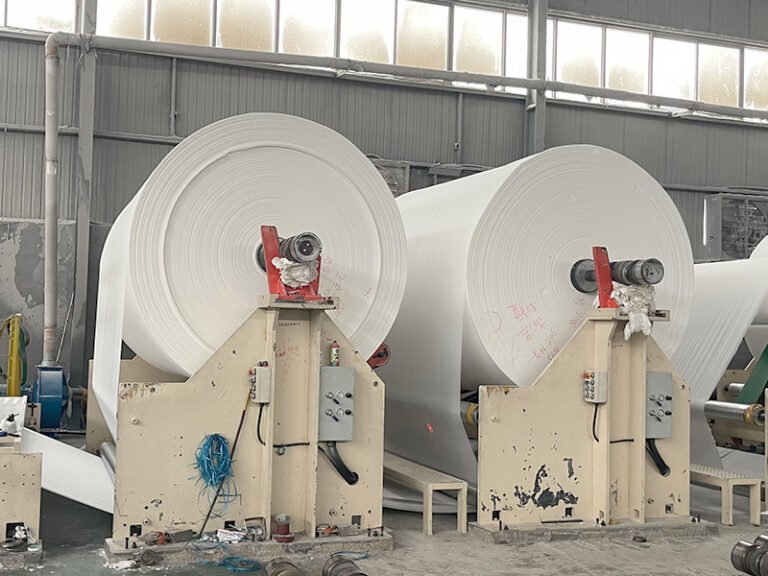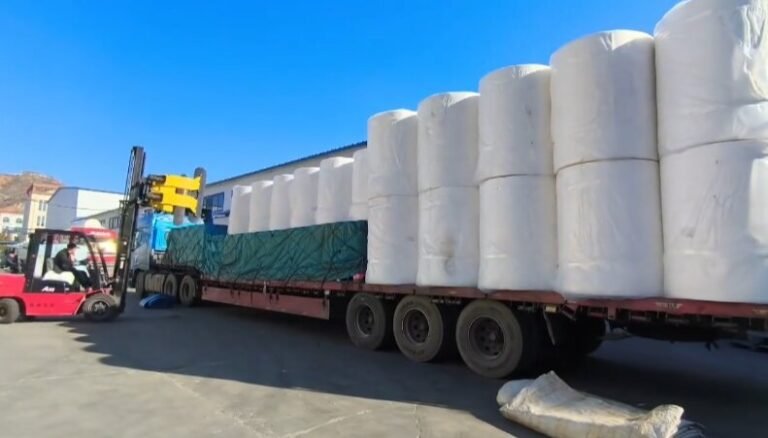
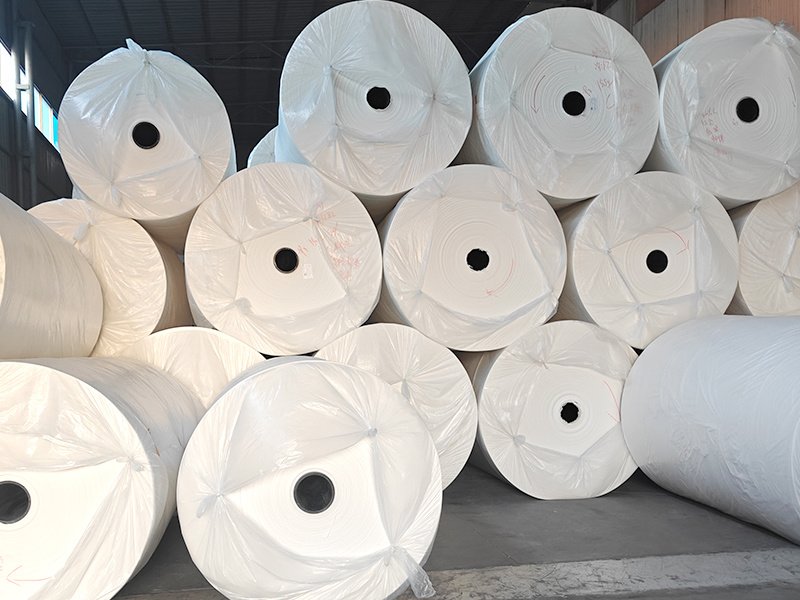
A mother jumbo roll leaves the mill as a weight and reaches your plant hoping to become a length. Between those two states sits everything that decides your margin per shift: the metres lost threading each reel change, the edges slit away to hit a finished width, the reels pulled off-line because the web will not hold tension. None of it is on the specification sheet. The sheet states width, grammage, brightness and tensile; your line records metres in and metres out. That gap is what this guide is about.
We have made virgin-pulp parent rolls for converting plants for eighteen-plus years out of the Baoding Mancheng base, and a supplier can only move part of your yield number. The rest lives on your creel and in your slitter schedule. Knowing which part is which decides whether a container converts or becomes a lesson.
Yield Is Not on the Specification Sheet
A spec sheet is a promise about the paper: web width, basis weight in grams per square metre, brightness, a tensile figure, written to be compared across suppliers on one page. Your converting line does not read that page. It reads the reel — how many metres the creel pulled, how many survived the slitter, how many reached a finished width without a splice, a snap, or a grammage swing that set the rewinder hunting. Two documents describing the same roll, disagreeing by design.
Every plant keeps two accounts. The purchasing account is what you ordered, measured in tonnes; the production account is what you sold onward, measured in metres and units. Their reconciliation is the yield figure nobody puts on a data sheet, and when the two drift it is not one number but a stack of small losses at threading, at the shear, and at rejection. A converter who cannot name the drift treats yield as a mystery, and mysteries get priced into the next order as a defensive buffer.
Most mills talk about yield in a single adjective: uniform. It is a supplier-side comfort word, not a buyer-side number, because a mill never sees your web-width choices or your threading speed. Paper suppliers write the spec, machinery vendors publish the capacity formula, and almost nobody on the supply side publishes the loss account itself — that gap is the article. Furnish verification at goods-in belongs to the virgin-versus-recycled parent-roll guide, and reading a spec sheet as a converter to the converting plant guide.
The Three-Part Loss Stack
Break the gap between tonnes in and metres out into the three places it actually escapes, and each becomes something you can measure, argue about, and reduce. Show them as a stack, not percentages: the shape of the loss matters more than any headline number, and no two lines share a number anyway.
| Loss component | Where it originates | Mill influence | What your line record shows |
|---|---|---|---|
| Threading and set-up scrap | Leader wasted, splice tails and tension ramp at each reel change | Partly — clean, true-wound reels thread faster | Metres binned before the run stabilises |
| Trim and edge scrap | Gap between parent-roll width and the widths you slit to | Partly — width cut to your creel, damage-free edges | Edge kerf plus damaged margin cut at the shear |
| Off-quality rejection | Web breaks, splice-through, grammage drift out of band | Yes — moisture, uniformity, tensile are the mill’s | Reels or metres pulled off-line mid-run |
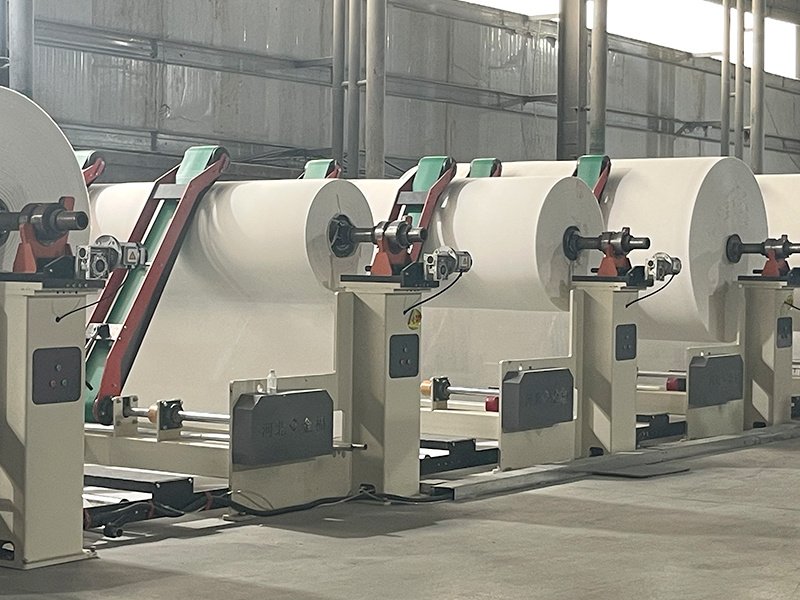
The first two are yours. The first metres of every reel cost you: you thread the leader, ramp tension, wait for the register to settle, and whatever runs during that ramp is scrap. Trim loss is the arithmetic between a parent-roll width and the finished widths you sell — a wider roll sends the difference down the waste chute, which is a scheduling decision, not a defect. The mill can only touch these at the edges, by winding true reels with clean square edges and by cutting width to your creel rather than shipping a warehouse stock size.
The third is largely the mill’s. A broken web, a splice that will not hold, or grammage drifting outside the band that keeps the rewinder honest all trace back to moisture, thickness uniformity, and long-fibre tensile. So the honest split is the whole point of the table above: threading and trim live on your side, off-quality rejection lives on the supply side. The rewind-tension, hardness and slitting detail sits in the jumbo tissue rolls for converters guide.
Delivered Reel Condition as a Yield Input
A reel does not arrive neutral. It arrives with a history — how it was stacked, wrapped and shipped — and that history is written into the first metres you unwind. Treating delivered condition as a yield input, not a courtesy, is the reframe most converters miss.
The outer turns take the beating: a forklift tine, a shifting pallet corner, a load stacked too high. A bruised surface you can peel away is a real cost in metres lost before good paper starts, and it never shows on the waybill; judge it by depth, peel the damage, inspect underneath, escalate only if the crush reaches the core. Splices belong to the same logic: every splice is a place the web can fail at speed, and one buried deep in a tight reel is a splice you find by breaking, not by seeing, so a supplier who keeps joins few and near the outer region hands you back uptime.
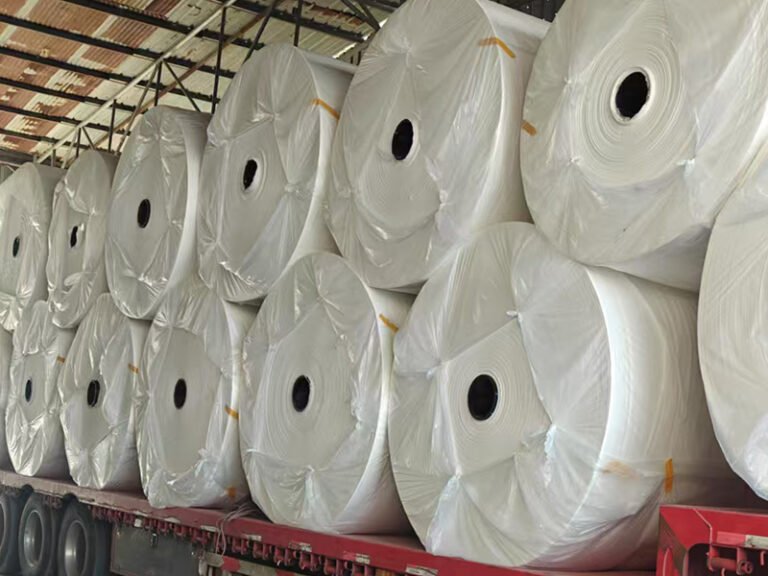
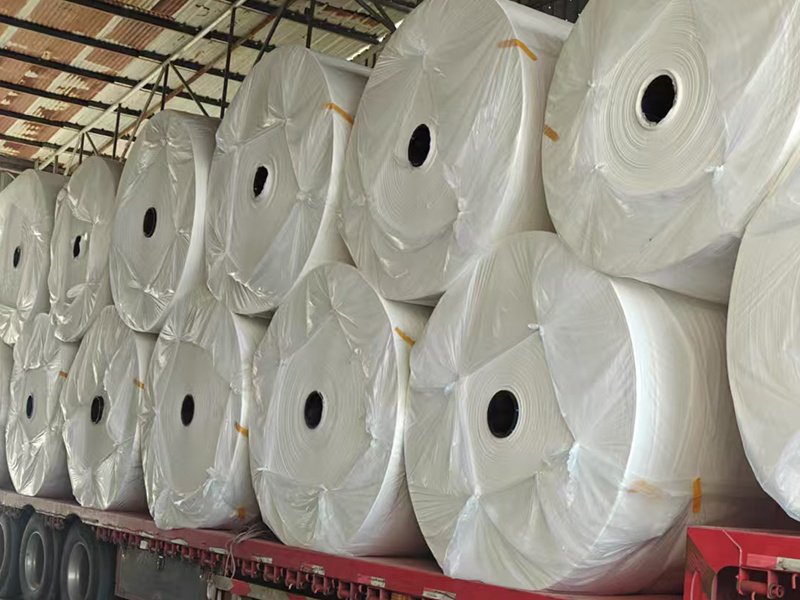
A damp reel turns condition into loss outright. Paper that took on moisture in transit loses tensile, sticks, and winds loose — a yield problem before a quality one. The ocean-leg protection is a packing decision (moisture-proof outer box, pallet strapping, a container checked for water-tightness before the doors close), and the layer-by-layer detail lives in the moisture-proof container-loading guide. Alongside the physical-indicator report and the wet-strength test clip, we ship packing photos and video of your own container, so a crush claim points at a specific pallet and layer instead of a vague complaint.
The Two Mother-Roll Variables the Mill Names
When we specify a mother roll we do not list twenty properties. Two we call out by name as control points, and both are yield variables, not beauty variables — reframing them that way is the reason this page exists.
Moisture balance, and its symptoms on the line
Paper is hygroscopic and will tell you so on the machine. An over-dry web drops tensile and snaps at speed; a reel that drinks moisture on the ocean leg flattens and telescopes; moisture uneven across the web curls, splits under tension, and winds loose. Each symptom becomes off-line time and binned metres, so moisture is held as a named control point to a band, and belongs in your contract with a stated test condition rather than a reassuring sentence.
Ring strength, and its symptoms in storage
Ring-crush strength is the load-bearing property of a reel: it stops a parent roll being squashed by the weight stacked against it in the container and your warehouse. Weak ring strength surfaces later as a deformed reel that will not run true on the creel, and as telescoping when loose outer layers slide off. It is a different property from tensile doing a different job, and a supplier who answers a ring-crush question with a tensile figure has not measured it.
We could print a target for each and look precise, but a number without a test condition is not a measurement, and the right band depends on your width, grammage and line speed. So these two sit as control points with a method, agreed per order, not as a constant dressed as a spec. The basis-weight and fibre-ratio definitions are covered in the parent roll GSM and fibre-ratio guide.
Metres and Tonnes, Never Money
Yield becomes a decision when you express it in the two units that are not money: tonnes in, metres out. Money is where the conversation turns adversarial; metres and tonnes keep it technical, and this guide stays deliberately on the technical side.
For sizing we use the tonnage-per-container figure already set on the supplier-selection side of this topic: a mother-roll order is commonly discussed around 15 tonnes, as recorded in the mother roll tissue suppliers guide. That number is a pointer to an existing decision, not one to re-open here.
Below is a worked illustration, not a published constant. Every number in the input column is a value your line record supplies — your ordered grammage, your working web width, your measured losses — and we endorse none of them for any SKU. The point is the method, shown end to end so you can drop in your own figures.
| Step | Operation | Input source | Illustrative value |
|---|---|---|---|
| Net mass shipped | Start from your per-container tonnage | Your order (the ~15 t pointer above) | e.g. 15 t = 15,000,000 g |
| Total sheet area | Area = mass ÷ grammage (g/m²) | Your GSM (13–45 band) | divide by your GSM |
| Theoretical metres | Metres = area ÷ working width | Your creel width, not ours | divide by your width |
| Less threading scrap | Metres binned per reel change × reel count | Your line record | measured on your machine |
| Less trim scrap | Width gap slit to waste | Your slitter schedule | measured on your machine |
| Less off-quality | Reels or metres pulled off-line | Your quality log | measured on your machine |
| Saleable metres | Theoretical − the three-part stack | Your reconciliation | the number that pays you |
Grammage, working width, threading scrap per reel change, edge kerf and rejection counts are yours; the mill supplies a roll that behaves predictably against them but cannot know them for you. That is why a supplier offering a ready-made “metres per tonne” figure is either guessing or selling. And it is why this page states no price per tonne, no guaranteed percentage yield, no reel width or net weight as a factory constant, and no waste percentage dressed up as a benchmark — expressing yield in metres and tonnes keeps the argument on the physics of your line instead of the arithmetic of a quote.
What Our QC Sequence Hands Your Line Record
A yield claim is only as good as the record behind it. Our three-gate sequence puts evidence into your reconciliation rather than admiration on the factory floor. The parent rolls we run to order are cut and controlled to the downstream rewinding and slitting equipment, and these gates make that sentence checkable.
Gate 1 is a mother-roll spot check on tensile and brightness: the incoming-furnish baseline, evidence that the fibre and strength you specified actually went forward, verified as 100% virgin wood pulp with a physical-indicator report rather than a listing description. Gate 2 runs during rewinding and measures grammage, tension and the perforation line — your runability evidence, because grammage honesty and tension control are what stop the rewinder hunting and keep short-run metres from stealing your length. Gate 3 checks carton specification and runs a drop test before shipping: the delivered-condition proof behind the reel-condition section above, confirming the pack survives the stack and the handling.
Two standing commitments close the loop. Meterage control holds rewind tightness and slit metreage so grammage is not overstated and metres not short. Runability-ready means a mother roll that runs clean on a high-speed machine — no web breaks, no jams — the only definition of good yield a converting plant actually feels. The full mother-jumbo-roll line, with widths, grammage and strength cut to your creel, is on the mother jumbo rolls page.
Acceptance Questions to Put in Front of Any Parent Roll Supplier
Before you commit a container, interrogate the supplier with four yield-specific questions per failure mode, tying every claim to a document and a consequence.
Name a failure — a grammage swing, a crush, a web snap at speed — and ask which of the three gates would catch it; a real quality system answers instantly and specifically, a vague one says “we check everything.” Then ask what document records it — the indicator report, the test clip, the packing photos — because a control point with no paper behind it is a habit, not a control.
Put a concrete claim on the table — a pallet of telescoped reels, a crush reaching the core — and ask exactly what happens, reconciled against which layer, pallet and waybill. A supplier holding packing photos of your own container can localize a claim; one relying on a description cannot. Finally ask the reorder term: how a spec agreed once is preserved on repeat, and where private-label artwork or formula is involved, how it is protected between orders. Ours is archived permanently so a repeat order never re-pays to develop what already works; that protection sits on the OEM and private-label page.
Order Structure and Timing for a Converter
The technical case only pays if the order can be placed and shipped on terms your planning can hold. Here is the shape of a mother-roll order, stated once and linked out rather than re-argued.
Mother rolls ship from a shared 20GP consolidated container — the white-label, plain-pack route for unprinted parent rolls — as covered in the MOQ guide. The move to a full 1×40′HQ applies to custom-printed packaging — printed boxes and printed PE sleeves — not to the plain mother roll itself. Width, grammage, brightness and tensile are cut and controlled to your rewinding and slitting machine, with moisture and ring strength held as named control points.
Sampling and swatches go out in 1–3 working days; a first production run is 25–30 working days, absorbing any plate-making and outer-box print; repeat runs are 20–25. Plan the pilot container to arrive when your creel is free to test it, not when you are already committed. Shipments leave from Tianjin Xingang on FOB, CIF, CFR or EXW terms, on 30% T/T down and the 70% balance before dispatch, with the quality report and a container-seal video released before the goods move.
When your converted output becomes finished commercial formats — the downstream jumbo roll tissue you slit and pack from these reels — sizing and dispenser fit are handled in the jumbo roll tissue buying guide.
Video: “Jumbo Roll Tissue manufacturing process” on the Top Source Paper channel (@topsourcepaper4025). It shows parent-roll production, not the specific line conversion above; use it as process context.
Frequently Asked Questions
How many metres are in a mother jumbo roll?
Nobody can publish one honest number, because metres per roll is the product of the net weight you ship, the grammage you ordered, and the working width your creel runs — all three are yours, not ours. Take your tonnage, divide by areal density to get square metres, divide by web width to get linear metres, then subtract the three-part loss stack. A fixed metres-per-tonne constant would be a guess dressed as a specification.
What causes trim loss on a converting line?
Trim loss sits mostly on the converter's side of the ledger: the gap between the parent-roll web width and the finished widths you slit to, the damaged edge you cut away at the shear, and the tail lost when a new reel is threaded. A supplier cannot set your slitter schedule, but it can deliver clean, square-edged, uniformly wound rolls so your trim stays a decision rather than a repair.
Should I reject a reel with outer-layer crush?
Judge it by depth, not presence. A bruised outer wrap that peels away in a few turns is a handling cost you unwind past and run; crush that reaches the splice band or deforms the core will telescope on the creel and take you off-line, so quarantine those. Either way, record which pallet and layer it came from so a claim has a location — the packing layers reels should arrive in are in the moisture-proof container-loading guide.
Does moisture in a parent roll matter?
More than most buyers expect, and as a yield variable rather than only a quality one. An over-dry web loses tensile and snaps at speed; a reel that absorbs moisture in transit flattens and telescopes; uneven moisture across the web curls, splits and winds loose. That is why moisture is held as a named control point and belongs in your contract as a band with a stated test condition.
What is the MOQ for mother jumbo rolls?
Mother rolls ship from a shared 20GP consolidated container. The full MOQ structure — including where custom-printed packaging moves to a 1×40′HQ — is set out in the MOQ guide for tissue paper orders.
Yield is not a number a supplier hands you; it is a reconciliation you run on your own line, against delivered reels that behave or do not. Ask for the records that make each part of the stack checkable — furnish baseline, runability evidence, delivered-condition proof — and hold the mill to the one part of the loss stack it can actually own.