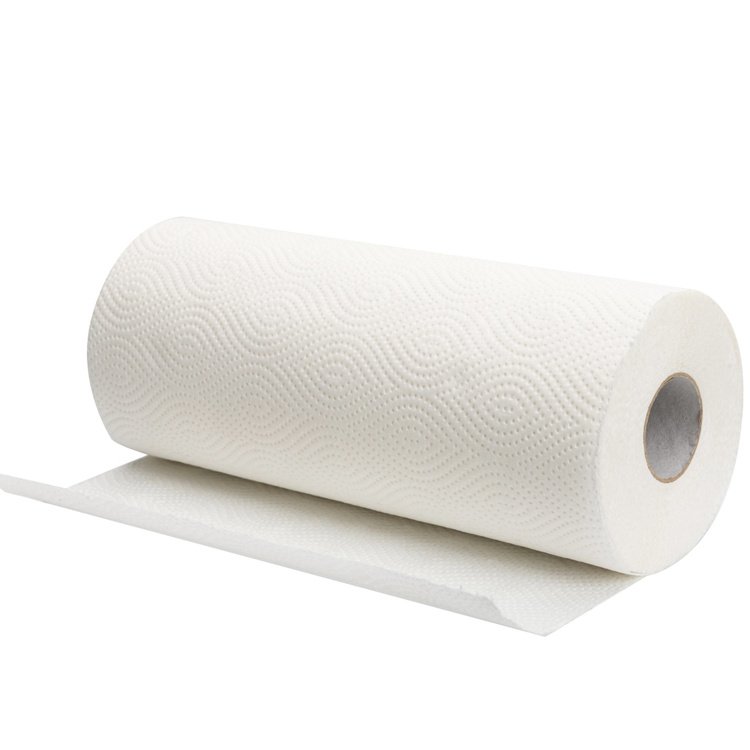
A buyer specifying 100 rolls per case is actually ordering two products at once: the kitchen tissue roll and the packaging that carries it across an ocean transit. The roll spec (GSM, ply, sheet size) is what your marketing team sees; the packaging spec (shrink unit count, film gauge, master-carton construction, print treatment) is what your warehouse team actually receives. When the two disagree, the failure looks like a crushed corner on one carton out of forty, a film split that let humidity in, or a colour band that came back one shade off after a reprint.
Top Source Paper quotes the same paper (100% virgin wood pulp, wet-strength resin on the kitchen paper towels line) under three different packaging regimes — 20GP white-label, mixed-container white-label, and 1×40′HQ private-label. This article maps the packaging variables themselves: what changes at each layer, what arithmetic you can actually run at the PO stage, and what a buyer in a coastal market should refuse to sign off on.
Key Takeaways
- Kitchen roll packaging is three nested layers — the individual PE sleeve on the roll, the shrink-wrap bundle (typically 4 rolls per film unit, adjustable at PO), and the outer corrugated master carton that must survive container stacking.
- Carton geometry is arithmetic, not guesswork: sheet length × sheets per roll = roll length; rolls per bundle × bundles per carton = rolls per carton. Fix all five numbers on the PO before plate-making.
- White-label MOQ is 20GP per product line; custom-print packaging (coloured carton, printed PE sleeve) jumps to 1×40′HQ. That threshold is set by plate minimum, not by demand.
- Ocean freight moisture risk on a Tianjin-Xingang export run is managed with heavy-duty moisture-proof corrugated, fumigation-free pallets, high-tensile strapping, and a pre-load seal-integrity check — all named in Top Source Paper’s ocean-freight protection spec.
- Printed master cartons and printed PE sleeves are two different cost lines with two different MOQ triggers; do not bundle them into one “custom packaging” PO unless you intend both.
- Every container Top Source Paper loads ships with three deliverables the buyer should ask for by name: a 100% Virgin Fibre Verification COA, a burst-resistance QC video, and a loading/moisture-proof packing photo set.
Why Packaging Is a B2B Decision, Not a Retail One
A retail buyer picks a kitchen roll by feel. A B2B buyer picks it by the arithmetic that happens between the factory gate and the shelf. Sheet count, GSM, and embossing pattern are all visible on the product; whether the roll reaches the warehouse intact, whether the film split on a humid crossing, whether the printed colour matched across three pallets, and whether the case count matches the buyer’s own shelf-planning model — those are packaging questions. Much of the friction that shows up on a returning-order correction is a packaging disagreement rather than a paper one.
The packaging decision is also the one a distributor is most likely to inherit. When a Chinese factory ships a “case of 24” and the retailer’s own planogram assumes “case of 30,” neither party is wrong — but the store’s shelf-stocking rhythm breaks. Fixing the case count is a packaging conversation, not a paper one, and it must happen before the plate fee is paid. A large share of the friction that surfaces on a reorder traces to packaging rather than the paper itself, though the exact split depends on your own claim history.
Three Nested Layers: PE Sleeve, Shrink Bundle, Master Carton
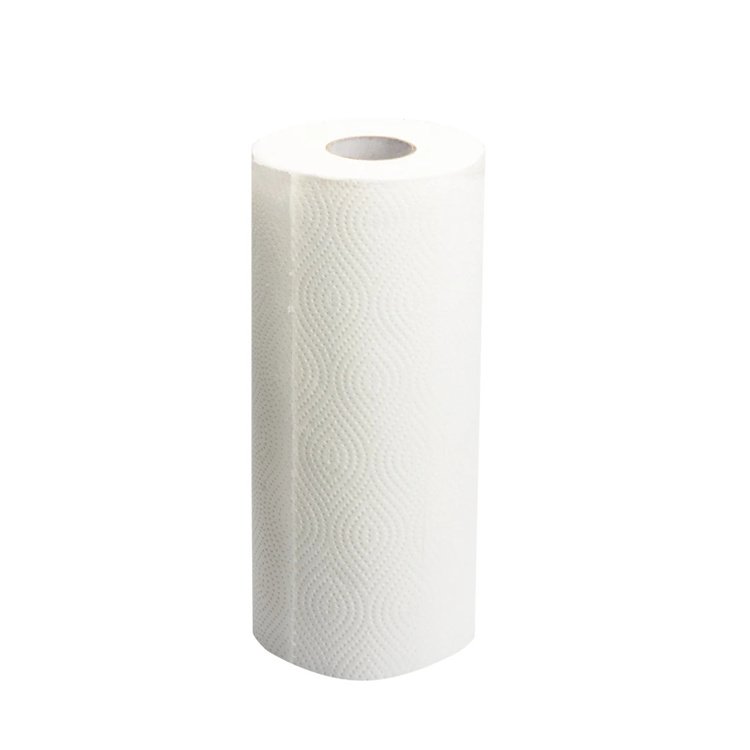
Kitchen tissue roll packaging is not one box. It is three decisions stacked:
- Layer 1 — the PE sleeve on the roll. A thin polyethylene tube, heat-sealed at both ends, that keeps the roll from unspooling and protects the outer sheet from dust. On white-label rolls it is transparent; on private-label it can be rotogravure-printed in one to four colours. This is the layer a buyer at a hardware chain sees when the roll comes out of the case.
- Layer 2 — the shrink-wrap bundle. Rolls tied together under a low-density PE film, heat-tunnel shrunk to a tight rectangle. The bundle is the “unit of convenience” the retailer hands to the shopper. Bundles of two, four, or six rolls are all specified on real kitchen-roll POs; which one you use is a buyer-and-mill agreement set on the PO, not a factory-fixed default.
- Layer 3 — the master carton. The corrugated box the bundles actually travel in. Top Source Paper’s shipping spec names a high-strength, thickened moisture-proof corrugated outer carton chosen so the box survives pallet-level compression; the exact flute class is set per PO rather than fixed in the public spec. The master carton is the layer that shows up at the buyer’s receiving dock and is scanned into their inventory system.
Most of the packaging conversation happens at layer 3. But when a private-label buyer says “custom packaging,” they usually mean layers 1 and 3 together — a printed PE sleeve plus a printed master carton — and the cost of those two is driven by two different plate processes.

The Arithmetic Behind Carton Geometry
Carton geometry is not a market rate; it is arithmetic the buyer and the factory agree on before plate-making. Run the numbers on a PO with the following four inputs:
- Sheet length (cut at the rewind line, in centimetres)
- Sheets per roll (the number that appears on the retail label)
- Rolls per shrink bundle (usually 4)
- Bundles per master carton (this is what determines the case count)
Multiply sheets-per-roll by sheet-length to get roll length in centimetres. Multiply rolls-per-bundle by bundles-per-carton to get rolls per carton. Then divide the target case weight (which the buyer’s own pallet plan sets) by the per-roll weight to sanity-check the case count. If the arithmetic gives you 22 rolls per case and the buyer’s shelf model assumed 24, that mismatch will not disappear at the destination port.
Two practical warnings from the factory side. First, a “5-metre roll” quoted in a spec sheet is only 5 metres if the rewind tension is held at the specified setting; over-tensioned rewinding stretches the sheet length and shortens the effective roll length by up to several percent. Second, sheet-count and roll-count claims that look identical on paper can differ in bulk because of core-tube thickness. The two numbers that actually matter at goods-in are the ones printed on the master carton itself, not the ones that show up in the sample. See How Kitchen Paper Towels Are Made for the wet-strength-resin and embossing steps that set the paper spec behind the arithmetic.
The manufacturing cadence that sets those lead times — rewinding, sheet-count punching, embossing, and case-packing — is what the factory-side video below documents. Watch it before you commit to a case-count on your PO.
Video: “Jumbo Roll Tissue manufacturing process” on the Top Source Paper YouTube channel (@topsourcepaper4025). The clip shows the rewind and case-packing line, not the specific kitchen SKU in this article; use it as process context, not as a product demonstration.
Shrink-Wrap Units: Film Gauge, Bundle Count, and Seal Method
The shrink-wrap unit is the smallest packaging decision that changes the pallet cube. Common configurations for a standard 2-ply kitchen roll line are:
| Bundle Size | Typical Retail Use | Pallet-Cube Impact | Buyer Notes |
|---|---|---|---|
| 2 rolls | Trial packs, small-format grocers | Higher bundle count per carton; more film per roll-metre | Adds ~15-20% film weight per unit versus a 4-roll bundle (arithmetic on film area, not a market rate) |
| 4 rolls | Mainstream supermarket shelf | Balanced; the most common configuration | Works with a range of sheet-cut configurations; confirm your own sheet size on the PO |
| 6 rolls | Warehouse-club and janitorial bulk | Fewer film seams per roll-metre; risk of corner-crush on tall bundles | Requires a taller master carton and often a heavier flute class |
Film gauge is a related decision, and Top Source Paper's kitchen line does not fix a single gauge in its public spec — it is set per PO. A heavier gauge shrinks tighter and resists puncture better than a lighter one, at higher resin cost per bundle (the cost rises roughly with film thickness, arithmetic on material, not a market rate). Ask the mill to confirm the resin grade against your own transit test rather than assuming a gauge. If the retail display depends on the bundle looking crisp on-shelf, specify the heavier gauge on the PO.
Seal method also matters. A centre-seal (fin seal down the back) is common; an end-seal at both ends is used when the buyer wants the roll to hang on a peg without showing a fold-over. If the buyer's chain uses peg strips, specify end-seal at the PO stage. Retrofitting a seal change after plate-making costs a rerun.
Master Carton Configuration: Blank vs Printed
The master carton is the packaging layer that separates a "white-label buyer" from a "private-label buyer." Both are buying the same paper. What differs is the box the paper ships in.
Blank master carton. Kraft-coloured corrugated, one or two colours of flexo print (usually the case count, GSM band, ply, and lot code). MOQ: 20GP per product line. Reorder cadence is fast, plate fee is negligible, and the buyer's own SKU sticker can be applied at their DC. This is the correct choice for a first-time importer testing whether the market accepts the paper at all.
Printed master carton. Multi-colour (one to four colours) litho or flexo, running a brand mark, product art, and compliance text on all four faces. MOQ jumps to 1×40′HQ because the plate minimum requires a container-scale run to amortise. Plate archive is permanent, so return orders do not re-charge the plate — but a colour tweak does.
Hybrid. A printed PE sleeve with a blank master carton. Retail-facing print survives; the receiving-side case label is your warehouse team's problem. This is the cheapest entry into a brand-visible product, and it is the configuration Top Source Paper quotes most often for regional distributors launching their own label. The full private-label packaging stack (printed carton + printed inner bag) is described separately in Private Label Tissue Packaging: Custom Cartons and Inner Bags.
If you are a janitorial distributor buying for a facilities contract and the paper is never seen by a shopper, printed master cartons add cost with no revenue. Skip them. If you are a brand owner launching a supermarket SKU, the printed sleeve alone is not enough — the case also needs to survive open-shelf restocking at the store, which is a printed-carton job.
When Custom Print Pays Back (and When It Does Not)
Custom printing pays back in three cases. It does not in a fourth.
- Pay-back case 1 — supermarket shelf. The retail decision happens at eye level. Printed PE sleeves carry a colour band, a brand mark, and a "product benefits" strip; on-shelf, that print is worth more than any feature of the paper itself.
- Pay-back case 2 — hospitality procurement. Hotels and quick-service restaurants that buy under their own label need the printed master carton to be scannable at the receiving dock; the printed box is a warehouse label, not a marketing one.
- Pay-back case 3 — promotional reseller. Regional janitorial distributors running their own house-brand SKU have to look distinct on their retailer's shelf; the printed case is their differentiation.
- No pay-back — institutional tender. When a hospital or airport buys on a five-year supply contract, the paper never shows to a shopper; the printed box adds cost with no revenue. Blank master cartons win.
A practical rule of thumb: if the buyer's own retail margin is above 30% and the product sits on a shelf the shopper sees, printed packaging pays. If the product sits in a storeroom, printed packaging does not. The full kitchen paper towel product line page lists the SKUs that support each of these packaging routes.
Moisture, Compression, and Ocean Transit Risk
Kitchen paper towels ship from Tianjin Xingang, arrive after the first-order production window of 25-30 working days plus ocean transit on the buyer's own lane, and are typically scanned into the buyer's DC some weeks after plate-release. Along that run the packaging fights three enemies: humidity swing, container condensation, and pallet-level compression.
Top Source Paper's shipping-protection spec names four controls that a buyer should insist on by name in the PO, not assume:
- Heavy-duty moisture-proof corrugated outer carton. Not the same as standard export corrugated. The moisture-proof treatment is a sizing agent applied at the mill stage so the fluting resists water vapour, not just splashing.
- Fumigation-free pallets. Standard export pallets are ISPM-15 heat-treated; fumigation-free pallets are typically pressed-wood, which the receiving-side port authority accepts without an on-site fumigation certificate.
- High-tensile strapping. Steel-band strapping cuts into the carton corner on a rough ride; the high-tensile strapping stretches and holds without crushing the flute.
- Pre-load seal-integrity check. The container is inspected for door-seal and floor integrity before the first pallet goes in. This is a two-minute check that saves weeks of dispute if a container arrives wet.
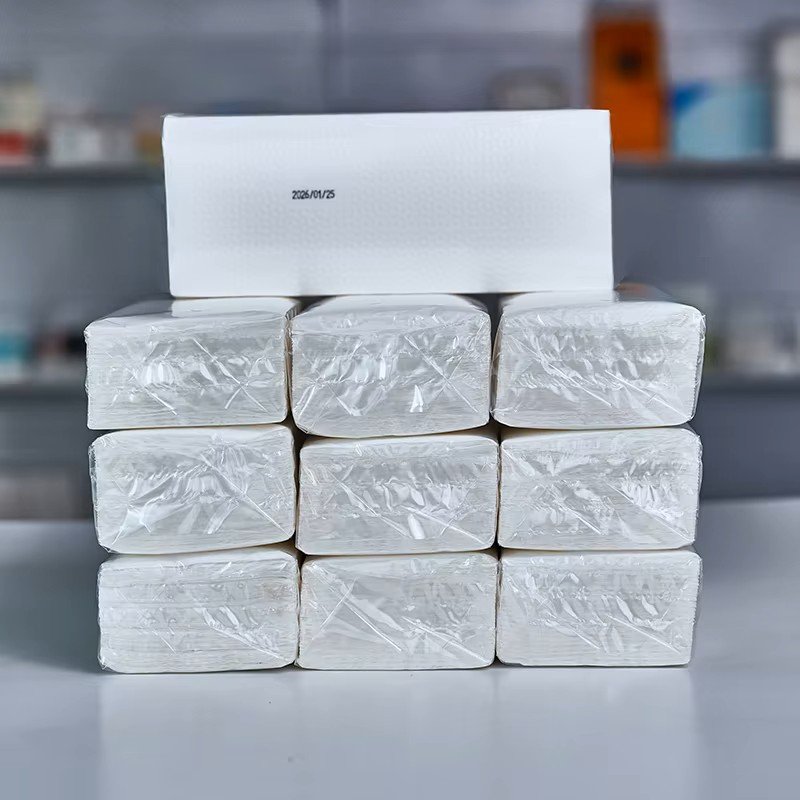
Buyers who skip any of these four controls on a first order commonly discover the failure at the fifth or sixth week when the affected cartons finally reach the shop floor. Ask for the loading photo set — moisture-proof packing is only verifiable after the fact if the factory photographs it, and Top Source Paper does photograph it as part of the deliverable package. The full ocean-freight protection protocol (including the pre-load seal-integrity check as a numbered step) is documented in Container Loading for Tissue Paper: Moisture-Proof Packing.
How the Packaging Choice Sets Your Order Minimum
Two thresholds matter on a kitchen tissue roll packaging conversation.
20GP white-label. One product line, blank master carton, transparent PE sleeve, a four-roll shrink bundle, one pallet tier configuration. The container is what the buyer actually needs to see; MOQ is set by the shipping economics, not by the mill. This is the correct entry point for a first-time importer.
1×40′HQ custom print. Private-label packaging — printed master carton or printed PE sleeve — requires a plate minimum. The plate fee is charged once and archived permanently, so return orders skip it; the first order pays for it. That means the mill's minimum run is a container-scale order, and the standard container for a mixed SKU private-label run is a 40′HQ.
Mixed-container white-label is not the same as 40′HQ custom print. A 40′HQ white-label can carry multiple SKUs (toilet rolls, kitchen rolls, hand towels) under blank master cartons and one PE-sleeve spec. A 40′HQ custom print is a single-SKU private-label order because plate-making ties the run to one packaging design.
If your SKU count is more than four and your packaging is blank, quote a 40′HQ white-label (mixed container). If your SKU count is one and your packaging is printed, quote a 40′HQ custom print. Do not conflate these. For a case-count planning conversation with your own warehouse team, the sister article Paper Towels by the Case: Buying Kitchen Towels in Bulk walks through the receiving-side math.
What the Buyer Signs Off on the PO
Pull the packaging decision into a single sign-off sheet before the plate fee is paid. The PO should specify each of the following in one block, not scattered across emails:
- Sheet length (cm), sheet count per roll, GSM band, ply
- Roll length derived from sheet × count; core-tube thickness
- PE sleeve gauge, transparent or printed, colour count and Pantone reference
- Bundles per master carton and derived rolls-per-carton
- Pallet configuration (cartons per pallet, layers per pallet, corner-board, strapping pattern)
- Container type (20GP white-label or 1×40′HQ custom print) and destination port
- Deliverable package: 100% Virgin Fibre Verification COA, burst-resistance QC video, moisture-proof loading photo set
Anything missing from this block is a conversation you will have after the container has left Tianjin — and after that point, the buyer's leverage drops to zero.
Kitchen Tissue Roll Packaging FAQ
How many rolls come in a kitchen tissue master carton?
There is no single market answer; the buyer's arithmetic decides. A carton of 24 rolls is four shrink bundles of six, for example; 12, 20, 30, or 36 rolls-per-carton all fall out of different bundle × per-carton multiplications, and the buyer's own case-weight and shelf plan pick one. Fix sheet length × sheets-per-roll × rolls-per-bundle × bundles-per-carton on the PO and the case count is the product.
Do I have to buy a 1×40′HQ container just to print my logo on the carton?
Yes. Custom-print packaging — whether a printed master carton or a colour-printed PE sleeve — sits at the 1×40′HQ minimum, because the mill prices any colour-printed carton or printed outer bag as custom print. For brand visibility on a 20GP white-label order, keep the sleeve transparent and the carton blank, then apply your own case label at your DC.
What is the difference between a printed PE sleeve and a printed master carton?
They sit at different layers but both fall under custom print. The printed PE sleeve is the retail-facing wrap on the individual roll; the printed master carton is the shipping case that also acts as a receiving-side label. A colour-printed sleeve and a colour-printed carton are each priced as custom-print packaging (the mill lists a printed carton and a printed outer bag together at the 1×40′HQ threshold), because plate-making is charged per packaging design, not per roll. What stays at the 20GP white-label minimum is a transparent sleeve over a blank carton.
How does Top Source Paper prevent moisture damage during an ocean run?
Four controls, in the PO and in the delivered photo set: heavy-duty moisture-proof corrugated outer carton (water-vapour sizing at the mill stage), fumigation-free pressed-wood pallets, high-tensile strapping, and a pre-load seal-integrity check on the container itself. Buyers should name these on the PO rather than trust the standard export assumption.
Can I mix white-label and private-label SKUs in one container?
Yes on a 20GP white-label (multiple SKUs, all blank master cartons). No on a 1×40′HQ custom print (the plate ties the run to one packaging design). If you need both on the same delivery, quote two containers, or keep the packaging transparent and blank at the 20GP white-label MOQ and defer any print to a separate 1×40′HQ run.
Conclusion
Kitchen tissue roll packaging is where the paper spec meets the shipping reality. Getting the arithmetic right at the PO stage — sheet length, sheets per roll, bundle count, carton geometry, film gauge, print treatment — is what prevents the container arriving with cases your shelf plan cannot absorb, or a printed sleeve your colour team cannot re-approve.
- Three nested layers (PE sleeve, shrink bundle, master carton); decide each independently.
- Carton geometry is arithmetic; write it into the PO, not the email thread.
- White-label 20GP vs private-label 1×40′HQ is a plate-minimum threshold, not a demand threshold.
- Ocean moisture protection is four named controls, all photographable at load time.
- Ask for the COA, the burst-resistance video, and the loading photo set by name.
If you are planning a first container of kitchen tissue roll packaging, the fastest next step is to send us your target sheet count and case-count arithmetic and we will quote the packaging configuration that fits, on the 20GP white-label or 1×40′HQ private-label MOQ as appropriate.