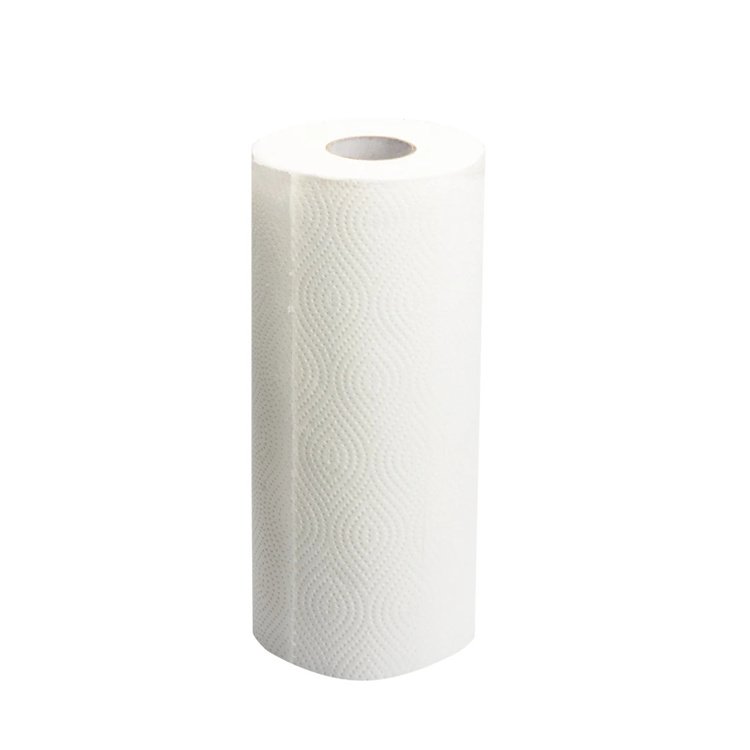
A kitchen paper towel that disintegrates the moment it touches a wet countertop is useless. A kitchen paper towel that stays intact after soaking up a full glass of spilled water is doing exactly what it was engineered to do. The difference between these two outcomes is not the fiber — both towels start from the same 100% virgin wood pulp. The difference is in two manufacturing decisions that happen long before the roll reaches your shelf: the wet-strength resin formulation and the embossing pattern.
For B2B importers sourcing kitchen paper towels in bulk, understanding how these two variables work — and how to specify them in your order — is the difference between a product that performs in the kitchen and a product that generates customer complaints. This guide walks through the manufacturing process step by step, from parent roll to finished kitchen towel, with the technical detail that matters for quality verification.
Step 1: Pulp Preparation and Fiber Blending
Kitchen paper towel production starts with the same raw material as every other tissue product: 100% virgin wood pulp. But the fiber blend is different. Kitchen towels require a higher proportion of long fibers than facial tissue or toilet paper, because long fibers provide the tensile strength that prevents the towel from tearing when wet.
The pulp is mixed with water to create a slurry — typically 99% water and 1% fiber at this stage. The slurry is pumped to the paper machine’s head box, where it is distributed evenly across the wire mesh. The ratio of long to short fibers is calibrated based on the target product: kitchen towels need more long fiber for wet strength; facial tissue needs more short fiber for softness.
This fiber ratio is one of the first specifications a buyer should confirm with their supplier. A factory that controls its own pulping — rather than purchasing pre-made pulp from third parties — has tighter control over this ratio and can adjust it for different product grades.
Step 2: Wet-Strength Resin Application
This is the step that separates kitchen paper towels from other tissue products. During the paper-making process, a wet-strength resin is added to the fiber slurry or applied to the sheet surface. The resin creates cross-links between the cellulose fibers that resist breakdown when the sheet is saturated with water.
The resin type and dosage determine the towel’s wet-burst strength — the force required to tear the sheet when it is fully saturated. Higher resin dosage means higher wet strength, but also higher cost and reduced biodegradability. The optimal dosage depends on the target market:
- Light-duty kitchen towels (1-ply, 13–18 GSM): Lower resin dosage. The towel absorbs water and holds together for basic wiping but breaks down relatively quickly when disposed of.
- Heavy-duty kitchen towels (2-ply, 25–45 GSM): Higher resin dosage. The towel remains intact through repeated wet wiping, wringing, and reuse. This is the “cloth-like” performance that premium kitchen towel brands market.
The resin must be food-contact safe — kitchen towels are used on food preparation surfaces, countertops, and dishes. Established factories use FDA-compliant or EU-regulation-compliant resins that meet food-contact safety requirements. When evaluating suppliers, explicitly confirm the resin type and its food-contact compliance status. This is a non-negotiable specification for any kitchen towel sold into retail or food service channels.
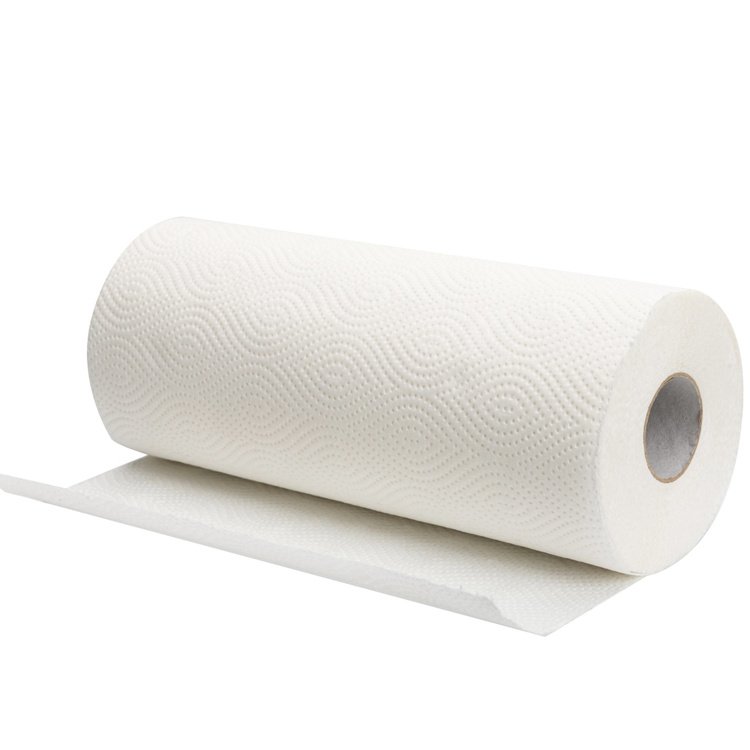
Step 3: Embossing — The Pattern That Creates Absorbency
Embossing is the process of pressing raised patterns into the tissue sheet during manufacturing. For kitchen paper towels, embossing serves two functions:
Surface area increase: The raised pattern creates valleys and peaks across the sheet surface. These channels act as capillary pathways that draw liquid across the towel faster than a flat sheet would. This is why an embossed kitchen towel absorbs a spill in 3 seconds while a flat sheet of the same GSM takes significantly longer.
Layer bonding (for 2-ply towels): In 2-ply kitchen towels, embossing also bonds the two layers together. The raised pattern from one layer interlocks with the pattern on the other layer, creating a unified sheet that performs as a single thicker material. The bonding must be strong enough to prevent delamination during wet use, but not so aggressive that it reduces the sheet’s flexibility.
There are three main embossing patterns for kitchen towels:
| Pattern | Description | Performance |
|---|---|---|
| Point-to-point (diamond) | Raised diamond points that interlock layers | Good absorbency, strong layer bond, standard for mid-range towels |
| Deco (decorative) | Complex raised patterns (flowers, geometric) visible on surface | Premium appearance, good absorbency, common in retail-branded towels |
| Micro (edge) | Fine raised pattern across entire surface | Maximum surface area for absorbency, softer hand-feel, used in premium grades |
The embossing pattern affects both performance and cost. Point-to-point embossing uses standard rollers that are widely available. Deco and micro patterns require custom-engraved rollers — a one-time tooling investment that the factory passes to the buyer as a plate charge. For private-label orders, the embossing pattern is part of the product specification that gets archived for reorders.
Step 4: Drying, Reeling, and Converting
After the wet-strength resin is applied and the sheet is embossed, the paper passes through a series of heated drying cylinders that remove the remaining moisture. The dried sheet — now a continuous web of kitchen towel paper — is wound onto a large parent roll.
The parent roll then moves to the converting line, where it is:
- Rewound onto smaller cores (typically 38 mm or 50 mm for kitchen towel rolls)
- Perforated at regular intervals (usually every 230–250 mm) for tear-off sheets
- Slit to the target roll width (typically 220–230 mm for standard kitchen rolls)
- Cut to the target roll length (measured in meters per roll or sheet count)
The converting precision matters for the end user. Inconsistent perforation leads to sheets that tear at the wrong point. Inconsistent rewinding tension leads to rolls that are loose on one side and tight on the other — a problem that causes the roll to jam in the holder. These are converting defects, not fiber defects, and they are controlled by the factory’s in-process QC monitoring.
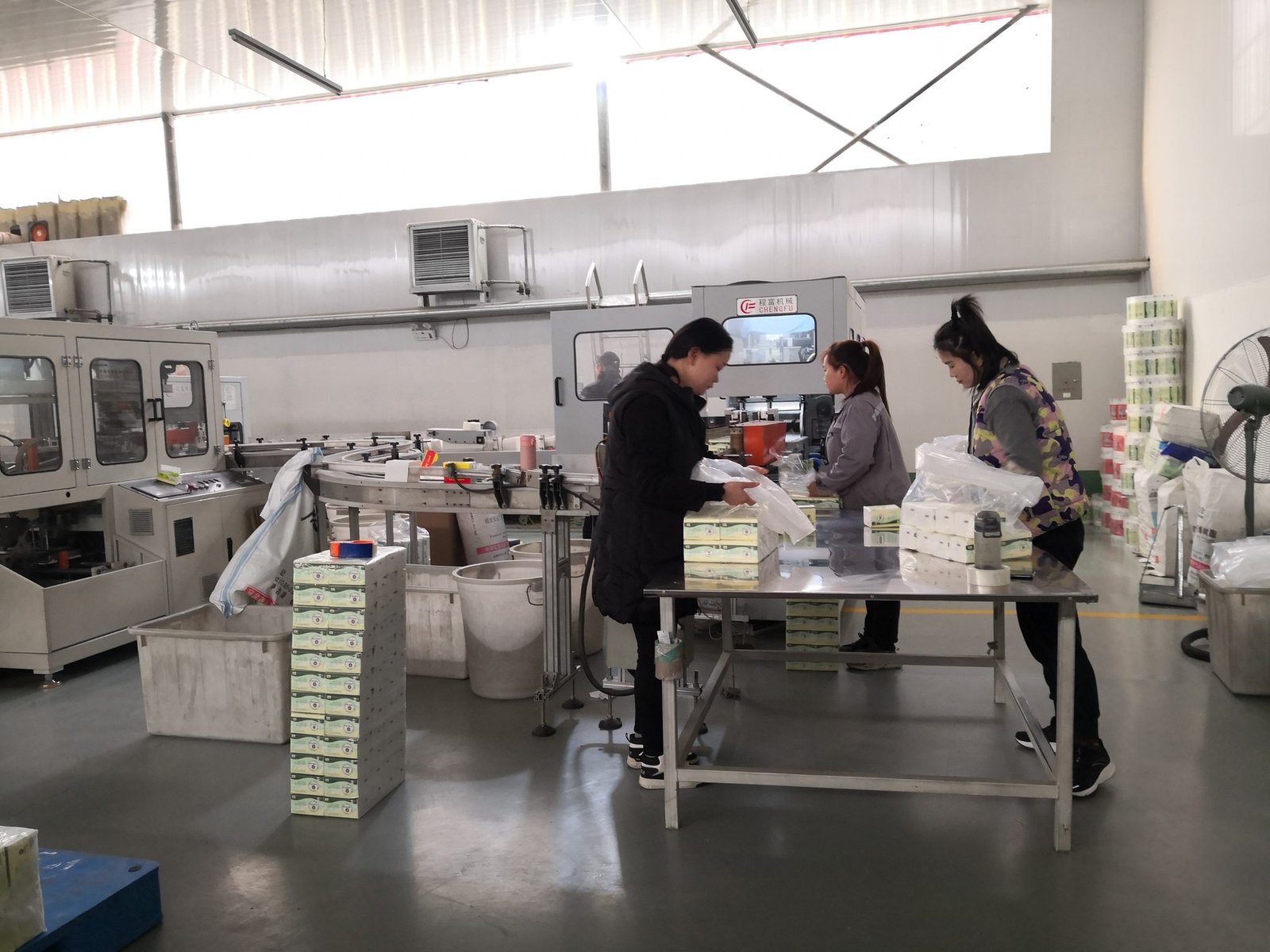
Step 5: Packaging and QC
Finished kitchen towel rolls are packaged in printed PE film or cardboard wraps, depending on the buyer’s specification. For retail packs, rolls are wrapped individually or in multi-packs (3, 6, or 12 rolls). For food service and institutional buyers, rolls are packed in bulk cartons.
Before packaging, the factory’s final QC stage verifies:
- Sheet count accuracy: Each roll contains the specified number of sheets — no short-rolling
- Perforation quality: Sheets tear cleanly at the perforation without ragged edges
- Embossing registration: Pattern is aligned correctly across the roll width
- Wet-strength spot test: Random samples from each production batch are wetted and tested for burst resistance
- Carton drop test: Packaged cartons survive a standard drop test without damage to the rolls inside
Every shipment is accompanied by three deliverables: a COA (Certificate of Analysis) covering tensile strength, brightness, and virgin fiber verification; a quality inspection video showing burst resistance testing; and loading documentation with photos and video of the moisture-proof packing process.
What Importers Should Specify in Their Order
When ordering kitchen paper towels from a virgin pulp factory, these are the specifications to confirm:
- Ply: 1-ply (economy) or 2-ply (premium)
- GSM: 13–18 GSM for light-duty; 25–45 GSM for heavy-duty
- Wet-strength resin: Confirm food-contact compliance and target wet-burst level
- Embossing pattern: Point-to-point, deco, or micro — affects absorbency and appearance
- Roll dimensions: Width (220–230 mm standard), length (meters per roll), core diameter
- Perforation interval: Typically 230–250 mm per sheet
- Packaging: Individual wrap, multi-pack, or bulk carton
These specifications determine both the product performance and the container loading efficiency. A 2-ply towel at 35 GSM with deco embossing loads differently than a 1-ply towel at 15 GSM with point-to-point embossing — the factory’s loading plan should account for weight distribution and carton stacking.
Ordering Terms
Kitchen paper towel orders follow standard B2B terms:
- White-label MOQ: One 20GP container for unprinted rolls in standard packaging
- Custom print MOQ: One 40HQ container for branded packaging or printed towel designs
- Sample lead time: 1–3 business days
- Production lead time: 25–30 business days for first orders; 20–25 for reorders
- Payment: 30% T/T deposit, 70% before shipment
- Shipping: From Tianjin Xingang Port. FOB, CIF, CFR, EXW terms available
For importers evaluating kitchen towel quality, request samples with different embossing patterns and GSM levels to test absorbency performance in your target market’s conditions. Top Source Paper in Baoding, China, provides sample sets with full specification sheets so buyers can compare wet-burst strength, absorption speed, and embossing quality before committing to a container order.
Frequently Asked Questions
Kitchen paper towels use wet-strength resin that creates cross-links between fibers, allowing the towel to remain intact when saturated with water. Regular paper towels lack this resin and disintegrate on contact with moisture. Kitchen towels also feature embossed patterns that create capillary channels for faster liquid absorption.
Yes, when produced by established factories. Kitchen paper towel wet-strength resin must comply with food-contact safety regulations (FDA or EU standards). Always confirm food-contact compliance in your order specification — this is non-negotiable for towels used on food preparation surfaces.
Point-to-point (diamond) embossing provides good absorbency at standard cost. Deco (decorative) patterns offer premium shelf appearance. Micro embossing maximizes surface area for fastest absorption. The choice depends on your target market positioning and price point.
White-label kitchen paper towels start at one 20GP container. Custom-printed packaging requires one 40HQ container. Samples for quality and absorbency testing ship in 1–3 business days.
Kitchen paper towels are engineered products, not commodity tissue. The wet-strength resin formulation and embossing pattern are the two manufacturing decisions that determine whether a towel performs or fails in the kitchen. For importers, specifying these variables — and verifying them through samples and COA documentation — is how you source a product that works as advertised.
The manufacturing process explained here is what makes kitchen towels food-safe; the cleanroom vs food-grade buying guide shows how to specify those properties on a purchase order.
Once the process is clear, the buying question is ply: the 1-ply versus 2-ply comparison covers cost per completed task.
The process explains why a towel holds together wet; the by-the-case guide explains how that product is bought, boxed and resold.