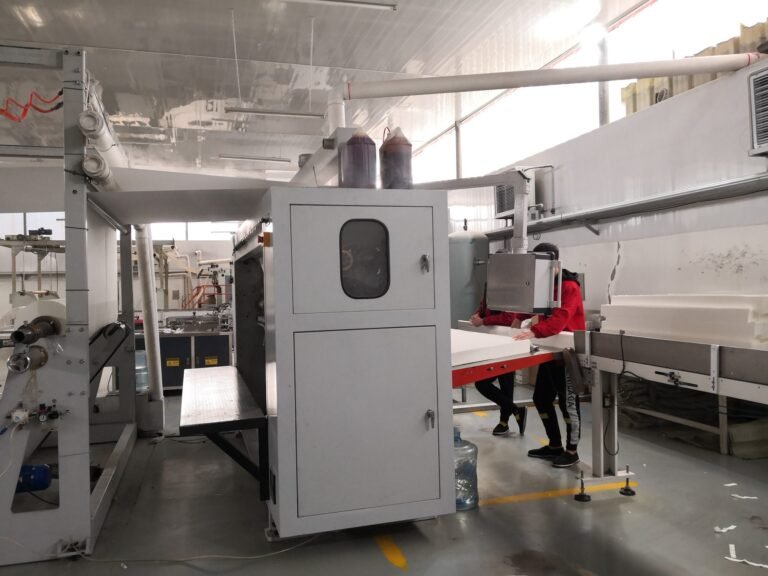
Tissue paper embossing is the one specification on a private-label tissue order that everybody writes down and almost nobody defines. The line arrives as “embossed, 3 ply, decorative pattern,” and the buyer assumes it describes the product. It describes an operation. What actually reaches your warehouse depends on which layer got embossed, how much of the sheet was pressed into that pattern, and what the pressing cost you in strength.
Get that vocabulary right and two things change. Quotes stop being comparable in ways they were not before, and you can put a verification step at goods-in that a supplier cannot argue with. This page is the buyer-side definition sheet: the three pattern families a converting line actually runs, what each one measurably does, and the exact lines to put on a purchase order.
Key Takeaways
- In converting terminology, deco embossing is embossing applied to the top layer of a multi-ply product and micro embossing is embossing applied to the bottom layer; the words name a position, not a quality grade.
- Embossing is what physically joins the plies and it raises bulk, compressibility, liquid absorption and softness – the same operation that can reduce tensile strength and thickness, according to the published converting research.
- This plant runs three families: micro embossing, edge embossing, and the three-dimensional net pattern (deco, point-to-point) used where absorbency is the job.
- Edge embossing bonds plies in thin strips near the perimeter, which is why a facial-tissue sheet can be specified as multi-layer heat-bonded with edges that do not delaminate.
- A pattern is not a formula: ask what the embossing does to paper dust, because the dust position here is a separate micro-pore purification process, not a consequence of the roll.
- “Proprietary pattern” is a commercial request, not an automatic right; what this mill documents is permanent archiving of your artwork and formula files with no repeat plate charge on a reorder.
- Verify at goods-in against a retained reference sample: which face carries the pattern, whether the bond is complete or edge-only, and whether the pattern registration lines up with any print.
- Deco and Micro Name a Position, Not a Grade
- What Embossing Buys and What It Charges
- The Three Pattern Families a Converting Line Runs
- Edge Embossing and the Delamination Question
- Dust Is a Different Dial From Pattern
- Writing Embossing Onto the Purchase Order
- The Proprietary-Pattern Question, Answered Honestly
- Proving the Pattern You Ordered Actually Arrived
- Where This Stops and the Other Guides Begin
- Frequently Asked Questions
Deco and Micro Name a Position, Not a Grade
Start with the definition most spec sheets blur. In the converting literature the distinction is positional: embossing applied to the top layer of a tissue product, one ply or several, is called deco or decorative embossing, while embossing applied to the bottom layer is called micro embossing (Costa Vieira et al., BioResources 15(2), 3888-3898). Neither word tells you the pattern is finer, the product is better, or the embossing is deeper.
Why the Naming Persists on Both Sides of an Argument
Deco sits on the face the shopper sees, so it carries the graphic. Micro sits on the inside face, where its job is to hold the laminate together without disturbing the print. A supplier who writes “micro embossing” on a facial-tissue spec may be describing an inner-face bond, or may be describing a small-dot pattern they call micro because it looks delicate. Ask which of the two they mean, and the answer tells you whether you are talking to someone who stands next to a roll stand.
What a Boolean Attribute Hides
Wholesale listings treat embossing as a tick box: embossed or not embossed. That is not a specification. Two ticked boxes can be a full-face pattern that bonds most of the sheet and a sparse perimeter bond that leaves the field loose, and the two products behave differently on a dispenser, on a shelf and in a complaint email. The attribute that matters is the family, the face it sits on, and the bond fraction – in that order.
What Embossing Buys and What It Charges
Embossing is the mechanical sculpture of the sheet during converting, and it does two jobs at once: it provides the physical connection between the plies, and it presses a pattern into the surface that raises bulk, compressibility, liquid absorption capacity and softness (Vieira et al. 2020). That is the marketing story, and it is true.
The same paper states the invoice. The embossing operation can impair other properties: tensile strength and thickness may both be reduced. The BioResources review of hygiene-tissue softness puts the mechanism plainly – the plies are pressed together either completely or only at the edges, held into a laminate by a pattern of indentations, and the design of the embossing roll itself feeds through into tensile strength and softness.
The Trade Every Buyer Should Price
Read those two sentences together and the trade is obvious to anyone who has handled a return claim. Deep, dense bonding gives you a sheet that survives a wet hand and a fast dispenser, and takes away the loft and the thickness the shopper equates with premium. Sparse bonding gives you a puffy, photogenic sheet and a higher chance the plies separate in the box. Neither setting is correct. The correct answer depends on which complaint your channel can absorb, and it should be written down before the sample run, not after.
The Three Pattern Families a Converting Line Runs
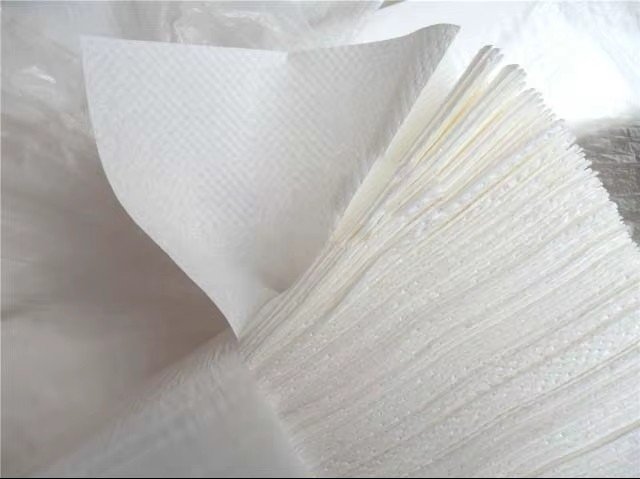
Here the position is documented rather than inferred. This plant runs three embossing families, and each belongs to a different job.
| Family | Where it sits | What it is for | What to confirm |
|---|---|---|---|
| Micro embossing | Inner or bottom face | Bind the laminate quietly; keep the visible face clean | Which face; bond fraction |
| Edge embossing | Thin strips near the perimeter | Hold plies together while leaving the field soft | Strip width; whether centre stays unbonded |
| Deco / point-to-point net | Visible face, three-dimensional | Bulk, absorbency, graphic identity | Pattern depth; print registration |
Where Each Family Lands in This Catalogue
The kitchen-towel line uses the three-dimensional net pattern because that product is sold on absorbency: the pattern is part of the structure that lifts water and oil uptake by 40 percent against the standard sheet, together with a wet-strength resin. That 40 percent belongs to the kitchen line and to no other product on this site. Toilet paper is specified with edge embossing on 13-18 GSM stock. Facial tissue is built as multi-layer composite heat-bonded embossing with edges that do not delaminate – a bonding statement, not a softness claim.
Notice what the pattern families do not do. They do not decide the furnish (that is 100 percent virgin wood pulp with a long/short blend here, and no recovered fibre), and they do not decide the dust behaviour. Treating a pattern as a proxy for either one is how buyers end up with a specification that cannot be enforced.
Edge Embossing and the Delamination Question
Edge embossing is the least understood of the three. In the patent literature it is described precisely: sheets bonded in thin strips, produced by edge embossing (see EP1456473A1). The centre of the sheet stays unconstrained, which is why an edge-bonded two-ply feels like two plies and not like a single stiff sheet.
Why the Delamination Complaint Lands on Facial Tissue
Delamination complaints cluster where a soft hand-feel is demanded and the bonding budget is thin. A box of facial tissue that separates into two layers at the corner of a pull is a bonding failure, not a ply failure – the plies were there. This is why the facial-tissue position here is written as heat-bonded multi-layer composite with edges that do not delaminate: it names the bonding method and the failure mode it is meant to prevent.
The Check That Costs Two Minutes
Take one sheet from a retained sample and pull opposite corners apart slowly, under light. You are looking for where the resistance comes from – a continuous bonded perimeter, discrete bond points, or just friction between loose plies. Then pull again at a right angle to the first direction. A pattern that resists one way and lets go the other has a bond geometry that will behave badly on an automated dispenser, and that observation is made of the sample, not of the datasheet.
Dust Is a Different Dial From Pattern
Embossing displaces fibre; it does not clean it. The reason a sheet sheds powder in a dispenser is upstream, in the furnish and in how the web was creped, slitted and handled. Here that is a separate control: a micro-pore purification step that holds the paper-dust rate down for sensitive-skin and low-dust wiping requirements, verified as a dust and wet-strength inspection on video that ships with the order.
Ask for the dust position in its own line on the spec sheet. When it is folded into a sentence about embossing, nobody owns it, and the first complaint from a hotel housekeeping team arrives with no document to check it against.
Writing Embossing Onto the Purchase Order
Most embossing disputes are lost before they start, because the order document contains a word instead of a requirement. The block below is the minimum that makes the specification enforceable. It is deliberately short; the items the mill does not publish stay on the buyer’s side of the table as questions rather than pretending to be numbers.
Purchase-order language for embossing on a private-label tissue line
“Embossing: state the family (micro / edge / deco point-to-point net), the face it is applied to (top or bottom), and whether bonding is complete or edge-only. Pattern artwork to be identified by a version number on the confirmed sample and repeated on every subsequent shipment.”
“One retained reference sample to be kept by both parties; production goods to match the retained sample on face, bond geometry and registration against any print.”
“Confirm in writing: pattern depth, bond area, engraving or tooling cost, tooling lead time, and whether the pattern is shared with any other customer. None of these are published as standard figures; they are order-specific and must be quoted.”
“Dust behaviour to be specified separately from embossing, with the wet-strength and dust inspection video pack named as a shipment deliverable.”
Two of those lines do most of the work. The version number turns a pattern into a traceable object, and the third paragraph pulls the numbers the buyer does not have out of assumption and onto the paper. Where ply and basis weight are concerned, that dial is turned in a different place and the formulation guide linked at the foot of this page owns it; the embossing line on your PO is one of four levers discussed there and should not be edited in isolation.
The Proprietary-Pattern Question, Answered Honestly
Brand owners ask for a proprietary embossing pattern because it is the cheapest piece of identity available on a tissue sheet: it is tactile, it photographs, and it cannot be matched by a competitor buying the same stock. The honest answer about how far that goes is narrower than most buyers expect.
A pattern pressed into paper is not automatically exclusive to you. Whether a mill will refuse to run your engraving for another customer is a commercial term to be agreed and written, not a property that comes with the artwork. What this site can state as standing policy is the document control around it: client-specific private-label design files and formulas are archived permanently, and a reorder does not attract a repeat plate charge (the packaging-side consequences of that archive are covered separately). Archive and exclusivity are different promises. Take the first one as read and negotiate the second one explicitly.
Ask These Three Questions Before You Assume Ownership
Who holds the engraving after the run? Will the mill state in writing that the pattern is not supplied to another customer in your market? If you change supplier, what physically travels with you – the artwork file, the roller, or nothing? A supplier who answers the third question with “the artwork, and here is the archived version number” is describing a process. One who says “don’t worry about it” is describing a favour.
Proving the Pattern You Ordered Actually Arrived
Embossing is the easiest specification for a shipment to drift on, because a lighter press still looks embossed. The QC sequence behind the checks below is the same first gate every line runs – a tensile and brightness reading on the parent reel – and the full three-gate flow is documented with the rest of the specification sheet in the parent-roll converting guide.
Two cheap checks on your side close the loop. First, confirm the face: lay the sheet flat and identify which side carries the graphic pattern and which carries the bond; if the order said deco on the top face and both faces feel identical, someone ran the web the wrong way round. Second, check registration where embossing meets print: a pattern that has shifted against your logo will look like a misprint and will be refused by a chain buyer who cannot tell which element moved. The formulation guide groups embossing and dust under one design lever; this page separates them because on the purchase order they are bought and verified on different lines.
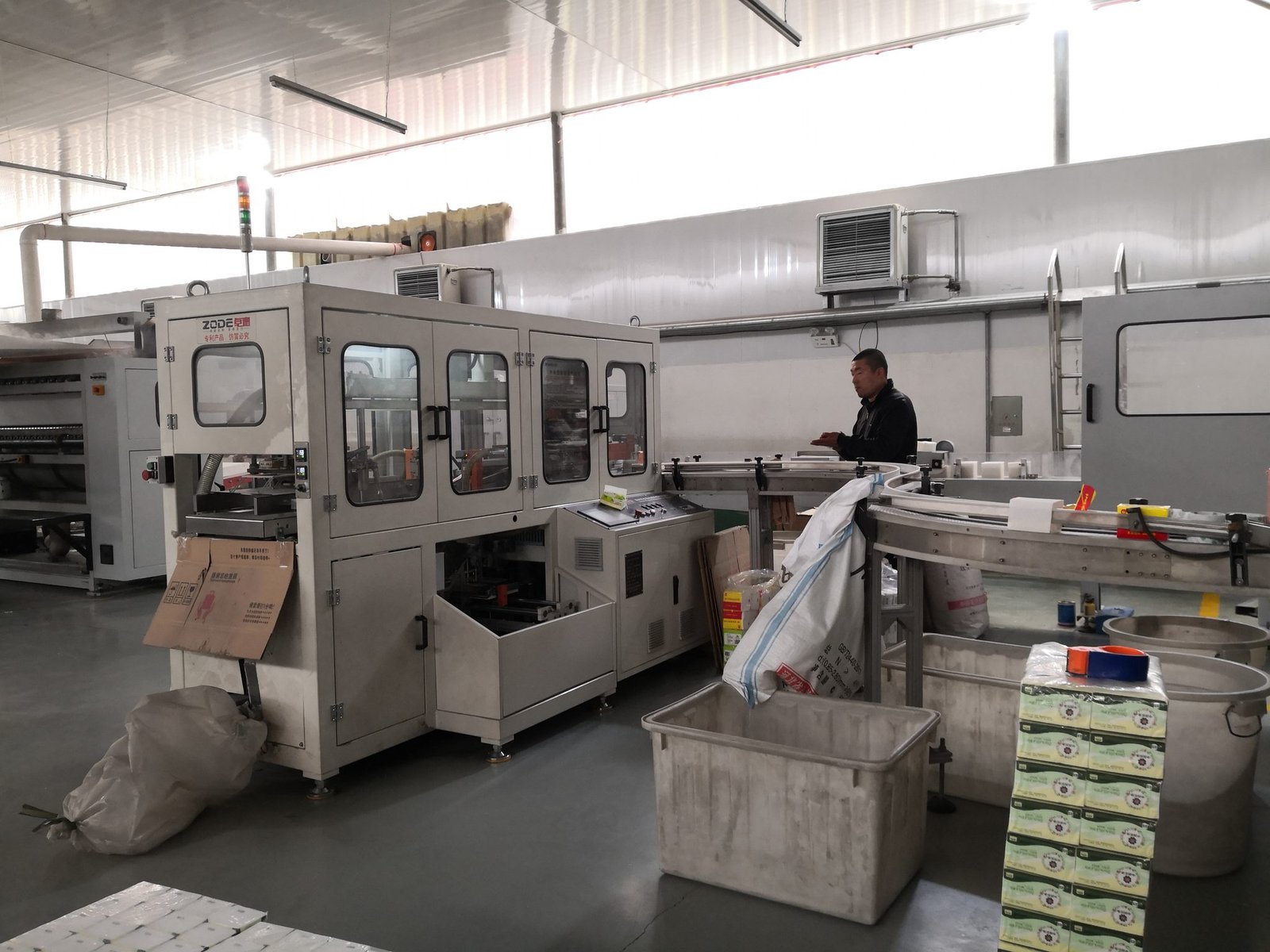
Video: “tissue paper manufacturing process”, from the Top Source Paper channel. Line footage from the tissue process; it is not a close-up of an embossing roll or a pattern-registration demonstration.
Where This Stops and the Other Guides Begin
Three nodes sit outside this page and are handled deliberately elsewhere. If your question is which ply and which basis weight to specify, that is the formulation guide. If it is which pattern feels softest on a premium facial tissue, the hand-feel comparison lives in the soft facial tissue guide. If it is how the net pattern physically creates absorbency inside a kitchen-towel line, that is walked step by step in how kitchen paper towels are made. For converters buying the reel rather than the finished carton, the embossing state is one row in the parent-roll specification sheet.
The route from here is short and fixed: name the family, name the face, name the bond geometry, put a version number on the sample, keep a reference sheet, and check registration at goods-in. When those five lines are on the order, the pattern stops being a photograph in a catalogue and becomes something a shipment can be held to. If you want the private-label programme quoted against a pattern you already have, send the artwork with its version number and the five answers come back before you pay for a sample.
Frequently Asked Questions On Tissue Paper Embossing
What is the difference between deco and micro embossing?
Position, not quality. In converting terminology the top layer of a multi-ply tissue product carries deco, or decorative, embossing, while micro embossing refers to the pattern pressed into the bottom layer. The published converting research uses exactly this split.
Does embossing make tissue more absorbent?
It raises bulk and liquid absorption capacity, which is why a three-dimensional net pattern is used on absorbency-led products such as kitchen towel. The same operation can reduce tensile strength and thickness, so absorbency is bought partly with strength.
What is edge embossing for?
Edge embossing bonds the plies in thin strips near the perimeter and leaves the field loose, which keeps a multi-ply sheet feeling like separate plies rather than one stiff sheet. Specify it if a soft hand and a clean visible face matter more than maximum bond strength.
Can a custom embossing pattern be exclusive to my brand?
Only if the mill agrees it in writing. A pattern is not automatically yours because you paid for the artwork. What is documented here is file control: design drawings and formulas archived permanently and no repeat plate fee on a reorder, which is different from an exclusivity warranty.
How do I check the embossing on a shipment?
Confirm which face carries the pattern against the order, look at bond geometry by pulling corners apart under light, and check pattern registration where the embossing meets any print. Keep a retained reference sample from the approved run, because a lighter press still looks embossed.