
Two quotes land on your desk in the same week. One is bath tissue at a price that looks like a mistake, packed in plain film with nothing printed on the wrapper. The other is a shelf-ready pack with a brand, a roll count and a barcode, and it costs more per roll than the first one by a margin you can barely explain to your own buyer. Both quotes say “wholesale”. They are not the same purchase, and treating them as one is how distributors end up holding inventory that fits neither the shelf nor the contract.
The line that separates them is not price and not thickness. It is who is legally obliged to tell the end buyer what is inside the package, and who is holding the risk of the next container. Get that straight and the format decision almost makes itself.
Key Takeaways
- “Wholesale bath tissue” is two different order objects: bulk-format rolls for facility use, and branded consumer packs bought at a wholesale price.
- A US retail consumer package of multi-ply tissue must state the number of ply and the total number of usable units plus unit size under 16 CFR 500.15, while roll goods are declared by total area and ply, supplemented by a count statement and single-unit dimensions.
- Standard toilet paper from this plant runs 1-ply to 3-ply inside a 13-18 GSM band, cored or coreless, with edge embossing; high-traffic washroom rolls run 18-28 cm in 2-ply or 3-ply.
- Plain and white-label goods ship from a shared 20GP. Custom printed cartons and outer bags start at one 40’HQ, so the shelf-pack route is the one that ties up capital.
- Dispersibility is tested on toilet paper specifically; a third-party lab does not run it as a general tissue parameter, which matters when you place rolls in a restroom.
The Word Wholesale Does Two Different Jobs
Ask three suppliers for “wholesale bath tissue” and you will get three different documents. The first will quote a roll built for a building: a long-meterage roll, wrapped in plain or neutral film, sized to go into a dispenser somebody else chose. The second will quote the same paper in a printed consumer pack sized for a shelf facing, because their factory also prints and they assume that is what you mean. The third will quote a per-roll price with no format at all, and the conversation will collapse when you ask what arrives.
The distinction that actually matters is directional. A facility format is specified against a dispenser and a refill interval, and the person who reads the wrapper is a cleaning contractor. A retail pack is specified against a shelf and a legal declaration, and the person who reads the wrapper is a shopper in ninety seconds. Everything downstream changes with it: who owns the artwork, the minimum commitment, the reorder speed, and what happens when a shipment arrives short.
Once you sort the quotes into those two boxes, the price comparison becomes honest for the first time. A per-roll number is only comparable between two quotes of the same job.
Comparison Spine For A Distributor’s Decision
| Decision point | Bulk facility format | Branded retail pack |
|---|---|---|
| Who reads the wrapper | Contractor or building services crew | Shopper, in seconds, at a shelf |
| Specification you sign off | Meterage, diameter, core, refill interval | Roll count, ply, sheet size, artwork |
| Labelling duty on the pack | Sits upstream with the pack you supply | Sits with whoever’s name is printed on it |
| Minimum order from this plant | Shared 20GP, plain or white-label | One 40’HQ for custom printed cartons |
| First-order lead time | 25-30 working days, no pre-press | 25-30 days including carton printing |
| Reorder rhythm | 20-25 working days, artwork-free | 20-25 days, plate already paid once |
| Failure mode | Roll does not fit the installed dispenser | Pack does not declare what the law requires |
Read the fourth row as the one that decides most first conversations. A shared 20GP lets a new distributor mix grades and test a market with somebody else’s container cost spread across several orders. A printed consumer pack cannot be consolidated the same way, because the plate, the carton and the wrapper all carry your name and nobody else’s. That is a commercial fact, not a small print.
What Retail Packs Demand From You
Sell a consumer pack of bath tissue across a US counter and the package itself becomes a regulated object. The Federal Trade Commission’s counting rule for multi-ply goods says that where a commodity comes in distinct usable units made up of one or more plies, the net quantity declaration must state both the number of ply and the total number of usable units, on top of the size declaration for each unit. The rule’s own worked example is a box of facial tissues: “100 2-ply facial tissues, 8 1/2 inches × 10 inches” (21.5 × 25.4 cm), as 16 CFR 500.15 sets it out.
Rolls get their own treatment inside the same section, and it surprises people. Roll-type commodities are expressly not treated as usable units no matter how they are perforated. They are declared by total area plus the number of ply, and that area figure then has to be supplemented by a count statement and the dimensions of a single unit. Translated into a purchase order, you are buying a number of rolls, of a defined sheet length and width, of a stated ply, and the arithmetic on the front of the pack has to reconcile with all three.
Two consequences follow. First, whoever’s name appears on that pack carries the declaration, so a distributor printing a regional brand is carrying it, not the factory. Second, the numbers cannot be marketing: if a carton claims a meterage the rolls do not carry, the correction is a destroyed print run. Origin marking runs alongside it: 19 CFR 134.11 requires every imported article, or its container, to show the English name of its country of origin to an ultimate US purchaser, conspicuously and permanently.
None of this makes the retail route bad. It makes it a route where your specification has to be finished before your artwork is.
What Bulk Formats Give You Instead
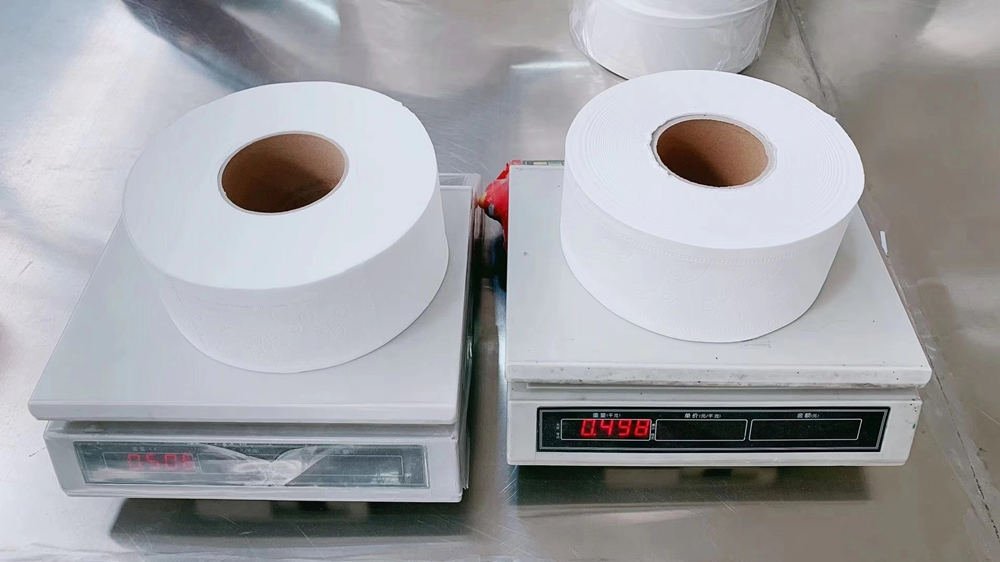
Facility formats skip the declaration argument and put you in front of a harder one: whether the roll fits the hardware already bolted to a wall. Standard rolls in this line run 1-ply through 3-ply inside a 13-18 GSM band, cored or coreless, with edge embossing and a water-soluble, biodegradable specification. Jumbo rolls start at 18 cm and run to 28 cm in diameter, in 2-ply or 3-ply, built with long fibre for tensile strength and sold on meterage rather than on roll count.
That last swap is the whole reason a janitorial buyer prefers them. A 28 cm roll in a locked long-roll dispenser gets refilled on a different week to a standard roll in an open holder, and the labour minutes you save belong to the contractor who services a whole portfolio of buildings instead. Roll count stops being the useful unit and metres-per-fixture-per-week becomes it.
There is a disposal consequence worth putting in front of your facilities customers, and it is not obvious. Third-party testing of dry tissue groups the usage-performance parameters as water absorbency, dusting rate, dust content and dispersibility, and it marks dispersibility as a parameter run for toilet paper specifically. That is the line a distributor uses to settle a customer who drops a facial tissue box in a restroom: the category expected to break down is bath tissue, and everything else is a different specification.

Roll Count Is A Purchase Order Term
Ask a distributor how many rolls are in a case and you will get a number, then an apology, then a different number for the next grade. There is no standard case. There is a carton you agree on and a cube you measure, and the only version of that sentence that survives a second delivery is the one written on the order.
| Order line | What a vague version costs you | What it should read |
|---|---|---|
| Rolls per carton | Case count drifts between shipments | Fixed integer, tied to the carton spec |
| Ply | “Thick” becomes whatever the mill had | 1-ply, 2-ply or 3-ply stated per grade |
| Grammage | Cannot audit against the COA | Target GSM inside the stated band |
| Meterage per roll | Short metres paid at a good rate | Metres, plus sheet length and width |
| Core | Roll spins in the dispenser | Cored with an internal diameter, or coreless |
| Embossing | Perceived quality drops with no defect | Edge embossing, or the pattern named |
Two of those six lines carry more risk than the rest. Grammage is the one an importer can verify on arrival against the certificate of analysis that travels with the shipment. Meterage is the one an importer usually only discovers when the refill interval shortens and a complaint arrives that nobody can measure from the paperwork. This plant’s published position is that rewind tightness and cut length are controlled and grammage is not inflated, which is the sentence you should require in writing from every supplier you are comparing.
Dimensions themselves are not a mystery, and they are already documented separately in the roll dimensions guide, so they are not re-derived here.
Where Cost Per Use Flips The Answer
A cheaper roll and a cheaper month are different things, and the variable that separates them is consumption per fixture rather than price per carton. Run the arithmetic on your own numbers, because a supplier’s version of it is always flattering.
Take three inputs you already have. Delivered cost per roll, freight included. Metres per roll, taken from the specification and not the carton art. Refills per fixture per week in your own buildings. Multiply cost per metre by metres consumed and you have a cost per occupied week, which is the only figure that compares a standard roll with a jumbo one. Substitute your own values, because the term that flips the ranking is the refill count, and only a walk-round of your own sites produces it.
Verdict on bulk formats: they win wherever labour, not paper, is the expensive line. A contractor servicing dozens of washrooms buys fewer visits before the bin overflows, and the overflow complaint is what actually costs them the contract.
Verdict on retail packs: they win wherever the shopper reads the front of the pack, and nowhere else. If your channel is a shelf, a long-metreage roll is not a cheaper product there; it is an unlabelled one, and it will be treated as suspicious by the buyer who cannot see a count.
A distributor worth anything in this category carries both and stops pretending the quote sheets are comparable. The jumbo against standard roll comparison covers the format mechanics; the decision here is which of those two order objects your channel can actually sell.
Storage Cube Nobody Puts On The Quote
Bath tissue is cheap by weight and expensive by volume, and volume is the constraint that quietly punishes the wrong decision. A container of rolls arrives as a floor-space commitment that stays with you through every week the stock does not move.
Work the direction rather than the number, because only you know your rent. A printed retail pack is the higher-risk hold: dedicated artwork, a dedicated carton spec and a full 40’HQ behind it, and if the brand does not sell, nobody else can sell it for you. A plain or white-label load in a shared 20GP is the lower-risk hold: the same paper can go to a contractor, a reseller who boxes it themselves, or a second market at a different price, because nothing printed on it commits you to one customer. That flexibility is worth money at exactly the point most buyers stop counting it, which is the second container.
The first order is almost never the one that hurts. It is the reorder you place after a good quarter, sized on the quarter rather than on the channel, arriving as printed cartons you now cannot move. If you want one rule, it is this: commit print to a channel that has already turned twice, and commit bulk to whichever one of your customers refills fastest.
Which Channel Fits Which Buyer
| Your channel | Stock | Because |
|---|---|---|
| Janitorial and building-services supply | JRT and long-metreage rolls | Refill labour dominates, not sheet feel |
| Cash-and-carry and trade counter | Both, plain-packed | Trade buyers compare by the metre, not the artwork |
| Independent grocery and regional chains | Branded or private-label packs | The shopper needs a count on the front |
| Property management portfolios | Bulk cored or coreless rolls | Dispenser types vary floor to floor |
| First container as a new importer | Shared 20GP, mixed grades | Tests two markets on someone else’s freight |
| Established distributor adding a brand | 1×40’HQ printed run | Plate and packaging cost is amortised once |
The row that catches most people is the last one. A distributor who has moved bulk for three years often decides to launch a brand on the strength of that volume, and discovers that a proven paper and a proven pack are different problems. Formats and inner-bag options for that move are on the toilet paper line page, and the container arithmetic belongs to the bulk sourcing guide.
For a buyer whose channel is contracts rather than shelves, the janitorial-side reading of the same paper is written up separately for commercial supply decisions.
What To Ask Before A Second Container
Ask for the evidence, not the assurance. Shipments here carry the standard certificate, test-video and loading-photo set that the reseller guide already itemises: a physical-index certificate, a wet-strength and dust test video pack, and loading and moisture-proof packing photos. A supplier who cannot send those without a request is selling you a price and hoping you do not check.
Then ask the two questions that decide whether your second order is easy. First, what controls grammage between the sample and the container, and who measures it before shipping? This line runs the same three-stage QC flow as every bulk order, which the bulk sourcing guide spells out stage by stage. Second, what happens on a reorder, in working days, once the carton is already paid for? Plain and white-label goods run 1-3 working days for samples, 25-30 for first production and 20-25 for reorders.
If your buyers sell into Europe, expect the eco conversation early. The European Commission runs an EU Ecolabel product group for tissue paper and tissue products covering tissues, toilet paper and napkins, currently set by Commission Decision (EU) 2019/70 and valid to 31 December 2028, with licence numbers in the form XX/YYY/ZZZ. Top Source Paper supplies 100% virgin wood pulp with no fluorescent brightening agents and no harmful chemical additives, and does not hold or claim that licence; a customer who needs it needs a licensed supplier.
Bottom line: decide whose name carries the declaration before you decide which price to accept. Bulk formats earn their money back in refill labour; printed packs earn theirs on a shelf and cost you a container of dedicated risk. A distributor who can say which of those two jobs a quote is doing will never again compare two numbers that mean different things.

Video: “toilet tissue paper manufacturing process”, Top Source Paper own channel
Frequently Asked Questions On Wholesale Bath Tissue
Is wholesale bath tissue the same as bulk toilet paper?
Not always. “Bulk” is a roll built for facility use and sold on meterage; “wholesale” can also mean a branded consumer pack bought at trade prices, with different order minimums and labelling duties.
How many rolls are in a case of bath tissue?
There is no standard case. Rolls per carton is a purchase-order term you agree with the supplier and fix in writing, alongside ply, grammage, meterage and core, so that a later shipment cannot quietly change the count.
What must a US retail pack of bath tissue declare?
For counted multi-ply goods, the number of ply and the total usable units, plus the size of a single unit. Roll goods are declared by total area and ply, supplemented by a count statement and single-unit dimensions.
Which is cheaper over a year, jumbo rolls or standard rolls?
Jumbo rolls usually win where refill labour dominates, because fewer refills consume less paper per occupied week. Divide delivered cost by metres, not by rolls, using your own refill counts.
Can I mix grades in one container?
Yes for plain or white-label goods, which ship from a shared 20GP. Custom printed cartons and outer bags start at one 40’HQ, so a mixed trial is the cheap route and a printed run is the committed one.
A retail pack sells partly on how white it photographs, and the toilet paper brightness guide explains what a brightness number on that spec sheet can and cannot prove.