A restaurant chain in Germany plans to roll out branded napkins across 40 locations. A wedding planner in California needs 5,000 custom-printed cocktail napkins for a single event season. An FMCG company in Australia wants to add a promotional napkin line to its hospitality catalog. All three are searching for the same thing: a factory that can produce personalized cocktail napkins in bulk, with consistent print quality, food-safe ink, and reliable delivery — at a price that makes commercial sense.
Custom napkin sourcing is deceptively simple on the surface. Every tissue factory claims to print napkins. But the details — ink type, fold precision, registration accuracy, food-contact compliance, and plate-making economics — separate suppliers who can deliver a premium branded product from those who produce napkins that smear, misalign, or arrive damaged. This guide walks through the specifications that matter, the customization options available, and the ordering process from sample approval to container delivery.
What Is a Cocktail Napkin: Size, Fold, and Use Case
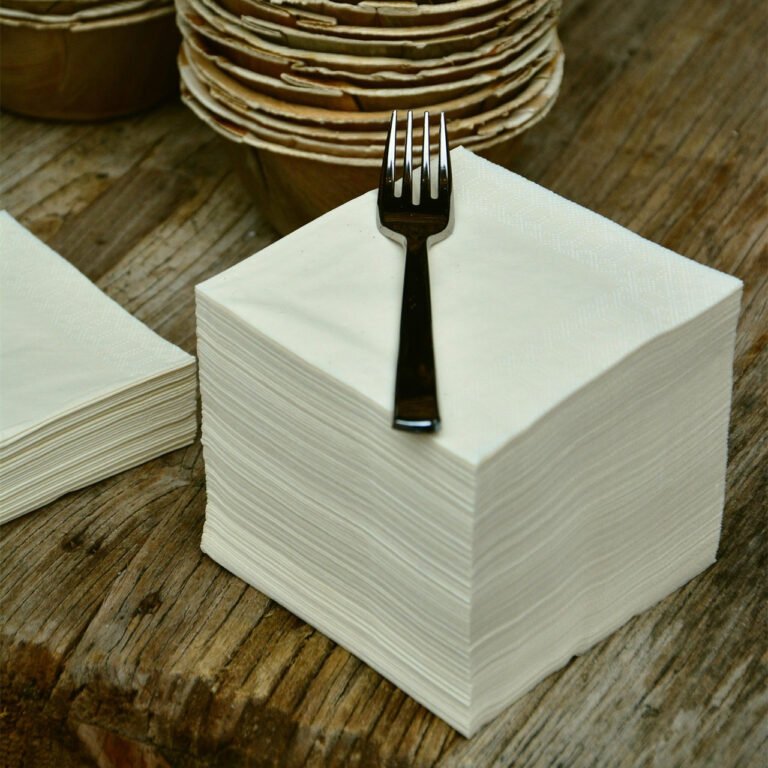
A cocktail napkin is a small-format napkin — typically 25 cm × 25 cm (10″ × 10″) when unfolded — designed for beverage service, appetizer plates, and bar counters. It is smaller than a dinner napkin (40–45 cm) and larger than a luncheon napkin (33 cm). The compact size makes it the highest-volume napkin category in food service: bars, cafes, catering events, and hotel lobbies go through cocktail napkins at a rate that dwarfs dinner napkin consumption.
For B2B buyers, cocktail napkins represent a high-frequency reorder product. Unlike dinner napkins, which may be purchased quarterly, cocktail napkins are consumed daily — making them an ideal product for building recurring supply relationships with consistent quality.
Customization Options: What Can Be Personalized
When ordering personalized cocktail napkins in bulk, these are the variables you can customize:
1. Printing: 1 to 4 Colors
Custom napkin printing uses eco water-based ink — not solvent-based ink. Water-based ink is food-contact safe, odorless, and does not transfer to skin or clothing during use. It is the industry standard for napkins used in food service.
The number of print colors affects both the visual impact and the cost:
- 1-color print: Logo only, or a single-color pattern. Most economical. Ideal for restaurant logos, monograms, and simple branding.
- 2-color print: Logo plus accent color. Adds visual depth without significant cost increase.
- 3–4 color print: Full-color designs, photographic elements, or complex brand patterns. Requires separate printing plates per color, increasing plate-making cost but delivering premium visual quality.
Each additional color requires a separate printing plate. Plate-making is a one-time cost per design — and reputable factories archive your plates permanently, so reorders do not incur repeat plate charges.
2. Ply: 1-Ply or 2-Ply
Cocktail napkins are available in both 1-ply and 2-ply construction. The choice depends on the use case:
- 1-ply: Thinner, more economical, suitable for high-volume low-cost applications (fast food, casual dining, large events).
- 2-ply: Thicker, more absorbent, premium feel. The two layers can be embossed together for added texture. Preferred for upscale restaurants, hotel bars, and branded event napkins.
Both ply options are produced from 100% virgin wood pulp. The fiber quality ensures the napkin is soft to the touch, free of dust and loose particles, and does not leave residue on glassware or skin.
3. Fold: 1/4 Fold or 1/8 Fold
The fold determines how the napkin presents in the dispenser or on the table:
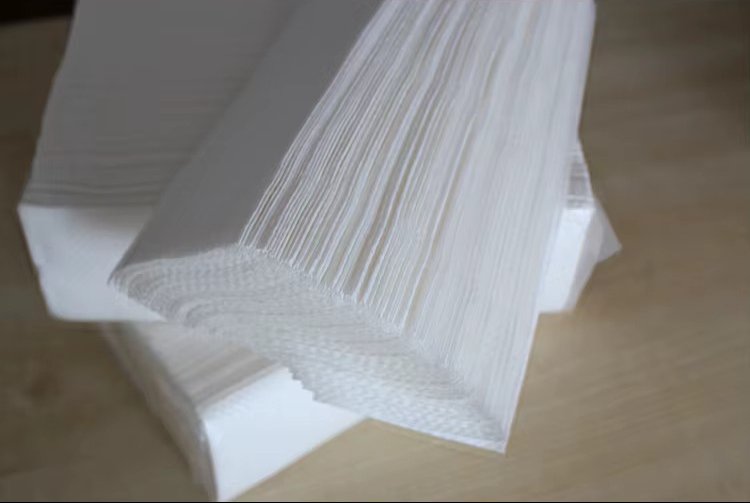
- 1/4 fold: The napkin folds into quarters, resulting in a compact square approximately 12.5 cm × 12.5 cm. This is the most common fold for cocktail napkins and fits standard dispenser trays.
- 1/8 fold: An additional fold creates an even more compact package. Used when napkin storage space is limited or when the napkin is pre-packaged in a holder.
For dispenser-fed applications in commercial settings, confirm the fold type matches the dispenser hardware. For table-service applications, the fold is less critical — the napkin is typically placed unfolded or in an open dispenser.
4. Decorative Border Embossing
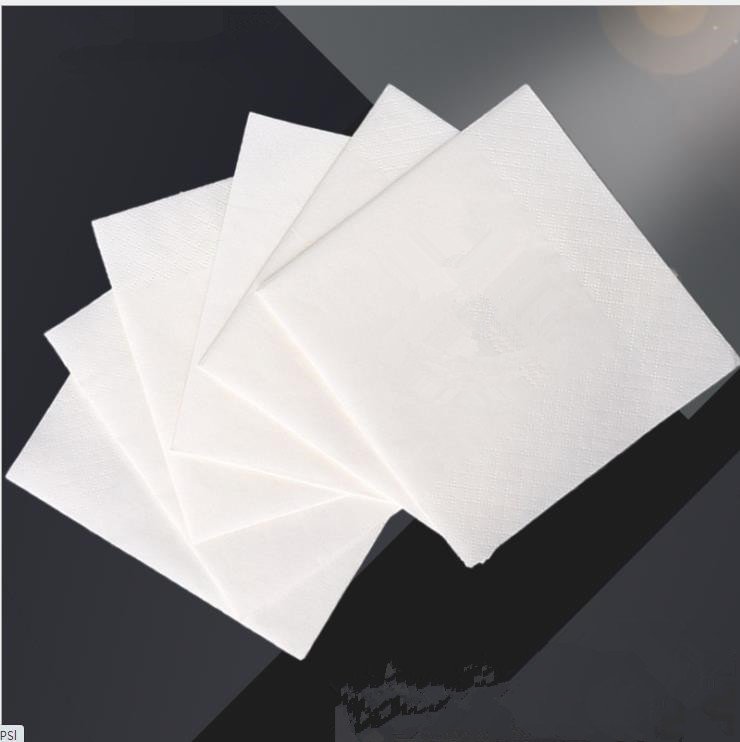
Beyond printing, cocktail napkins can feature decorative border embossing — a raised pattern pressed into the paper during manufacturing. This adds tactile quality and visual sophistication without additional ink cost. Common embossing patterns include:
- Simple line borders
- Geometric repeating patterns
- Custom brand-specific patterns (requires custom embossing roller)
Custom embossing rollers are a one-time tooling investment. For brands planning long-term napkin programs, the roller cost amortizes quickly across reorders.
Food Safety: Why Water-Based Ink Matters
Cocktail napkins are used in direct contact with food, beverages, and skin. The ink used for printing must meet food-contact safety standards. Water-based ink — the type used by established tissue manufacturers — is:
- Non-toxic: No harmful solvents or volatile organic compounds (VOCs)
- Odorless: Does not affect the taste or smell of beverages and food
- Smear-resistant: Once dried, the ink does not transfer to glasses, clothing, or skin during normal use
- Biodegradable: Compatible with the 100% virgin wood pulp base, allowing the napkin to decompose naturally after disposal
When evaluating suppliers, explicitly confirm that the printing process uses water-based ink. Some lower-cost producers use solvent-based ink that may smear, emit odor, or fail food-contact compliance requirements. This is a non-negotiable specification for any napkin used in food service.
Ordering Process: From Design to Delivery
The typical ordering process for personalized cocktail napkins follows these steps:
Step 1: Design Submission and Plate-Making
Submit your artwork in a vector format (AI, EPS, or PDF) with specified Pantone colors for each print layer. The factory’s pre-press team reviews the design for printability — checking line thickness, color separation, and registration marks — and returns a digital proof for approval.
Once the proof is approved, printing plates are produced. This plate-making step is the primary reason custom napkin orders carry a higher MOQ than white-label orders.
Step 2: Sample Production
A physical sample is printed on the actual napkin stock and shipped for approval. This sample shows the exact ink colors on the actual paper, the embossing registration, and the fold precision. Sample turnaround is typically 1–3 business days from design approval.
Approve the sample before production begins. The sample becomes the quality benchmark — the bulk order should match it in color, registration, and fold.
Step 3: Production
First production run takes 25–30 business days, including plate-making, sample approval, printing, folding, and packing. Reorders are faster at 20–25 business days, with no repeat plate charges since your design files are permanently archived.
Step 4: Quality Inspection and Shipping
Before shipment, the factory conducts a final inspection covering print registration, color consistency, fold accuracy, and carton packing. Documentation includes a COA, quality inspection photos, and container loading video.
MOQ, Pricing Structure, and Logistics
Custom-printed cocktail napkin orders follow standard B2B tissue sourcing terms:
- MOQ: One 40HQ container for custom-printed napkins. The plate-making cost is amortized across the container volume, making per-unit pricing competitive at scale.
- White-label (unprinted) napkins: Available from one 20GP container — useful for buyers who want stock napkins without branding.
- Payment: 30% T/T deposit, 70% before shipment.
- Shipping: From Tianjin Xingang Port. FOB, CIF, CFR, and EXW terms available.
- Packing: Standard export cartons with moisture-proof protection, fumigation-free pallets, and high-strength strapping for ocean freight.
For buyers planning recurring napkin programs, the economics improve significantly with each reorder. The plate-making cost is a one-time investment; subsequent orders only pay for production and materials. Factories that archive design files permanently make reorders seamless — no re-plate, no design re-submission, just a production order against your archived specification.
Common Mistakes When Ordering Custom Napkins
Three errors recur in B2B napkin sourcing:
Submitting raster artwork instead of vector. Printing plates require vector files for clean edges. Raster images (JPEG, PNG) produce blurry print results. Always submit AI, EPS, or PDF artwork.
Skipping the physical sample. Colors look different on screen versus on paper. The same Pantone blue can appear warmer or cooler depending on the napkin’s natural white tone. Always approve a physical sample before authorizing production.
Not confirming ink type in writing. If the quote does not explicitly state “water-based ink,” confirm before ordering. Solvent-based ink is cheaper but fails food-contact safety requirements and produces napkins that smear and smell.
For repeatable business branding rather than one-off events, the custom napkins with logo guide for restaurants and caterers is the program-level playbook.
Frequently Asked Questions
Custom-printed cocktail napkins require a minimum order of one 40HQ container. White-label (unprinted) napkins are available from one 20GP container. The plate-making cost is amortized across the full container volume.
Food-safe water-based ink is the industry standard for printed napkins. It is non-toxic, odorless, smear-resistant once dried, and biodegradable. Always confirm water-based ink in your order specification.
1 to 4 colors can be printed. Each additional color requires a separate printing plate (one-time cost). One-color logos are most economical; 4-color prints deliver premium visual quality for branded event napkins.
First orders take 25–30 business days including plate-making and sample approval. Reorders take 20–25 business days with no repeat plate charges, as design files are permanently archived.
Personalized cocktail napkins are one of the highest-impact branding products in food service. A well-printed napkin signals quality, attention to detail, and brand consistency — every time a guest picks one up. The factories that produce the best results are the ones that combine 100% virgin wood pulp quality, water-based food-safe ink, and permanent design file archival for seamless reorders. When these three elements align, the napkin becomes not just a consumable but a brand asset.
For event buyers converting cases into covers, the banquet dinner napkin fold and case guide works the arithmetic.