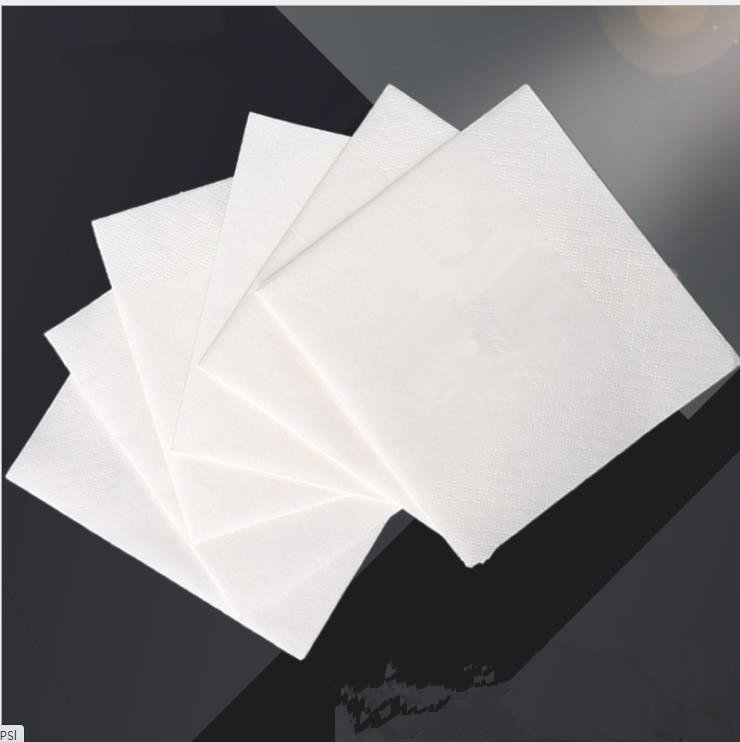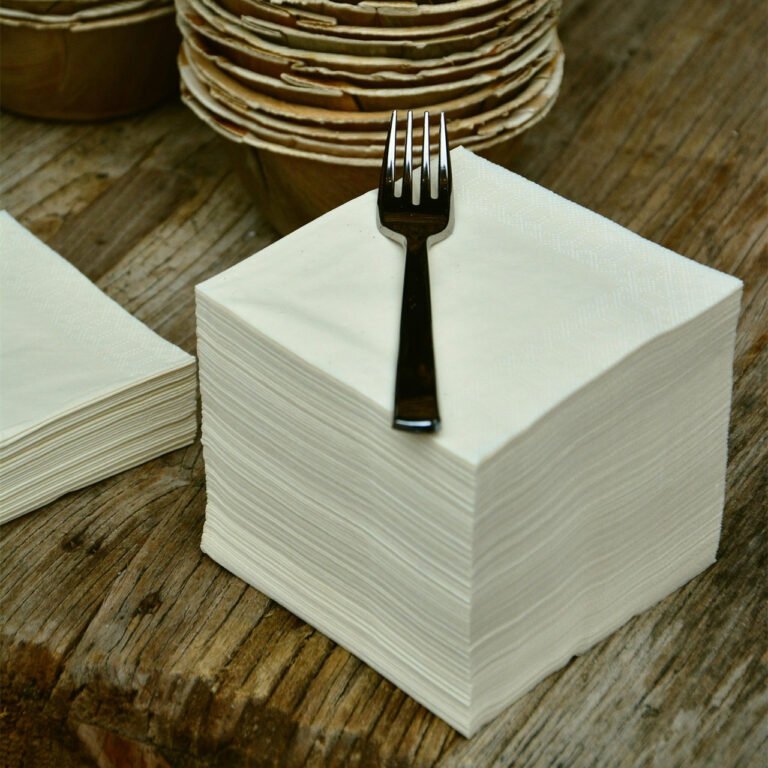
Short answer: a printed paper napkin that touches food is a food-contact material under Regulation (EC) No 1935/2004, and a generic ink letter does not close a chain’s file. Compliance teams want a product-level declaration for the finished napkin: legal basis named, ink system identified, set-off and through-substrate controls documented, batch trail behind it. The migration numbers that circulate online, 10 mg/dm2 and 60 mg/kg, are plastic-rule numbers from Regulation (EU) No 10/2011, not a paper rule. Migration testing on finished napkins is commissioned by the importer; the converter declares what it controls and signs a statement tied to batch records.
What Migration Is, and the Legal Stack Under a Napkin
Migration is the transfer of substances from a material toward food, and a printed napkin has three routes, not one. Direct contact is obvious: print meets grease, moisture, sauce. Set-off is the quiet one: ink transfers between stacked sheets under strap tension, so napkin B’s inner face carries residue though only A faced the fountain. Through-substrate migration is the third: molecules keep moving through the bulk during storage, so a pallet can read differently a month later in a warm warehouse. That is why a chain’s questionnaire asks about drying, stacking and storage, not only ink: a food contact napkin migration declaration describes this whole system. Three layers of EU law sit under that napkin.
The framework: Regulation (EC) No 1935/2004, harmonised EU law for all food-contact materials, makes the general safety test binding. Process law: Commission Regulation (EC) No 2023/2006 requires the manufacturing process to be well controlled at all stages — hence auditors walk print halls. The third layer is where the confusion lives.
Commission Regulation (EU) No 10/2011, the most comprehensive specific EU measure, covers plastic materials and articles; its overall migration limit of 60 mg/kg food, or 10 mg/dm2 of contact material, belongs to that substrate. A paper napkin is not in scope, so when those figures are quoted against a napkin someone has borrowed a plastic rule. Where no EU-wide specific measure exists, member states may keep or adopt national provisions under Article 6 of Regulation 1935/2004, which is why German recommendations and paper-and-board technical documents carry weight. Practical rule: ask the chain which national measure applies, have your lab quote its paper limits, and require every report to name the substrate tested. Verify with your own counsel; none of this is legal advice or a certificate this factory holds.
Why Water-Based Ink Proves Less Than Buyers Think

This line prints in one to four colours of water-based ink, a fact on our specification sheet — not a migration result. Water-based describes the carrier, not the dried film: the ink still carries pigments, binders and additives, any of which can be migration-relevant. The honest chain has three links: the ink manufacturer declares the system suitable for food contact on a named substrate; the converter runs it with documented drying, coverage and stacking control; the converter signs for the finished article, because only it owns the paper, ink, geometry and warehouse the buyer imports.
The sheet under the print is the half questionnaires skip. Recycled fibre, optical brighteners and process aids all change what is available to move. This line is specified in 1-ply and 2-ply from 100% virgin wood pulp with no recovered waste pulp, no added fluorescent brightening agents and no harmful chemical additives; the food-contact-safe position on the napkin line is a material standard, not a printed-article certificate. That is a real migration control rather than a marketing adjective, and it still does not replace a product-level statement once ink enters the picture.
Who Signs What: the Paperwork Ladder and What Each Document Proves
Most disputes here are role confusion: documents come from whoever is nearest the thread, then prove something else.
| Paperwork item | Who produces it | What it actually proves | What it cannot prove |
|---|---|---|---|
| Ink supplier statement | Ink manufacturer | System declared suitable on a stated substrate | Your coverage, drying, stacking |
| Product-level declaration | Converter owning the article | Article identity, furnish, ply, GSM, print system, batch trail | Numbers the converter never had tested |
| Composition declaration | Converter, for what it buys and uses | Virgin pulp, no added brighteners, named additives | Chemistry of an ink it did not formulate |
| Migration test report | Independent lab, commissioned by the importer | Transfer into a stated simulant at a stated time, that lot | Later lots |
| Batch records | Converter | Drying, speed, stacking where set-off risk is created | A limit nobody measured |
| Restricted-substance list | Importer and converter together | The file matches the chain’s template | A material never tested |
Read the middle columns as a division of labour: the converter signs what it controls, the lab what it measured, the importer assembles the package. Ask the chain for its questionnaire first; a defined form gets a defined answer.
The Declaration Template That Closes the File
A defensible statement carries fixed elements: issuing company and signatory; product identity as article number, sheet size, fold, ply, GSM inside the 13-45 range this portfolio runs, colour count; date, version, validity. Legal basis named as Regulation (EC) No 1935/2004 with good manufacturing practice under (EC) No 2023/2006, plus whichever national measure or benchmark is relied on, stated not implied. Intended use: food types, contact time and temperature, whether the printed face may touch food, single or repeated contact. Then composition of paper, additives, ink system and coating; an ink statement naming manufacturer and system; migration controls against the customer’s restricted-substance list; set-off assessment; sensory check of no unacceptable taste, odour or colour transfer; traceability with the recall route. The Commission describes a declaration of compliance as resting on supporting documentation of the safety reasoning; reproducing that logic is what an auditor wants, and why an unsigned letter fails even when every word in it is true.
Two habits keep it durable: bind the statement to an article number and batch range, not a product family (one covering four SKUs argues about an average never averaged), and keep supporting reports in a folder an authority can see. For the folds, formats and print options those elements must name, the napkin range page carries the specification lines a declaration quotes.
What Belongs in the Manufacturing System, Not Just the Paperwork
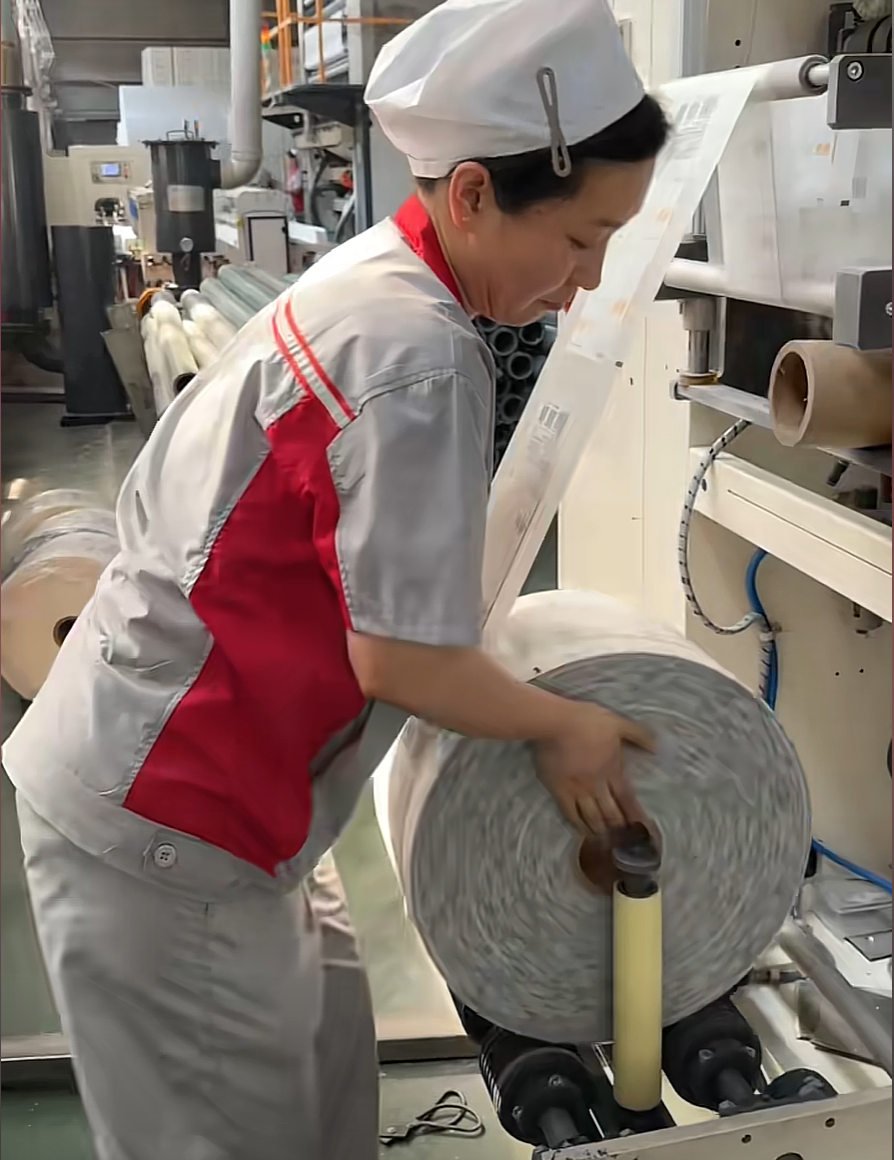
A declaration is a photograph of a process. An undocumented process makes the statement fiction; five controls make it signable.
- Practice that exists. Documented specs, batch records, print-hall segregation: containers closed at shift end, printed and unprinted sheets apart.
- Drying logged per batch. Dryer temperature and line speed set per ink system and recorded per run; set-off risk peaks when napkins stack warm under strap tension.
- Artwork designed for compliance. Lower coverage on the food-facing side, print on the inside fold face; logo placement on custom napkins is the cheapest migration lever in the file.
- Storage and transit as contact conditions. Transfer accelerates with heat: an August container crossing the equator is a storage condition the declared use should match.
- Change control in the purchase order. If the ink supplier reformulates, the declaration is stale the day the drums arrive; require notification and re-declaration before the next batch ships.

None of those five costs a lab run; each is what an auditor checks after reading the letter. A statement with no batch record behind it is a promise about paper.
Testing Without Theater
Migration testing is real, expensive and method-sensitive, and full lab runs on every colour of every SKU are not how this trade lives. Build a ladder: start from supplier statements, test where food is fatty or acidic, contact is repeated or hot, or the protocol demands a number. A retailer who says test everything will usually accept a written risk assessment that also shows where testing was done.
Roles follow the ladder. The importer instructs the lab on finished napkins drawn from a production lot, specifying simulant, time and temperature, and insists the report name the substrate and article number. The converter supplies composition declarations, batch records, and the product-level statement. We publish no migration test report on napkins and we do not sell a certificate we do not hold; what ships is the physical-indicator COA on tensile strength, brightness and 100% virgin-fibre verification — the substrate and process evidence a lab needs to plan a test. Timing decides the rest: the statement is signed at artwork approval, the one window where the converter has both motivation and the correct sample, the flow that settles a locked approval sample before mass production.
The Importer Is the Compliance System
A converter can supply print that meets European expectations; the declaration is still the importer’s product. Ask before artwork approval, not after the first rejected container. Require a product-level statement bound to batch records, control set-off through drying and stacking, and put change control in the purchase order. Keep one compliance folder per SKU travelling with the artwork: ink statement, declaration, drying records, testing commissioned, change-control log. The wider set of reports an importer should request is a shorter list than most buyers assume; this folder is its napkin-specific entry. When a stricter successor arrives at the chain, you reformat a file that exists instead of rebuilding one.
Order terms mark the gates where a document gets attached: plain and white-label napkins start at a 20GP, custom-printed napkins with buyer artwork on both the carton and the outer PE sleeve start at 1×40’HQ; samples run 1 to 3 working days, first production 25 to 30 including packaging tooling, reorders 20 to 25; payment is 30% T/T with 70% before shipment against a QC report and sealing video, ex Tianjin Xingang. A shipment held at a European DC because nobody can prove the top pallet matches the approved sample is a paperwork failure, not a paper one.
Frequently Asked Questions
Can we just forward the ink supplier’s food-contact letter?
No. That letter covers an ink formulation, not your napkin with your paper, coverage, drying and warehouse. The file needs a product-level statement from the converter that owns the finished article, with the ink letter inside as one supporting exhibit. Forwarding it alone also hides what auditors ask about hardest: set-off and storage-time transfer.
Do the overall migration limits of 10 mg/dm2 and 60 mg/kg apply to a paper napkin?
Those are plastic numbers, from Regulation (EU) No 10/2011; a paper napkin is not that substrate. For paper, framework rules and good manufacturing practice apply on top of whichever national measure or customer specification applies; your laboratory should quote the limits under it, with the substrate named in the report. If someone cites those figures at you, ask which rule they are reading.
Who commissions migration testing, and on what sample?
The importer instructs the laboratory, being the party placing the goods on the EU market and the one whose compliance team must defend the result. The sample: finished napkins from a production lot, carrying the SKU’s actual furnish and colours, tested under the contact conditions the declaration states, not the mildest available. The converter contributes composition data and batch records for that lot, not a report it ordered for someone else’s purpose.
Do unprinted coloured napkins trigger the same requirements?
Yes, by a different route. Colourants in the bulk sheet move the same way surface ink does, so a coloured napkin touching food is still a food-contact article and the declaration should name the colouring system and fixing chemistry. Dye selection, batch records and storage follow the same logic as print: a coloured sheet and a printed sheet of the same SKU deserve the same documentation depth.