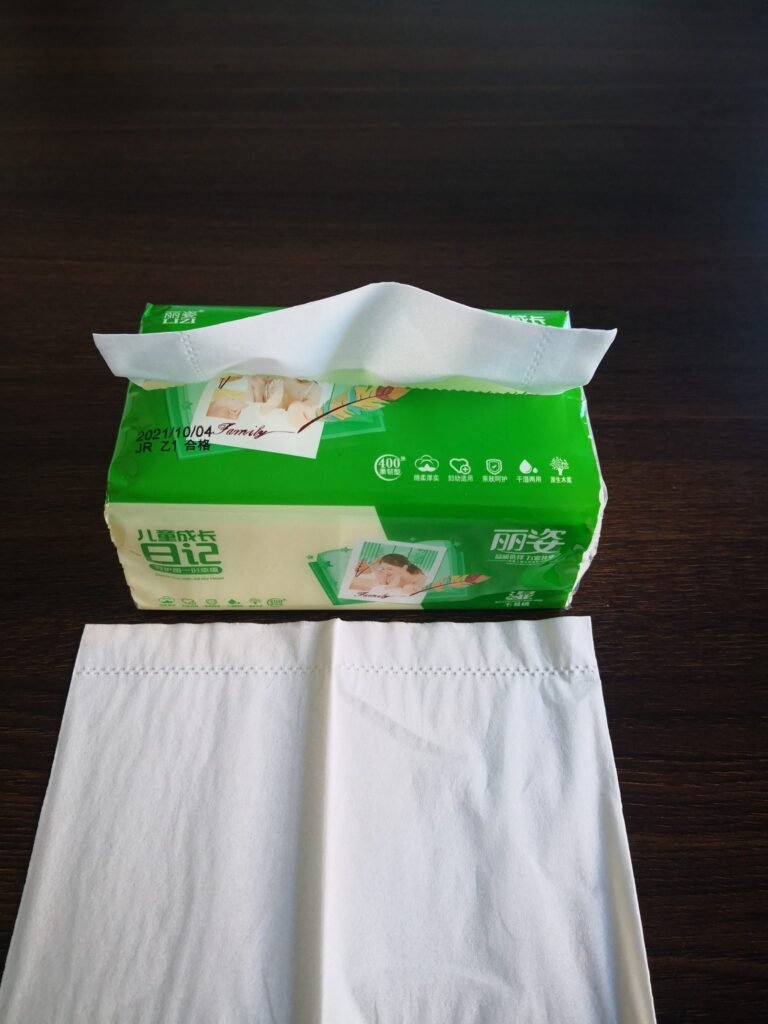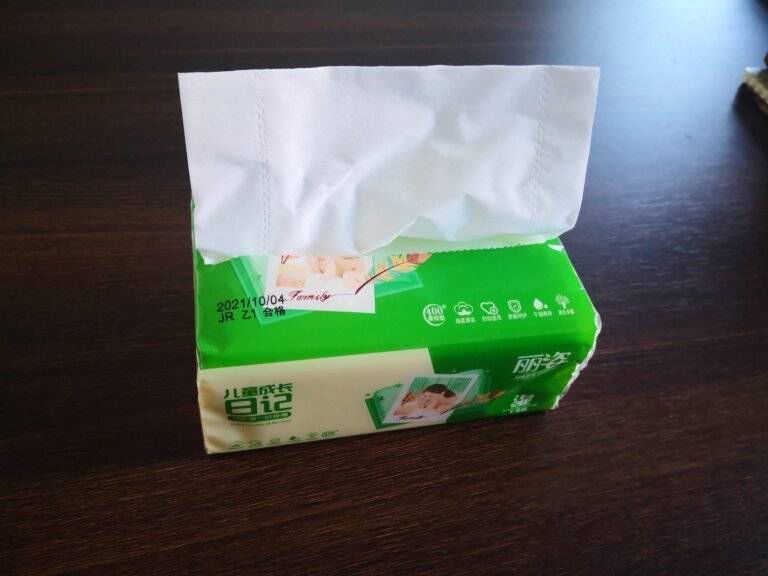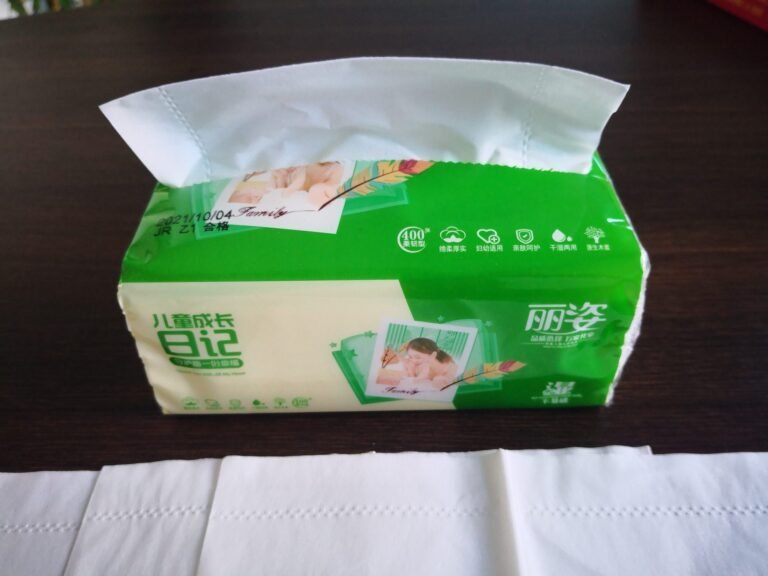
Facial tissue is one of the highest-volume SKUs in the hygiene paper trade, and every buyer who sources it from China faces the same packaging decision early in the specification process: boxed (rigid carton) or soft-pack (flexible PE film). The choice is not cosmetic. It affects per-unit cost, shelf presence, shipping density, moisture protection, and the end-user’s perception of quality. Getting it wrong means paying more for logistics without adding value — or delivering a product that looks cheap on a retail shelf.
This comparison breaks down both formats across the dimensions that matter at the purchasing stage: unit economics, container loading efficiency, print customization, moisture barrier performance, and which market segments prefer each format. The goal is to give importers, brand owners, and distributors the information needed to specify the right format for their target market.
Boxed Facial Tissue: Structure, Cost, and Shelf Presence
Boxed facial tissue uses a rigid paperboard carton as the outer packaging. The box is typically made from 300–350 GSM coated duplex board or white card, printed in 1–4 colors with the brand’s design. Inside, the tissue sheets (usually 2-ply or 3-ply, approximately 20 cm × 20 cm per sheet when flat) are interleaved and stacked in a rectangular block. A die-cut oval or rectangular opening on the top of the box allows the user to pull tissues one at a time.
A standard boxed facial tissue contains 100–200 sheets (50–100 sheets when counted as pulled pairs, since most users pull two sheets together). Common box dimensions are approximately 23 cm × 11.5 cm × 8 cm for a 100-sheet count, scaling up to approximately 25 cm × 13 cm × 9 cm for a 200-sheet count.
The box format delivers three advantages.
First, shelf presence. A printed box acts as a miniature billboard on the retail shelf. The rigid structure stands upright without support, and the full printable surface area (all six faces) gives brand owners maximum space for logo, product claims, and barcode. In supermarkets and convenience stores across the Middle East, Africa, and Southeast Asia — where facial tissue competes for eye-level shelf space — the box format dominates because it looks premium and communicates brand identity clearly.
Second, structural protection. The rigid carton protects the tissue stack from crushing during transit and stacking. For importers shipping full containers, this means the top layers of cartons in a pallet do not deform the boxes below. Stacking height is limited only by the compression strength of the outer shipping carton, not the individual retail boxes.
Third, perceived quality. In premium market segments — hotel guest rooms, corporate offices, high-end retail — boxed tissue signals quality. The act of opening a rigid box and the visible stack of neatly folded sheets inside creates a unboxing experience that soft-packs cannot replicate.
The trade-off is cost. The paperboard box adds approximately 15–25% to the per-unit packaging cost compared to a soft-pack of equivalent sheet count. It also adds weight (approximately 40–60 grams per empty box) and volume, which reduces the number of units per shipping carton and increases per-unit freight cost.
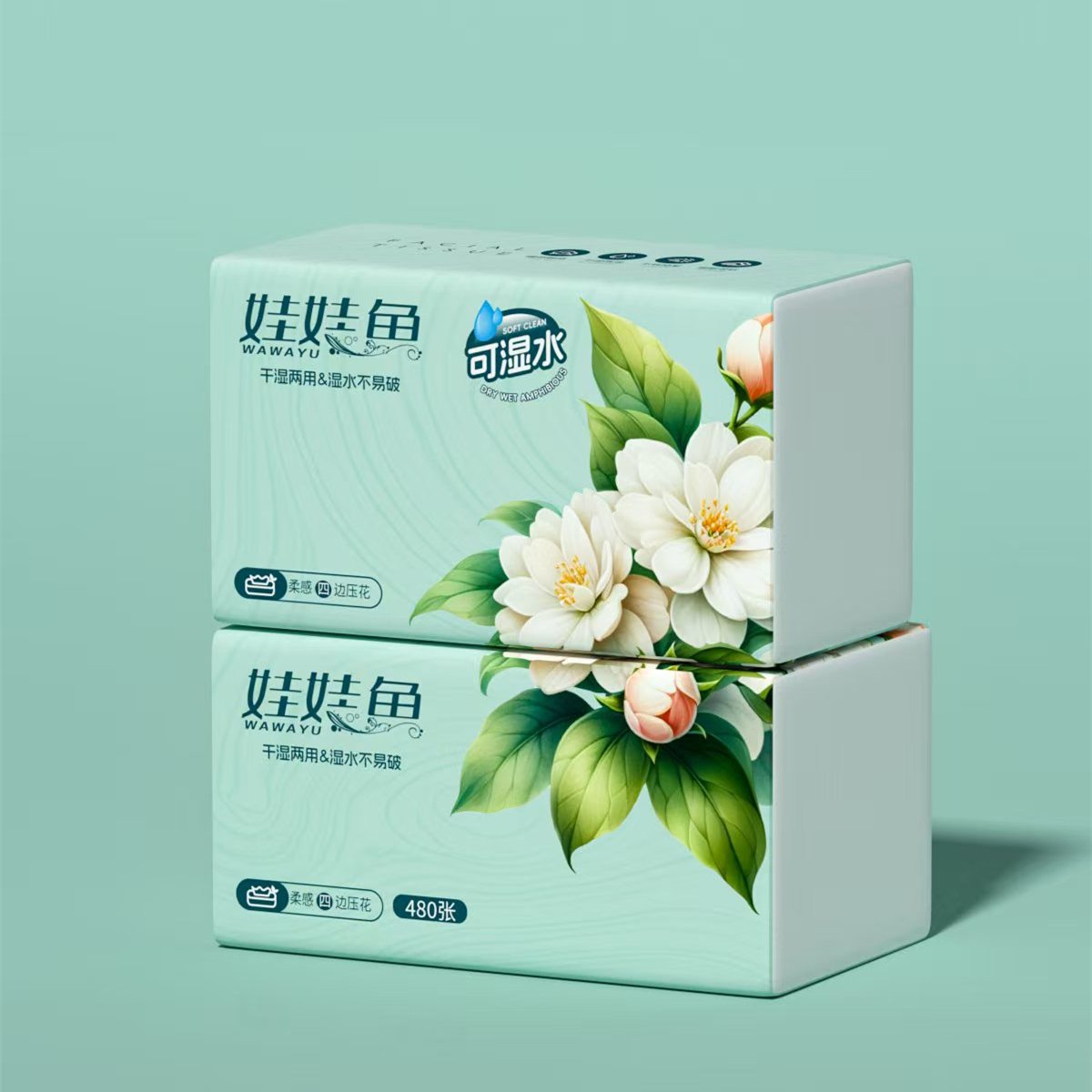
Soft-Pack Facial Tissue: Economics, Density, and Moisture Barrier
Soft-pack facial tissue replaces the rigid carton with a flexible polyethylene (PE) film wrapper. The tissue stack inside is identical in sheet count, ply, and dimensions — the only difference is the outer packaging. The PE film is typically 30–50 microns thick, heat-sealed on three sides, with a pre-scored tear strip or die-cut opening for tissue access.
Soft-packs come in two sub-formats: cube boxes (a soft-pack with a self-supporting rectangular shape that stands upright on a flat surface, approximately 12 cm × 12 cm × 10 cm for 100 sheets) and flat soft-packs (a non-self-supporting flexible pack that lies flat, approximately 20 cm × 10 cm × 5 cm for 100 sheets). Cube boxes are the dominant format in retail because they can stand on a table or shelf without a holder. Flat soft-packs are more common in institutional and bulk-supply channels where the tissue is placed in a dispenser or stored in a cabinet.
The soft-pack format delivers three advantages.
First, lower unit cost. Eliminating the paperboard box saves 15–25% on packaging materials. For high-volume, price-sensitive markets — supermarket chains in West Africa, wholesale distributors in Latin America, promotional bulk giveaways — this cost saving directly improves margin or enables competitive pricing.
Second, higher shipping density. Without the rigid box, soft-packs compress slightly and nest more efficiently in the outer shipping carton. A 20GP container holds approximately 10–15% more soft-pack units than boxed units of the same sheet count. For importers paying per-container freight, this translates directly to lower per-unit landed cost.
Third, moisture barrier. The PE film wrapper provides a superior moisture barrier compared to an open-top paperboard box. For markets in tropical climates — Southeast Asia, West Africa, Central America — where humidity during storage and transit is a constant concern, the sealed soft-pack keeps the tissue dry and prevents the top sheets from becoming damp or contaminated.
The trade-off is shelf presence. A soft-pack cannot stand upright without internal support (cube packs achieve this through their stack geometry, but the walls are flexible and can bulge). The printable surface is limited to the front and back faces of the pack. In a retail environment where visual impact drives purchase decisions, the soft-pack looks less premium than a rigid box.
Head-to-Head Comparison: Boxed vs Soft-Pack
The following table summarizes the key differences across the dimensions that matter most to buyers.
| Dimension | Boxed Facial Tissue | Soft-Pack Facial Tissue |
|---|---|---|
| Packaging cost (per unit) | Higher (+15–25%) | Lower (baseline) |
| Shelf presence | Strong — rigid, full 6-face print | Moderate — flexible, 2-face print |
| Shipping density (units per 20GP) | Baseline | +10–15% more units |
| Moisture protection | Moderate (open top) | High (sealed PE film) |
| Stacking strength | High (rigid structure) | Lower (flexible walls) |
| Perceived quality | Premium | Economy / value |
| Best market fit | Hotels, premium retail, corporate | Supermarkets, wholesale, tropical climates |
| Customization | Full-color box print, embossing, window cut | PE film print (flexographic, 1–3 colors) |
| Typical sheet count | 100–200 sheets | 100–150 sheets (cube), 100–200 (flat) |
Technical Specifications: What Both Formats Share
Regardless of packaging format, the tissue inside is specified using the same parameters. At Top Source Paper, facial tissue is produced in the following standard configurations.
| Parameter | Specification |
|---|---|
| Material | 100% virgin wood pulp (no recycled fiber) |
| Ply | 2-ply or 3-ply |
| GSM per ply | 13–17 GSM (total 26–51 GSM for 2-ply; 39–51 GSM for 3-ply) |
| Sheet size (flat) | 20 cm × 20 cm (standard), 18 cm × 20 cm (compact) |
| Embossing | Micro embossing or point-to-point deco pattern |
| Sheets per pack | 100, 120, 150, 200 |
| Key properties | Ultra-soft hand-feel, zero-dust purification, no fluorescent brighteners |
The embossing pattern serves a functional purpose beyond aesthetics. Point-to-point embossing bonds the plies together at regular intervals, preventing layer separation during use while maintaining bulk and absorbency. Micro embossing creates a finer surface texture that feels softer against the skin — a critical differentiator in premium facial tissue where softness is the primary purchase driver.
Top Source Paper’s facial tissue uses a long-fiber to short-fiber ratio optimized for softness without sacrificing wet strength. The zero-dust purification process controls paper dust and lint to levels suitable for sensitive skin and cleanroom-adjacent environments. No fluorescent brightening agents are used, making the tissue compliant with food-contact safety standards.

Container Loading: How Format Affects Economics
The packaging format directly impacts how many retail units fit in a container — and therefore the per-unit landed cost.
Related: facial tissue packaging formats.
For boxed facial tissue (100 sheets, 2-ply, box dimensions approximately 23 × 11.5 × 8 cm), a standard shipping carton holds 24 or 36 boxes. A 20GP container accommodates approximately 800–1,000 shipping cartons (19,200–36,000 retail boxes). A 40HQ holds approximately 1,800–2,200 shipping cartons (43,200–79,200 retail boxes).
For soft-pack facial tissue (100 sheets, 2-ply, cube pack dimensions approximately 12 × 12 × 10 cm), a standard shipping carton holds 36 or 48 packs. A 20GP container accommodates approximately 900–1,100 shipping cartons (32,400–52,800 retail packs). A 40HQ holds approximately 2,000–2,400 shipping cartons (72,000–115,200 retail packs).
The soft-pack delivers approximately 10–15% more retail units per container due to the smaller individual package dimensions and the ability to compress slightly during loading. For importers calculating landed cost per unit, this difference can be significant — particularly on long-haul routes where freight cost is a major component.
White-label facial tissue (plain packaging, no custom print) ships with an MOQ of one 20GP. Custom-printed boxes or printed PE film wrappers require one 40HQ minimum, as the plate-making cost for box printing or film printing is amortized across the larger volume.
Which Format Should You Choose?
The decision depends on three factors: your target market, your price positioning, and your distribution channel.
Choose boxed facial tissue if:
- Your end customers are hotels, corporate offices, or premium retail chains where shelf presence and perceived quality justify the higher unit cost.
- You are selling in markets with low humidity where moisture protection is not a primary concern.
- Your brand strategy depends on full-color packaging with maximum print area for brand communication.
- You need stacking strength for multi-layer pallet display in warehouse clubs or bulk retail.
Choose soft-pack facial tissue if:
- Your target market is price-sensitive supermarket chains, wholesale distributors, or promotional bulk buyers.
- You are shipping to tropical or high-humidity markets where moisture barrier is critical for product integrity.
- You want to maximize units per container to reduce per-unit landed cost.
- Your distribution channel is institutional (office supply, janitorial) where the tissue is placed in a holder or dispenser and retail shelf presence is irrelevant.
Many importers carry both formats to serve different segments. The facial tissue product range at Top Source Paper supports both boxed and soft-pack configurations with full customization of sheet count, ply, GSM, and packaging print.
Customization Options for Both Formats
Whether you choose boxed or soft-pack, Top Source Paper supports full OEM and private-label customization.
For boxed tissue, customization includes: full-color offset printing on the box (up to 4 colors + varnish), embossed or debossed logos, window cut-outs with transparent film, and custom box dimensions to match your retail shelf requirements. Plate-making lead time is 3–5 working days; the plate cost is waived on reorders.
For soft-pack tissue, customization includes: flexographic printing on the PE film (1–3 colors), custom film thickness (30–50 microns), and branded tear-strip design. The print quality on PE film is lower than offset-printed cardboard — flexographic printing produces solid colors and simple graphics rather than photographic detail — but the cost per unit is significantly lower.
In both cases, the tissue itself can be customized: embossing pattern (micro, deco, or custom logo embossing), sheet size, ply count, GSM, and sheets per pack. Sampling takes 1–3 working days, and the OEM and private label service covers the entire process from design file to finished container.
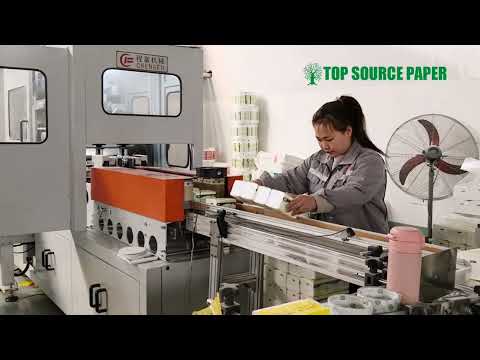
Sourcing Workflow: From Inquiry to Container
The sourcing process for facial tissue follows the same framework regardless of packaging format.
- Submit specifications: packaging format (boxed or soft-pack), ply, GSM, sheet size, sheets per pack, print design, and quantity.
- Receive quotation with FOB Tianjin pricing and lead time.
- Request physical samples (1–3 working days production, shipped via express courier).
- Approve samples, sign proforma invoice, transfer 30% T/T deposit.
- Production: 25–30 working days for first orders (includes plate-making and print setup), 20–25 working days for reorders.
- QC inspection with COA (fiber composition, tensile strength, brightness), burst resistance video, and loading photos provided before final payment.
- Balance 70% payment, container dispatched from Tianjin Xingang Port.
Trade terms available include FOB, CIF, and CFR. Payment terms are 30% T/T deposit, 70% before shipment. All shipments include a 100% virgin wood pulp COA and moisture-proof outer carton packing standard.
For questions about facial tissue specifications or to request boxed and soft-pack samples for comparison, contact the Top Source Paper team directly.
For a deeper look at how facial tissue and toilet paper differ on the manufacturing line 鈥?ply bonding, GSM, hygiene grade and flushability 鈥?see the facial tissue vs toilet paper comparison.