Custom printed napkins are one of the highest-margin items in the tissue export catalog — and one of the most misunderstood. Restaurant owners, event planners, and hospitality procurement teams often assume that custom printing means high minimums, long lead times, and expensive plate costs. The reality at a modern virgin pulp tissue factory is different: with flexographic water-based ink printing, a custom napkin can go from design file to container-loaded product in 25–30 working days, with plate costs waived on every reorder after the first.
This guide covers the full specification set that buyers need to get right: napkin size and fold types, ply and GSM, print colors and registration, edge embossing options, packaging formats, and container economics. Every number here traces to Top Source Paper’s production capabilities — not industry averages or guesswork.
Napkin Sizes and Fold Types: The Specification That Drives Everything
Restaurant napkins are specified by two dimensions: the open size (the full sheet unfolded) and the folded size (what sits on the table or in the dispenser). The fold type determines how the open sheet converts to the folded size.
The four standard fold types in commercial napkin production are:
- 1/4 fold (quarter fold) — The sheet is folded in half twice, creating four equal panels. A 38 cm × 38 cm open napkin folds to approximately 19 cm × 19 cm. This is the most common fold for casual dining and mid-range restaurants.
- 1/8 fold (eighth fold) — The sheet is folded in thirds, then in half, creating eight panels. A 40 cm × 40 cm open napkin folds to approximately 13 cm × 20 cm. Used for compact dispenser-loaded napkins in fast-service restaurants.
- 1/16 fold — A more complex fold creating sixteen panels, producing a very compact final size. Used for cocktail napkins and bar service where space is limited.
- Flat (unfolded) — The napkin ships as a full flat sheet, typically stacked in packs of 500 or 1,000. Used by banquet halls and catering operations that fold napkins in-house for table setting.
The most requested sizes at Top Source Paper for export markets are:
| Application | Open Size | Fold | Folded Size |
|---|---|---|---|
| Cocktail / bar napkin | 20 cm × 20 cm | 1/4 fold | 10 cm × 10 cm |
| Casual dining | 33 cm × 33 cm | 1/4 fold | 16.5 cm × 16.5 cm |
| Mid-range restaurant | 38 cm × 38 cm | 1/4 fold | 19 cm × 19 cm |
| Premium dining / banquet | 40 cm × 40 cm | 1/4 fold | 20 cm × 20 cm |
| Fast-service dispenser | 30 cm × 30 cm | 1/8 fold | 10 cm × 15 cm |
| Banquet flat napkin | 45 cm × 45 cm | Flat | 45 cm × 45 cm |
Custom sizes are available on request. The converting line at Top Source Paper can handle open sizes from 15 cm × 15 cm (small cocktail) up to 50 cm × 50 cm (large banquet) with fold precision of ±2 mm.
Ply and GSM: How They Affect Hand-Feel and Cost
Napkins are produced in 1-ply and 2-ply constructions. The ply decision is a direct trade-off between softness/bulk and cost per unit.
1-ply napkins use a single sheet of tissue at 13–17 GSM. They are the standard for high-volume, cost-sensitive applications — fast-food chains, cafeteria service, airline economy class, and promotional giveaways. The thinner profile means more napkins per shipping carton and lower fiber cost per unit.
2-ply napkins bond two sheets together through embossing, creating a total GSM of 26–34 (or higher for premium grades). The two-ply structure delivers noticeably better absorbency, a softer hand-feel, and the opacity that prevents the napkin from looking see-through when wet. Premium restaurants, hotel banquet halls, and event planners specify 2-ply as the minimum.
At Top Source Paper, all napkins are produced from 100% virgin wood pulp. The fiber is sourced from certified sustainable forests, and the production process uses no fluorescent brightening agents or recycled fiber. This is non-negotiable — recycled fiber produces visible specks, inconsistent absorbency, and dust that transfers to diners’ hands and clothing.
The GSM range spans 13–45 GSM per ply across all product lines. For napkins specifically, the most common specifications are:
- Economy 1-ply: 13–15 GSM — fast food, promotional, airline economy
- Standard 1-ply: 15–17 GSM — casual dining, cafeteria
- Premium 2-ply: 15 + 15 GSM (30 total) — mid-range restaurant, hotel
- Luxury 2-ply: 17 + 17 GSM (34 total) or higher — fine dining, banquet, wedding events
Custom Printing: Colors, Registration, and Ink Standards
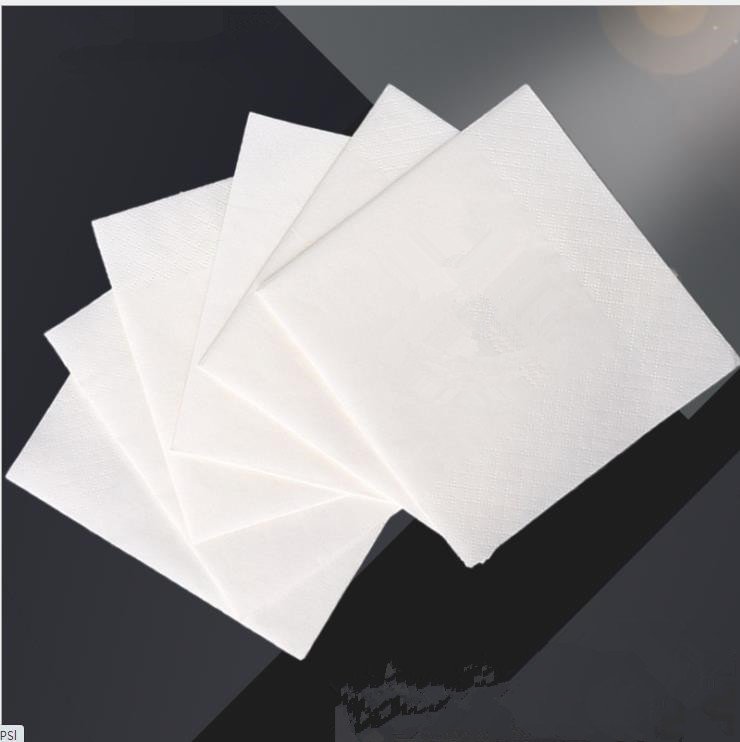
Custom printing transforms a generic napkin into a branded touchpoint. For restaurant chains, hotel groups, and event companies, a printed napkin with a logo or monogram signals attention to detail and reinforces brand identity at every table.
Top Source Paper uses flexographic printing with water-based ink for all custom napkin orders. This is the industry standard for food-contact-adjacent paper products because water-based inks are non-toxic, odorless, and compliant with food-safety regulations in the EU, US, and most import markets.
The printing process supports 1 to 4 colors per design. Each color requires a separate print station and a separate printing plate (a flexible photopolymer sleeve that wraps around the press cylinder). Plate-making takes 2–3 working days and incurs a one-time plate cost per color. However, plates are stored permanently for each client and reused on every reorder at no additional charge — which means the second and subsequent orders are cheaper than the first.
Print registration (the alignment of multiple colors) is held to ±1 mm tolerance. For designs with fine text or tight color registration requirements, a 4-color design at 38 cm × 38 cm napkin size is well within the production capability. For designs with large solid-color areas, the flexographic process produces even coverage without the banding or streaking that can occur with lower-quality presses.
Common print designs include:
- Logo only — single color, centered or corner-positioned
- Logo + border pattern — two colors, with a decorative frame
- Full monogram — hotel or restaurant initials in an ornamental design
- Event-specific — wedding dates, corporate event logos, conference branding
- Seasonal — holiday-themed designs for Q4 restaurant promotions
Edge Finishing: Border Embossing and Cut Edge Options
Beyond printing, the napkin’s edge treatment affects both appearance and functionality.
Border embossing — A decorative pattern is pressed into the perimeter of the napkin (typically 1–3 cm from the edge) using an embossing roller. This creates a raised frame that adds visual depth and structural rigidity to the napkin’s edge, preventing it from curling after unfolding. Border embossing is available in dozens of standard patterns (geometric, floral, art deco, rope twist) or as a custom pattern made to the client’s design.
Cut edge (deckle edge) — The napkin is cut with a slightly irregular, natural-looking edge that mimics the look of handmade paper. This is a premium finish used for fine dining and wedding events where a rustic-elegant aesthetic is desired.
Plain edge (straight cut) — The standard production edge, cleanly cut with no decorative treatment. This is the default for most commercial napkin orders and the most cost-effective option.
Edge embossing adds approximately 5–8% to the converting cost but delivers a visible quality upgrade that end-users notice. For restaurant chains building a premium brand image, border embossing is one of the lowest-cost ways to differentiate the napkin from generic competitors.
Packaging and Container Loading
Napkins are packed in stacks, with the stack count and outer carton format determined by the application.
For restaurant and hospitality use, napkins are typically packed in stacks of 500 or 1,000 pieces, wrapped in poly bags for moisture protection, and loaded into standard corrugated cartons. A 38 cm × 38 cm 1/4-fold 2-ply napkin, packed at 1,000 per carton, produces a carton weighing approximately 18–22 kg. A 20GP container holds approximately 600–800 such cartons (600,000–800,000 napkins). A 40HQ holds approximately 1,400–1,800 cartons (1.4–1.8 million napkins).
For retail and foodservice distribution, napkins are packed in smaller consumer packs — 50, 100, or 200 pieces per pack — with printed poly bags or paper bands. These retail packs are then loaded into shipping cartons at 24–48 packs per carton. The smaller pack format increases handling cost but enables direct-to-shelf distribution without repacking.
White-label napkins (plain, no print) ship with an MOQ of one 20GP. Custom-printed napkins with branded packaging require one 40HQ minimum, as the plate-making and print setup cost is amortized across the larger volume.
The Ordering Process: Design to Delivery
Sourcing custom printed napkins from Top Source Paper follows a structured workflow.
- Design submission — Send your artwork in AI, PDF, or CDR format. The design team checks color separation, registration feasibility, and print area vs napkin size. If you do not have artwork, Top Source Paper’s design team can create the layout from your logo and brand guidelines.
- Specification confirmation — Confirm napkin size, ply, GSM, fold type, print colors, edge finish, pack count, and quantity.
- Plate-making — Printing plates are produced in 2–3 working days. A digital proof (PDF) is sent for approval before plates are finalized.
- Physical sample — A printed sample on the actual napkin stock is produced and shipped via express courier (1–3 working days production + courier transit).
- Production — 25–30 working days for first orders (includes plate-making, sampling, and production). 20–25 working days for reorders using existing plates.
- QC and documentation — COA (fiber composition, brightness, tensile strength), print color match verification, and loading photos/video provided before final payment.
- Shipment — Container dispatched from Tianjin Xingang Port. Trade terms: FOB, CIF, or CFR.
Payment terms: 30% T/T deposit, 70% balance before shipment. All orders include a 100% virgin wood pulp COA and moisture-proof outer packing as standard.
For importers building a branded napkin program across multiple restaurant locations or hotel properties, the plate storage policy means you pay the plate cost once and never again — reorders at the same specifications are produced at the lowest possible unit cost. The napkin papers product range at Top Source Paper covers all standard sizes and fold types, and the OEM and private label service handles the full customization workflow.
For questions about custom napkin specifications, print feasibility, or to request a sample pack, contact the Top Source Paper team directly.
For restaurant, cafe, and catering buyers putting the branding decision into practice, see custom napkins with logo: ordering for food service.