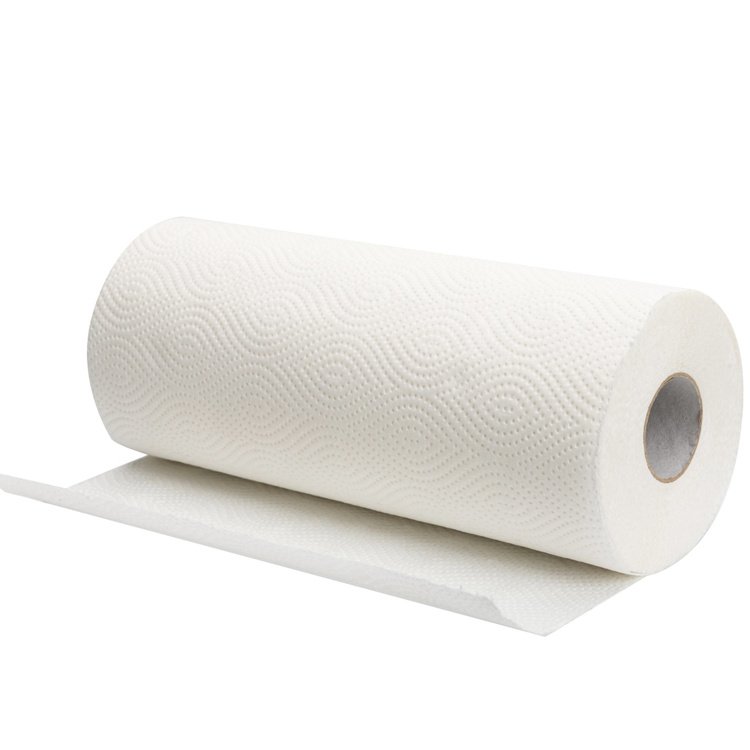
Kitchen paper towel is the tissue format where specifications most directly determine whether the product works. A bathroom roll that is slightly softer or slightly thinner than expected is an annoyance. A kitchen towel that disintegrates on a wet surface, leaves lint in a food preparation area, or fails to pick up frying oil is a functional failure — and in a food processing plant it is a contamination risk and an audit finding.
Importers regularly buy kitchen towels on price per roll, then discover that the three variables that decide performance — basis weight, wet strength and absorbency geometry — were never in the conversation. This guide explains what each of those variables actually does, what to write on the specification sheet, and how to verify a supplier’s claims before the balance payment is released.
Why Kitchen Towel Specs Differ From Bathroom Tissue
Toilet tissue is engineered to break down. Kitchen towel is engineered to hold together while wet, under load, in contact with food. Those two objectives pull in opposite directions, and they are achieved by different means: toilet tissue relies on water-soluble construction and short-fibre softness, while kitchen towel relies on wet-strength chemistry, longer fibre and a three-dimensional embossed structure that creates volume for liquid to occupy.
This is why a buyer cannot treat kitchen roll as a heavier version of bathroom tissue, and why a supplier who quotes kitchen towels using the same language they use for toilet rolls probably is not controlling the process that matters. The specification has to name the wet-strength system, the embossing geometry and the basis weight basis, in that order of importance.
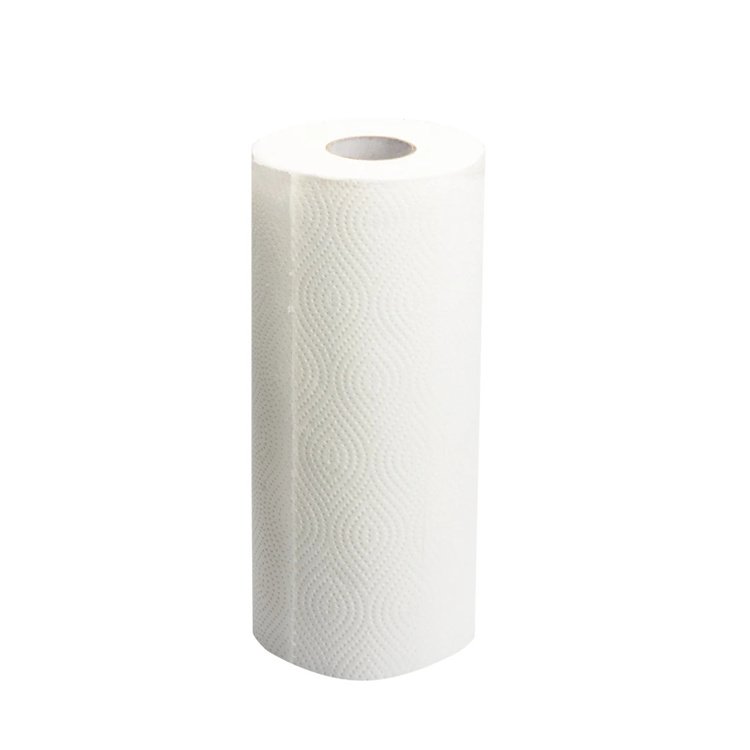
Top Source Paper produces kitchen paper towels at its virgin wood pulp tissue factory in Mancheng District, Baoding, in northern China’s tissue export cluster. The line runs 1-ply and 2-ply thickened construction, with a three-dimensional high-absorbency web-pattern emboss and a wet-strength resin formulation, delivering a stated 40% improvement in water and oil absorption efficiency. The rolls are built for catering kitchens, food processing plants, domestic cooking and cleaning, and heavy grease wiping.
GSM: Reading Basis Weight on a Kitchen Roll
Basis weight, expressed in grams per square metre, is the amount of fibre in a given area of sheet. Across the full Top Source Paper range — toilet rolls, jumbo, facial tissue, hand towels, napkins and kitchen paper — capability spans 13 to 45 GSM, and kitchen towel sits toward the heavier end of that span because it has to carry liquid without failing.
Three things about GSM trip buyers up.
First, the basis of the number. A GSM figure means nothing until you know whether it describes a single ply or the finished sheet. On a 2-ply kitchen roll the two readings differ by roughly a factor of two, and a quotation that omits the basis is a quotation that can be satisfied by a lighter product than you pictured. Fix this in the proforma invoice and insist the same basis appears on the certificate of analysis.
Second, GSM is not thickness. Two rolls at the same basis weight can feel completely different, because embossing creates bulk without adding fibre. A heavily embossed sheet traps air and reads as thick and absorbent in the hand; a flat sheet at the same GSM reads as dense and less capable. Both are legitimate products for different uses, but you need to know which one you are buying. This is why GSM and embossing pattern have to be specified together rather than separately.
Third, GSM drift is the cheapest way for a supplier to protect margin. A few grams per square metre across a container is invisible to the eye and significant on the invoice. This is precisely what the in-process stage of the three-tier QC system is there to catch: during converting, inspection covers basis weight, tension and the perforation line. Buyers should ask for the in-process basis weight records for their own order, not only the finished-goods COA.
Wet Strength: What the Resin Formulation Does
Wet strength is the property that separates a kitchen towel from everything else in the tissue category. Dry paper is held together by hydrogen bonds between fibres; water breaks those bonds, which is why ordinary tissue falls apart the moment it is wet. A wet-strength resin adds a chemical bonding system that survives water, so the sheet retains a useful proportion of its dry strength when saturated.
The kitchen towel line uses a wet-strength resin formulation, and the fibre side of the equation is handled by Wet-Burst Strength Optimized construction: a long-fibre ratio reinforcement applied specifically to kitchen paper and hand towels so the sheet does not disintegrate when wet and leaves no lint behind during wiping. The two mechanisms work together — the resin holds the bonds, the long fibre carries the load.
For an importer, the practical consequences are worth spelling out.
Lint is the failure that matters most in food environments. A towel that sheds fibre onto a preparation surface, into a product, or onto a wiped-down stainless bench is not merely unpleasant. It is a foreign-body contamination issue and it will appear in a food safety audit. Lint-free wet wiping is the property to specify explicitly, and it is the property to test physically rather than accept on a data sheet.
Wet strength has a trade-off against dispersibility. A sheet engineered to survive saturation will not break down in water the way a flushable bathroom tissue does. Kitchen towel is therefore not a drain-safe or flushable product, and it should never be positioned as one. Buyers whose market conflates the two categories need to keep the specification and the labelling clearly separated.
Wet strength is measurable. A wet tensile and dust-rate test video pack can be provided alongside the 100% virgin wood pulp COA covering tensile strength, brightness and virgin fibre verification — name both in the purchase order. That video pack exists because wet performance is the property easiest to claim and hardest to verify from a data sheet alone. Ask for it, watch it, and repeat the test yourself on arrival.
Absorbency: Embossing Geometry and the 40% Figure
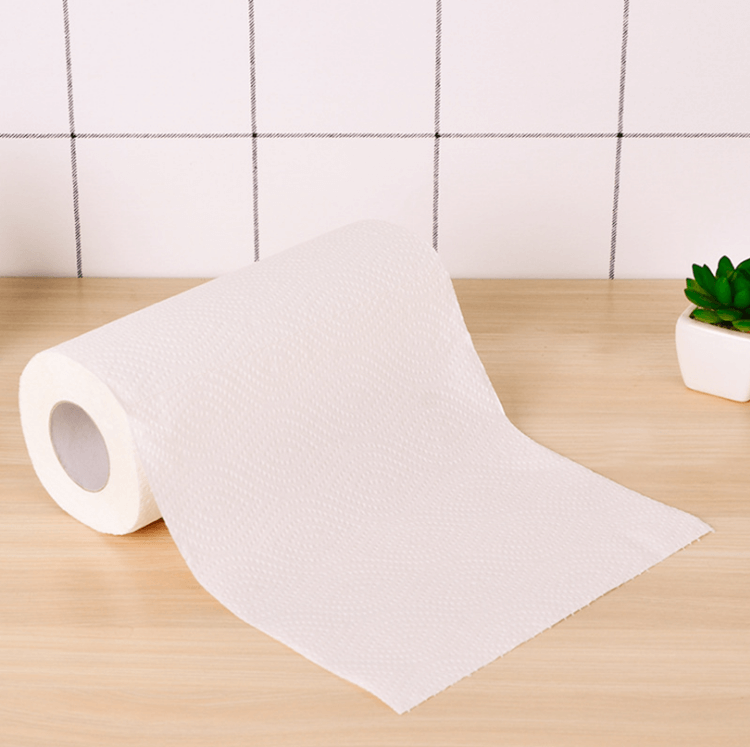
Absorbency in a kitchen towel is mostly a geometry problem. Liquid has to get into the sheet and stay there, which requires open volume between the fibres and a surface that draws liquid in rather than beading it. That volume is created by embossing.
Three embossing processes are available across the range: micro embossing, edge embossing, and three-dimensional web-pattern embossing in Deco and point-to-point forms. The kitchen towel line uses the three-dimensional high-absorbency web-pattern emboss, which is the deepest and most structural of the three. Point-to-point embossing bonds the plies at discrete points rather than across the whole surface, which leaves large unbonded areas between the bond points — pockets that hold liquid. A flat, densely bonded sheet has nowhere to put the water it picks up.
Combined with the wet-strength resin formulation, this construction is what produces the factory’s stated figure: a 40% improvement in water and oil absorption efficiency. The oil half of that claim is the one importers tend to underrate. Water absorption is easy — most paper absorbs water. Oil absorption depends on surface structure and on the sheet surviving the mechanical action of wiping a greasy pan or a fryer basket without shredding. A towel that lifts oil and stays intact is doing two difficult things at once, which is why the number is worth interrogating rather than assuming every supplier can match it.
When you compare absorbency claims between suppliers, ask three questions in this order. What embossing process is used, named specifically? What wet-strength system is in the furnish? And on what basis was the absorption improvement measured, against what control? A supplier who cannot answer the third question has quoted you a marketing figure rather than a test result.
Food-Contact Safety and the Additive Position
Kitchen towel touches food, food surfaces and hands that then touch food. The additive position of the sheet is therefore part of the specification, not a footnote.
Products from this line are food-contact safe, contain no fluorescent brightening agents and no harmful chemical additives, and are produced from 100% virgin wood pulp with a balanced long and short fibre ratio. No recycled or reprocessed pulp is added. The virgin furnish point is not a marketing preference here — recycled fibre carries an unknown history of inks, adhesives and contaminants that a virgin web does not, and in a food-contact application that unknown is the entire argument.
Fluorescent brightening agents deserve separate mention because they are widespread in the category and invisible to the buyer. They are used to make paper read as brighter and whiter than the pulp naturally is. They are also a migration concern in food contact, and they are detectable: brightness is measured on the COA, and a UV lamp in a goods-received check makes an over-treated sheet obvious. Ask for the brightness figure and for written confirmation that no fluorescent brightening agents are used.
Kitchen Towel Specification by End Use
| End use | Construction emphasis | Ply position | Property to verify hardest |
|---|---|---|---|
| Catering and commercial kitchens | Wet strength and oil pickup under repeated wiping | 2-ply thickened | Lint residue on a wet wipe; sheet survival on a greasy surface |
| Food processing plants | Food-contact safety and clean-sheet behaviour | 2-ply thickened | Virgin fibre verification on the COA; no fluorescent brightening agents |
| Retail consumer kitchen roll | Absorbency feel, roll presentation and pack shelf impact | 1-ply or 2-ply depending on price point | Basis weight and its definition; embossing pattern matching the approved sample |
| Heavy grease and industrial wiping | Wet-burst strength and durability under load | 2-ply thickened | Wet tensile result; no disintegration under scrubbing action |
Retail-format kitchen roll also has to survive being handled, stacked and shipped, so the emboss pattern that looks right on a sample has to still look right after a container voyage. The full kitchen paper towel range sets out the construction options available for each of these end uses.
Related: how to vet paper towel manufacturers.
Writing the Kitchen Towel Specification
The fields below are the minimum a kitchen towel order needs. Leaving any of them blank transfers the decision to the supplier.
- Ply — 1-ply or 2-ply thickened, stated as an integer.
- Basis weight and its definition — the GSM figure plus whether it is per ply or for the finished sheet, within the 13 to 45 GSM range.
- Wet-strength system — the resin formulation named, and the lint-free wet-wiping requirement stated explicitly.
- Embossing — three-dimensional web-pattern, Deco, point-to-point, micro or edge, named rather than described as “embossed”.
- Absorbency claim basis — if a supplier quotes an absorption improvement, the measurement basis and control must be documented.
- Fibre furnish — 100% virgin wood pulp, no recycled content, verified on the COA.
- Additive position — food-contact safe, no fluorescent brightening agents, no harmful chemical additives, in writing.
- Roll geometry — sheet size, sheets per roll, core inner diameter, roll diameter, perforation position.
- Pack and carton — rolls per pack, packs per carton, plain or custom printed, and the carton spec that will be drop tested.
- Trade and payment frame — FOB, CIF, CFR or EXW from Tianjin Xingang Port, 30% T/T deposit and 70% balance before shipment.
Kitchen towel sits alongside other washroom and food-service paper lines in most container programmes, so order sizing is usually a consolidation question rather than a single-line question. White-label and plain stock starts from one 20GP container; custom printed packaging moves the minimum to one 40HQ because plate-making and print setup are amortised across the container. Sampling and dispatch of small samples takes 1 to 3 working days, first bulk production runs 25 to 30 working days including packaging plate-making and outer carton printing, and repeat orders run 20 to 25 working days. Consolidating kitchen roll with folded hand towels is common in janitorial programmes — the multifold paper towel guide and the paper hand towel range cover the other half of that basket.
Verifying Kitchen Towel Claims Before You Pay
Three documents can be provided with every order and should be named in the purchase order: a 100% virgin wood pulp physical-property COA covering tensile strength, brightness and virgin fibre verification; a wet tensile and dust-rate test video pack; and container reinforcement and moisture-proof packing photographs and video. They are supplied before the 70% balance falls due, which is deliberate: the inspection checkpoint should land while you still hold payment leverage.
Documents are necessary but not sufficient. Run four physical checks on a random sample pulled from cartons in the middle of the pallet, not from the top layer.
The wet wipe test. Saturate a sheet and wipe a smooth surface firmly, three or four passes. Then look at the surface in raking light. Any visible fibre residue means the lint claim fails, and in a food environment that is a rejection-level finding rather than a negotiation point.
The wet tear test. Hold a saturated sheet by two corners and apply load. A properly resin-treated long-fibre web carries weight; an under-treated sheet splits at the centre. Compare against the approved sample, because absolute feel is subjective and comparison is not.
The oil pickup test. Put a measured quantity of cooking oil on a non-porous surface and lift it with a known number of sheets. This is the only realistic way to sanity-check an absorbency improvement claim without a laboratory, and it takes five minutes.
The brightness check. Read the COA brightness figure and look at the sheet under a UV lamp. An unusually strong fluorescent response against a virgin-pulp claim is the fastest indicator of brightening agents in the furnish.
Behind those checks sits a three-stage QC process: parent roll sampling for tensile strength and brightness, in-process inspection during converting for basis weight, tension and perforation line, and pre-shipment final inspection covering carton specification and drop test. Ocean freight protection uses thickened waterproof corrugated outer cartons, fumigation-free pallets with high-tensile strapping, and a pre-loading container seal and watertightness check — relevant for kitchen towel specifically, because a wet-strength sheet that has absorbed transit moisture will not perform the way a dry one does. If you are building the wider supplier evaluation around these documents, the guide to sourcing tissue paper from China sets out the full verification sequence, and the buyer resources library collects the logistics and documentation material.
Frequently Asked Questions
What GSM should kitchen paper towels be?
Kitchen towel sits toward the heavier end of the 13 to 45 GSM capability range that spans all product categories at this factory, because the sheet has to carry liquid without failing. The critical step is not the number but its definition: state on the proforma invoice whether the GSM figure is per ply or for the finished sheet, and require the same basis on the COA.
What makes a kitchen paper towel wet-strength?
A wet-strength resin formulation adds a chemical bonding system that survives water, since ordinary paper is held together by hydrogen bonds that water breaks. It works together with long-fibre ratio reinforcement — Wet-Burst Strength Optimized construction — so the sheet does not disintegrate when wet and leaves no lint during wiping.
How is absorbency improved by 40%?
The stated 40% improvement in water and oil absorption efficiency comes from the combination of a three-dimensional high-absorbency web-pattern emboss and the wet-strength resin formulation on the kitchen towel line. The emboss creates open volume between bonded points for liquid to occupy; the resin lets the sheet survive being saturated while it is wiped. When comparing suppliers, ask what the improvement was measured against.
Are kitchen paper towels food-contact safe?
Kitchen towels from this line are food-contact safe, contain no fluorescent brightening agents and no harmful chemical additives, and are made from 100% virgin wood pulp with no recycled or reprocessed pulp. Request the additive position in writing and check brightness on the COA.
Can kitchen paper towel be flushed?
No. Wet-strength construction is deliberately designed to resist breaking down in water, which is the opposite of a flushable bathroom tissue. Kitchen towel is a waste-bin product, and it should never be specified or labelled as dispersible.
What is the MOQ for custom printed kitchen towels?
White-label and plain stock kitchen towel starts from one 20GP container. Custom printed packaging moves the minimum to one 40HQ, because plate-making and print setup are amortised across a full container. Sampling takes 1 to 3 working days, first production 25 to 30 working days, and repeat orders 20 to 25 working days.
Specify the Three Variables That Decide Performance
Kitchen paper towel is bought well or badly on three variables: basis weight and its definition, the wet-strength system, and the embossing geometry that creates absorbency. Name all three in the specification, require the food-contact and additive position in writing, and verify with a wet wipe, a wet tear, an oil pickup and a brightness check before the balance is released. Imported on that basis, a kitchen towel line performs in a food processing plant the same way it performed on the approved sample — which is the only standard that matters.
More kitchen towel specifications, food-service paper guidance and container planning material is collected in the kitchen paper towel library. To request kitchen towel samples for wet-strength and oil-pickup testing, or to have an existing specification reviewed, contact the Top Source Paper team — samples are prepared and dispatched within 1 to 3 working days, and inquiries can also go to info@chinatoiletpaper.com or +86-13180210660 on WhatsApp.
Related reading: For how kitchen roll differs from standard folded paper towels, see our guide on this topic.
For food-processing buyers confused about cleanroom vs food-grade requirements, the dedicated food-grade paper towel specification guide sets the distinction clearly.
Ply is the decision those specs are built around; the 1-ply versus 2-ply kitchen towel comparison works through cost per task.
Spec sheets set the wet-strength target; the paper towels by the case guide turns that spec into the cost-per-foot a reseller can price.