
Most guides on the toilet paper manufacturing process will tell you the pre-production sample is your safety net. That’s half true. A buyer I know learned this the hard way on a $50,000 jumbo roll order for a Lagos hotel chain. The sample was perfect—bright, soft, spot-on at 16 GSM. The mass production run landed three months later with a coarser hand feel and a GSM that had drifted to 13.5. The difference was the creping ratio on the Yankee dryer. The supplier had demoed the good blade, then run the order on a dull one. The sample wasn’t the safety net. Controlling the spec sheet with a locked quality tolerance was. That’s the gap between reading about pulping stages and actually guarding your brand against a conversion-line decision made at 2 AM.
Here’s what changes when you treat a manufacturing specification as a binding technical contract rather than a aspirational product description. You stop asking “can you make it soft?” and start asking “what’s your crepe percentage, and will you guarantee it in writing across all 42 jumbo rolls on my container?” You stop evaluating suppliers on a single FOB price point and start looking at whether their pulping line can actually source the long-fiber virgin pulp required to hit an OBA-free brightness of 89%. The entire chain—from pulper to perforation—has about five decision points that directly determine whether a guest touches a tissue that reinforces a five-star brand or one that triggers a complaint. Understand those levers, and you’ll know more than most converters know about their own equipment.
Raw Materials That Define Bulk Tissue Quality
The fiber you select at sample approval stage dictates your entire quality tolerance downstream.
Why did the pre-production sample feel plush and expensive, but the $50,000 container that landed at port felt like economy-grade paper? I’ve audited the aftermath of this exact failure across three continents. The answer almost always traces back to one decision point: the fiber specification sheet nobody read carefully during sample approval. Virgin wood pulp and recycled fiber are not two versions of the same thing. They behave differently under the Yankee dryer, they absorb moisture differently, and they age differently inside a shipping container crossing the equator. If your supplier cannot articulate those differences with actual production data, you’re gambling with your brand.
Virgin wood pulp — specifically northern softwood kraft — contains long fibers measuring 3 to 5 millimeters. That length is the mechanical backbone of softness and wet strength. When the pulping digestion runs approximately 3 hours under controlled chemical conditions, lignin dissolves without shearing those fibers into useless short fragments. Recycled fiber, even after modern enzymatic de-inking that can push brightness above 85%, starts with inherently shorter, stiffer fibers that have already been dried, creped, and mechanically stressed once before. You can blend them. You can engineer acceptable hand feel. But you cannot restore the original fiber length, and that shows up in linting propensity and dispenser tear-outs at the worst possible moment — during a guest’s stay.
- Virgin Pulp Tensile Index: Exceeds 20 Nm/g in properly digested long-fiber stock. This translates to fewer sheet breaks during rewinding and consistent perforation tear on the finished roll.
- Recycled Fiber Linting Risk: Shorter fibers shed more during use. In a hotel bathroom with dark tiles, that lint becomes a housekeeping complaint within the first week.
- Cost Reality Check: Varying GSM from 13 to 18 g/m² swings raw material cost by up to 30% on the same roll dimensions. Recycled base stock looks cheaper on the FOB pricing sheet, but factor in higher reject rates and dispenser maintenance calls before locking in your numbers.
- Hygiene Gap: Recycled feedstock requires chemical or enzymatic de-inking to remove inks, adhesives, and stickies. Virgin pulp skips this entire contamination vector — which matters when your end user is a hospital patient or a luxury resort guest with sensitive skin.
The 2026 sourcing landscape has introduced a practical middle ground that didn’t exist at scale five years ago: blending virgin outer plies with recycled or bamboo inner plies. The outer layers — the ones guests actually touch — use 100% virgin long-fiber stock for that immediate perception of softness. The inner plies carry the recycled or bamboo content, dropping the overall fiber cost without sacrificing the finished product’s premium aesthetic and tactile feedback.
One specification most first-time buyers never ask about: OBA-free brightness. Optical brightening agents are fluorescent compounds that trick the eye into perceiving whiteness by converting UV light into visible blue light. They’re cheap. They’re common in commodity-grade tissue. They are also a documented skin irritant for a subset of users, and no five-star hotel procurement manager wants to explain to their GM why a guest developed contact dermatitis from the bathroom tissue. Virgin wood pulp, when processed without OBAs, delivers an honest brightness range of 85 to 92% — clean, natural, and verifiable under UV inspection. If your supplier hesitates when you request OBA-free certification, you have your answer about what’s actually in the sheet.
| Matière première | Fiber Quality & Douceur | Luminosité & OBA-Free | Relative Cost | Durabilité & Use Case |
|---|---|---|---|---|
| 100% Virgin Wood Pulp | Long, flexible fibers deliver premium softness and high wet strength; ideal for luxury touch. | 85–92% ISO brightness without optical brightening agents (OBA-free), eliminating skin allergy risks. | Highest raw material cost (up to 30% more than recycled), but reduces dispenser jams and guest complaints. | Upscale hotels, healthcare; FSC-certified options available for responsible forestry claims. |
| Recycled Fiber (Chemical Bleaching) | Shorter, stiffer fibers from repulping waste paper; prone to roughness and lower tensile strength. | Achieves 70–80% brightness via chlorine‑based bleaching; may contain fluorescent whiteners (OBA risk). | Lowest upfront cost; higher long‑term costs from more frequent dispenser refills and potential rejections. | Budget public facilities; meets minimum green requirements but often fails luxury brand standards. |
| Recycled Fiber (Enzymatic De‑inking) | Preserves longer fiber length through enzymatic action; softer than chemically bleached recycled pulp. | Can reach >85% brightness without OBA; meets EU green compliance and modern hygiene expectations. | Moderate cost premium over chemical recycling; competitive with virgin when blended for inner plies. | Eco‑conscious brands targeting Europe; blends well with virgin outer layers for balanced performance. |
| Fibre de bambou | Naturally long fibers; softer than wood‑based recycled pulp but slightly less plush than virgin wood. | Can be processed OBA‑free; brightness typically 82–88% with mild ECF bleaching; perceived as ‘natural’. | Price point between recycled and virgin; growing supply chain makes it a viable mid‑range option. | Fast‑growing, biodegradable; matches Asian and eco‑hospitality market desires for plant‑based alternatives. |
| Blended (Virgin Outer + Bamboo/Recycled Inner) | Outer virgin ply provides softness; inner eco‑fiber(s) reduce cost while maintaining acceptable hand feel. | Overall brightness 85%+; OBA‑free achievable if virgin ply and enzymatic inner are used. | 15–25% cost saving vs. 100% virgin while retaining premium user experience; minimizes dispenser clogging. | 2026 trend for private‑label hospitality; meets sustainability KPIs without compromising guest satisfaction. |
Pulping and De-Inking: The Hidden Fiber Strength Battle
How a mill separates fibers dictates downstream strength, softness, and whether the sheet gums up the Yankee dryer.
For virgin wood pulp, the process starts in a high-consistency pulper running at 12–15% fiber concentration. This slow-turning drum defibers the sheets without the high-shear cutting that lowers tensile strength. From there, the pulp slurry enters a digester where chemicals and heat dissolve lignin over roughly three hours. The target is a clean fiber separation that preserves length — critical because long softwood fibers are what give premium toilet paper its cloud-like hand feel and resistance to tearing.
Recycled fiber bales demand a different path. After pulping, a froth flotation stage injects air bubbles that lift inks and stickies to the surface for removal. In advanced mills, enzymatic treatments (a 2026 standard) replace heavy chemical bleaching. Enzymes break down residual ink particles without shortening fibers, delivering brightness above 85% while cutting sludge volume. Skipping enzymatic de-inking risks leaving stickies that later deposit on the Yankee dryer, causing sheet breaks and batch-to-batch softness chaos — a hidden failure mode most buyer audits miss.
- OBA-free brightness: 100% virgin wood pulp reaches 85–92% brightness without optical brightening agents, so no fluorescent whiteners touch guest skin.
- Fiber length preservation: High-consistency pulping and gentle digestion keep softwood fibers intact; recycled fiber, even with enzymes, averages 30% shorter fibers.
- Stickies management: Proper flotation plus enzymatic de-inking removes pressure-sensitive adhesives that otherwise accumulate on dryer surfaces, forcing unscheduled shutdowns.
Here’s where virgin pulp becomes a procurement lever. The OBA-free status isn’t just a marketing point — it eliminates a skin-sensitization risk that can trigger guest complaints in upscale hotels. If a supplier cannot provide third-party fluorescence test reports showing zero optical brighteners, walk away. That one document separates a hygiene-compliant OEM from a converter operating on thin margins.
Yankee Dryer & Creping: The Hidden Cost of Softness
Creping ratio is the single biggest lever between premium hand-feel and a dispenser jam that triggers a guest complaint.
The Yankee dryer is the heartbeat of any tissue machine, and I still see procurement managers stare blankly when I mention it. Picture a massive, mirror-polished cast-iron cylinder, 12 to 18 feet in diameter, heated internally with high-pressure steam at 350 to 400 degrees Celsius. The continuous wet sheet from the forming section gets pressed against this rotating giant and dries almost instantly as it travels around the circumference. At the exit point, a hardened steel doctor blade—positioned at a precise angle—scrapes the dried sheet off the cylinder surface. This scraping action isn’t an accident or a removal method. It’s the deliberate, micro-folding mechanism that creates bulk, stretch, and the tactile softness your hotel guests expect.
The creping blade forces the dried fibers to buckle and fracture in a controlled micro-zigzag pattern. These stacked micro-folds create air pockets inside the sheet, which is what the human finger interprets as ‘cushiony softness.’ A dull blade or an inconsistent blade-to-cylinder contact pressure will produce a flat sheet with hard spots—tissue that feels rough and cheap, even if you started with the highest-grade virgin wood pulp. That’s why production logs that don’t track blade wear per ton of output are a red flag for batch-to-batch softness inconsistency.
The creping ratio is the number that ties all of this to your FOB pricing. It’s simple math: the speed of the sheet hitting the Yankee dryer divided by the speed of the sheet coming off the doctor blade onto the reel. A creping ratio of 20% means the final sheet is 20% shorter than the sheet that entered the drying section. Run the blade faster and the ratio jumps to 25% or higher, creating a thicker, softer sheet that takes more fiber per roll of finished product. The cost trade-off is brutal—you’re paying for raw material that literally gets folded into air, shrinking the sheet length you get from every ton of pulp. Too high a ratio and your jumbo roll sheet count drops, raising your cost-per-occupied-room without adding any functional benefit the guest can notice.
- Dispenser Jamming Hazard: Over-creped tissue adds bulk without adding tensile strength. The sheet stretches but doesn’t tear cleanly along the perforation. In high-traffic dispensers, this causes partial-sheet hangs. The next guest yanks harder, the roll binds, and housekeeping gets a complaint. I’ve pulled jammed rolls from five-star properties where the creping ratio was maxed out to hit a ‘luxury softness’ sample approval, completely ignoring the mechanical reality of the dispenser.
- Absorbency Ceiling: A creping ratio in the 15 to 18% range creates an open sheet structure that wicks moisture quickly—ideal for facial tissue where quick absorption is the selling point. Crank it past 22% and you get a thicker, bulkier sheet that feels premium, but the over-compressed micro-fold layers actually resist liquid penetration. In a kitchen towel application, this is a product failure. In a toilet tissue, it just means guests use more sheets per use, burning through your roll at a faster rate.
- Cost-Per-Use Calibration: A competent OEM toilet tissue manufacturer doesn’t chase maximum softness. They dial in the creping ratio to hit a specific quality tolerance that balances hand-feel against sheet count. For European hotel groups mandating FSC-certified stock, I typically see the sweet spot at a 16 to 18% ratio on 3-ply tissue. This delivers a ‘soft but substantial’ perception while keeping the sheet count inside the target range that controls overall amenity spend.
Ask your manufacturer for the creping ratio and blade change frequency on the production lot that aligns with your sample approval. No number on a data sheet impacts your guest satisfaction score and your bottom line more directly than this one. If they can’t produce that figure, you’re buying from a converter that owns slitting machines—not a real mill with process-level control.
| Process Parameter | Technical Specification | Business Impact on Softness |
|---|---|---|
| Creping Ratio (Doctor Blade Angle & Speed) | Adjustable from 10% to 25%; a higher ratio creates more micro-folds per linear meter. | A higher creping ratio directly increases bulk and surface softness. However, a ratio too high above 20% reduces tensile strength, causing sheet disintegration or dispenser jams. |
| GSM Control at Yankee Dryer | Calibrated between 13 g/m² and 18 g/m² per ply; verified via online QCS (Quality Control System) scanners. | Stepping up from 13 to 15 g/m² increases raw material cost by up to 15% but delivers a perceptibly thicker, more luxurious hand-feel without sacrificing wet strength. |
| Coating Chemistry (Adhesion & Release) | Thermosetting polymers and release agents applied to the cast-iron shell surface. | Uniform coating prevents sticky build-up and sheet holes. Inconsistent coating creates hard spots in the sheet (crusts) that guests perceive as rough texture against the skin. |
| Hood Drying Temperature Profile | High-velocity hot air impingement at 300–400°C in the wet-end hood vs. 150–180°C in the dry-end hood. | Rapid initial drying locks in fiber ‘fluff’ (caliper). Over-drying scorches the surface, making the final tissue feel brittle and dusty—a primary cause of ‘linting’ complaints on dark hotel washroom surfaces. |
Jumbo Roll Converting: How Rolls Get Their Length and Perforation
A jumbo roll’s diameter tells you nothing about value — two identical-looking rolls can differ by 40% in usable sheets.
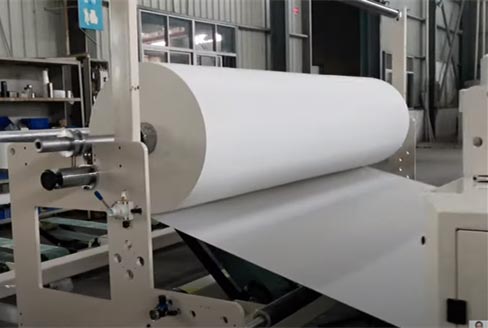
The converting line takes enormous parent reels from the Yankee dryer and turns them into finished jumbo rolls. Three sequential operations define the final product: rewinding, slitting, and perforation. On a high-speed rewinder, the parent reel unwinds while tension control maintains uniform web tension — critical because slack produces telescoping rolls that jam dispensers. A log saw then slits the long log into precise roll widths. Finally, a perforator blade makes precisely spaced cuts so the end user can tear off a clean sheet. The pitch of those perforations directly sets the sheet length.
For procurement, this is where the economic levers are locked. GSM, ply count, and sheet dimensions are all fixed at the converting stage. Choose a 13 g/m² 2-ply with 200mm sheet length versus an 18 g/m² 3-ply with 180mm length, and the cost per roll — and the number of guest uses per case — shifts dramatically. Varying GSM from 13 to 18 g/m² can swing raw material cost by up to 30% for the same roll diameter and sheet count. A manufacturer that offers custom converting allows you to dial in the exact sheet count that matches your dispensers, reducing reload frequency and direct labor cost.
This is where the 15% maintenance cost reduction statistic becomes real. When jumbo rolls in high-traffic facilities are converted with accurate sheet counts and clean perforations, janitorial staff make fewer trips to restock. Inconsistent perforation — too deep, causing tears, or too shallow, causing snagging — leads to guest frustration and waste. That directly hits guest satisfaction scores, the KPI that keeps hotel procurement managers up at night.
Before you sign off on a production run, verify how the converting line handles your spec. Request a pre-production sample with the exact ply, GSM, and perforation pattern. Once the log saw engages on a 40HQ container’s worth of material, there’s no undoing the settings. The tolerance for sheet length variation should be within ±1.5mm; anything looser and you’ll see rolls that don’t fit your dispenser, wasted product, or both.
Quality Control Standards for OEM Tissue Manufacturing
Without batch-level tensile and linting tests, your brand is one guest complaint away from a sourcing crisis.
Most procurement managers treat quality control as a checklist item rather than a diagnostic tool. That’s a mistake. In OEM tissue manufacturing, four tests separate a supplier that protects your brand from one that erodes it silently: tensile strength, wet strength, brightness, and linting propensity. These aren’t lab curiosities—they directly control whether your toilet paper tears in a guest’s hand, leaves residue on skin, or looks dull under hotel bathroom lighting.
- Tensile Index (dry): Industry benchmark: >20 Nm/g for virgin fiber. Anything below that and the sheet will rupture during dispensing. We test every batch to ensure dry strength stays above this threshold, because a jammed dispenser is a maintenance cost you can’t afford.
- Wet Strength: Measured as the ratio of wet tensile to dry tensile. A minimum 15% retention is typical for toilet paper. Too low, and the paper disintegrates instantly; too high, and it clogs plumbing systems—a hidden liability in older hotel infrastructure.
- Brightness (ISO 2470): For 100% virgin wood pulp, expect 85–92% without optical brightening agents. The real issue is OBA-free: if a supplier can’t prove zero fluorescent whiteners, the tissue risks skin reactions. Under FDA CFR Title 21 and EU Regulation (EC) No 1935/2004, OBA-free is not optional for products touching skin in premium settings.
- Linting Propensity: Measured by particles released per gram of tissue. In healthcare or luxury hospitality, lint carries bacteria and ruins the perception of cleanliness. Top-tier manufacturers maintain controlled creping and fiber bonding to keep lint below 0.5 mg/g—an invisible spec that directly impacts guest satisfaction scores.
ISO 9001 provides the process backbone, but compliance with FDA and EU frameworks adds the safety layer. A mill holding these certifications has documented controls over raw material traceability, machine calibration, and chemical chemical management systems.
Batch consistency risks aren’t theoretical. If your manufacturer can’t show you a control chart for tensile strength across the last 20 production runs, you’re exposed. The fix is simple: require a certificate of analysis (COA) per container that includes tensile, wet strength, brightness, and linting data against agreed specs. That’s not micromanaging—it’s the only way to guarantee that what you approved in the sample approval stage is what lands on your loading dock.
Private‑Label Customization: Where the Process Meets Brand Identity
Batch-to-batch brand drift in private-label tissue often traces back to a single failure point: treating customization as a finishing step instead of an integrated engineering milestone.
Walk any experienced OEM plant floor in Mancheng and you will notice a fundamental difference between converters who bolt on branding after the fact and mills that embed customization into the converting line itself. The latter approach is what separates a reliable private-label toilet paper manufacturer from one that ships you 40,000 rolls with a logo 3mm off-center.
Embossing, logo printing, and custom packaging are not standalone stations. They are interdependent processes that must be sequenced inside the rewinding and slitting phase. Interrupt that flow — stop the line to swap an embossing roller or flush a printing station — and you introduce tension variance. That variance shows up as loose sheets, uneven perforation, or a printed logo that shifts position across the jumbo roll diameter. The fix is not operator vigilance alone. It requires the converting line to have synchronized tension control between the embossing nip, the print cylinder, and the log saw infeed.
- Embossing integration point: Steel-to-rubber embossing rollers apply the pattern right after the rewinder builds the log diameter, before the sheet reaches final ply bonding. The roller pressure must stay within ±0.5 bar across the full width, or the emboss depth varies from edge to center — a defect hospitality buyers spot immediately when a nested roll feels inconsistent.
- Logo printing interlock: Flexographic print stations on modern converting lines use servo-driven registration that locks print position to perforation placement, not to line speed. If the line accelerates or decelerates, the print cylinder compensates. Without this, a 2% speed change drifts the logo by up to 4mm on a 100m roll — enough to make a branded sheet look sloppy when pulled from the dispenser.
Custom packaging adds another layer of discipline. The poly-wrapping or cartoning machine must index to the exact roll count and diameter coming off the log saw. When a hospitality buyer orders 2-ply, 400-sheet rolls in a specific wrapper dimension, the film cut-off length and seal bar dwell time need recalibration. Skip this and you get loose wraps that wrinkle in transit or tight wraps that tear at the perforation. The tolerance on seal bar temperature is narrow — typically ±5°C for polypropylene film — and running outside that range causes seal failures that expose the roll to humidity, which degrades sheet strength within weeks.
Hygiene and regulatory compliance do not pause when a customization order enters the line. A dedicated private-label run must still pass the same microbial control checks as a standard production batch. Embossing rollers and print cylinders sit in direct contact with the sheet. Any residual ink solvent or roller lubricant transfers to the tissue surface. This is where the OBA-free protocol becomes non-negotiable. A manufacturer running fluorescent whitener-free virgin pulp in the base sheet can still contaminate the product at the printing station if the ink formulation contains optical brighteners. The entire customization chain — pulp, sheet, ink, adhesive, wrapper — must carry the same OBA-free certificate chain.
For hospitality buyers managing replacement lots across 300-property portfolios, brand consistency is not measured by the spec sheet. It is measured by whether a roll pulled from a room in Singapore feels identical to one in London six months later. That requires the manufacturer to archive the exact embossing pattern depth, ink viscosity batch number, and wrapper film lot for every production run. When the reorder lands, those archived parameters are pulled and re-verified against a retained sample from the previous lot. Without that traceability, you are gambling FOB pricing on the hope that the next container matches the last one. A 30-year operator with 2,860 tons/month of throughput can afford to warehouse retained samples and run spectrophotometer checks on print color before shipping. A commodity trader cannot. That distinction is what makes or breaks a 50K hospitality contract renewal.
The cost of skipping this integration discipline shows up in two places: the sample approval stage and the reorder. A buyer who approves a pre-production sample without asking how the embossing and printing stations are qualified will discover the answer when the mass production run arrives and the logo wears off after 50 dispenses. That is not a quality tolerance issue. It is a process integration failure. Ask the manufacturer to walk you through their converting line sequence — specifically where the print station sits relative to the embosser and whether they run inline or offline packaging. Their answer tells you more about brand consistency risk than any certificate on file.
Conclusion
Skip the OBA-free documentation or accept an unadjustable creping ratio because a supplier says “it’s fine,” and the scenario writes itself: three hotel properties report guest skin irritation from fluorescent whitener residue six months into the contract, while a price-driven purchase order delivers consistent dispenser jams. Fixing that means scrapping a 40HQ container of stock and reordering at rush freight cost—typically 30–40% above the original landed price. The manufacturing chain rewards buyers who lock specifications at the pulper, the Yankee dryer, and the converting line, not those who approve a pre-production sample and hope the mass run matches.
Before requesting FOB pricing, audit a potential supplier’s creping spec, OBA-free certificate, and the GSM tolerance band they commit to in writing. Browse the industry-specific solutions page to see how a facility running 2,860 tons per month since 1995 handles those variables across virgin wood pulp toilet paper, jumbo rolls, and custom-branded hospitality lines.
Questions fréquemment posées
What raw materials are used to make commercial toilet paper?
Commercial toilet paper is primarily made from virgin wood pulp or recycled paper fibers. The fiber type directly controls softness, strength, and whether the sheet is OBA‑free, with virgin pulp offering premium hand‑feel. Specify fiber type and OBA‑free requirement during sample approval.
How does the Yankee dryer affect toilet paper softness?
The Yankee dryer creates a micro‑creped structure on the sheet that directly controls softness. A higher creping ratio increases bulk and surface feel but reduces tensile strength, so the ratio must be carefully balanced. Confirm the creping ratio and its impact on dispenser performance before production.
What is the standard GSM for bulk jumbo roll tissue?
Standard commercial jumbo roll tissue typically ranges from 13 to 18 g/m². Lower GSM cuts unit cost but risks tearing, while higher GSM improves durability in high‑traffic washrooms. Align GSM with your dispenser type and expected traffic to avoid complaints.
Can recycled toilet paper be as soft as virgin paper?
Recycled toilet paper can approach but rarely match virgin pulp softness due to shorter, damaged fibers. Blending virgin outer plies with recycled cores is a common compromise for eco‑conscious brands that still need premium performance. Request hand‑feel samples if softness is a brand priority.
What certifications should I look for in a toilet paper manufacturer?
Look for ISO 9001 for quality management, FSC for responsible fiber sourcing, and FDA compliance for North American markets. These certifications ensure consistent production, sustainability, and regulatory safety. Ask for current, valid certificates before sample approval.
